
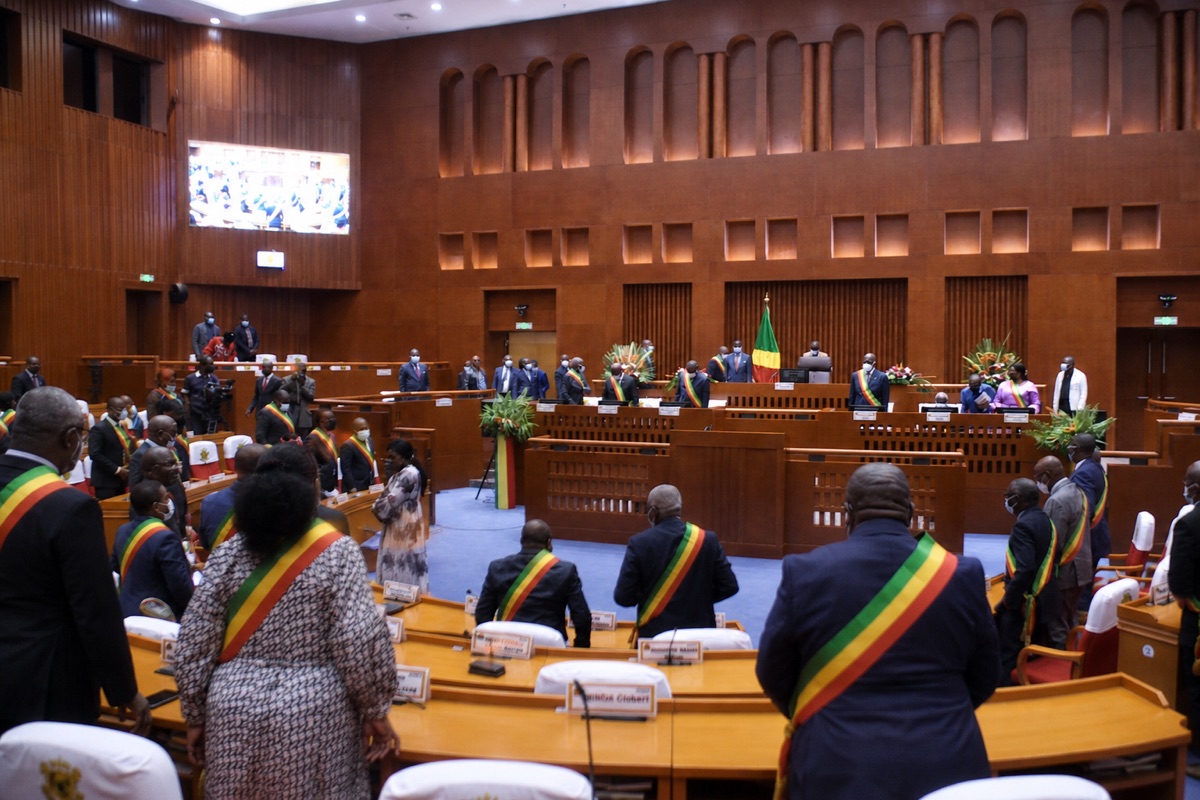
The upper chamber of the Republic of the Congo has resumed its legislative calendar, opening the ninth ordinary session of its Senate with an agenda that is at once dense and revealing. Twelve files now sit before the senators in Brazzaville, spanning social cohesion, public health, education, civil aviation and the architecture of the country’s international partnerships. Read together, the docket offers a candid portrait of the preoccupations animating Congolese public life, and of the legislative priorities the executive and the National Assembly have chosen to push toward final consideration.
A Docket That Mirrors National Anxieties
Rarely does a single sitting concentrate so many distinct registers of governance. The breadth of the twelve matters, ranging from questions of national identity to the technical scaffolding of air-traffic safety, suggests a parliament asked to legislate simultaneously on the symbolic and the procedural. For an institution often perceived as a chamber of deliberation rather than initiative, the session is an occasion to demonstrate that its review function carries genuine weight. The senators inherit several texts already shaped elsewhere, yet their scrutiny remains the constitutional gateway through which these measures must pass.
Cohesion, Health and the Weight of Memory
Three proposals dominate the early attention of observers, each having already secured a first reading in the National Assembly. The first seeks to combat tribalism and analogous practices, an explicit attempt to fortify national unity and the principle of living together in a country where ethnic arithmetic has long shadowed political competition. That the legislature should reach for statutory language to address so intimate a social fracture is itself a statement of intent.
The second text concerns reproductive health in the Congo, a domain where legislation intersects with demographic policy, the autonomy of citizens and the capacity of an overstretched public health system. The third is arguably the most freighted with historical resonance: a measure recognising the transatlantic slave trade and opening an exceptional path to Congolese nationality for people of African descent. Here the chamber is invited to translate the language of memory and reparative justice into the concrete grammar of citizenship law, a gesture with implications reaching well beyond the country’s borders.
Building Institutions for Safety and Schooling
If the first cluster of bills speaks to identity and memory, a second responds to the state’s administrative ambitions. The senators will examine a text establishing a national authority for the investigation and analysis of civil aviation accidents and incidents. The creation of such a body reflects a wider continental movement toward independent safety oversight, removing the inquiry into accidents from the operators and regulators whose conduct may itself be in question. For a sector where public confidence is fragile, the institutional design will matter as much as its founding statute.
Alongside it stands a draft law setting out the organisation of the educational system in the Republic of the Congo. Few instruments carry comparable long-term consequences. A framework governing the structure of schooling shapes the formation of generations, the calibration of curricula and the relationship between public provision and private initiative. The deliberation will test whether the chamber can reconcile aspiration with the fiscal and human constraints that bear upon every reform of national education.
Treaties That Redraw the Map of Partnership
The final strand of the agenda turns outward, toward the country’s place in a shifting international order. The senators are asked to authorise the ratification of an agreement between the Congo and the Russian Federation on the reciprocal promotion and protection of investments, a category of treaty designed to reassure capital and to bind two states into a durable economic understanding. A second instrument, a framework cooperation agreement with the Republic of Cuba, signals a parallel intent to deepen ties with a longstanding partner of a different stripe.
That both texts should appear on the same docket invites reflection on the diplomatic posture of Brazzaville. Congolese foreign policy has long cultivated a plurality of alignments, and the simultaneous embrace of investment protection with Moscow and cooperation with Havana fits a tradition of calibrated non-exclusivity. For the senators, ratification is largely an act of endorsement, yet it confers parliamentary legitimacy on choices made in the corridors of the executive.
What the Session Reveals
The ninth ordinary session, then, is less a routine procedural exercise than a compressed register of the questions a young republic must answer. Whether the chamber treats these twelve files as instruments of genuine deliberation or as formalities to be ratified will say much about the maturing role of the Senate within the Congolese constitutional settlement. The coming weeks of debate will furnish the answer, and with it a measure of how seriously the country takes the legislative craft it has set itself.
