
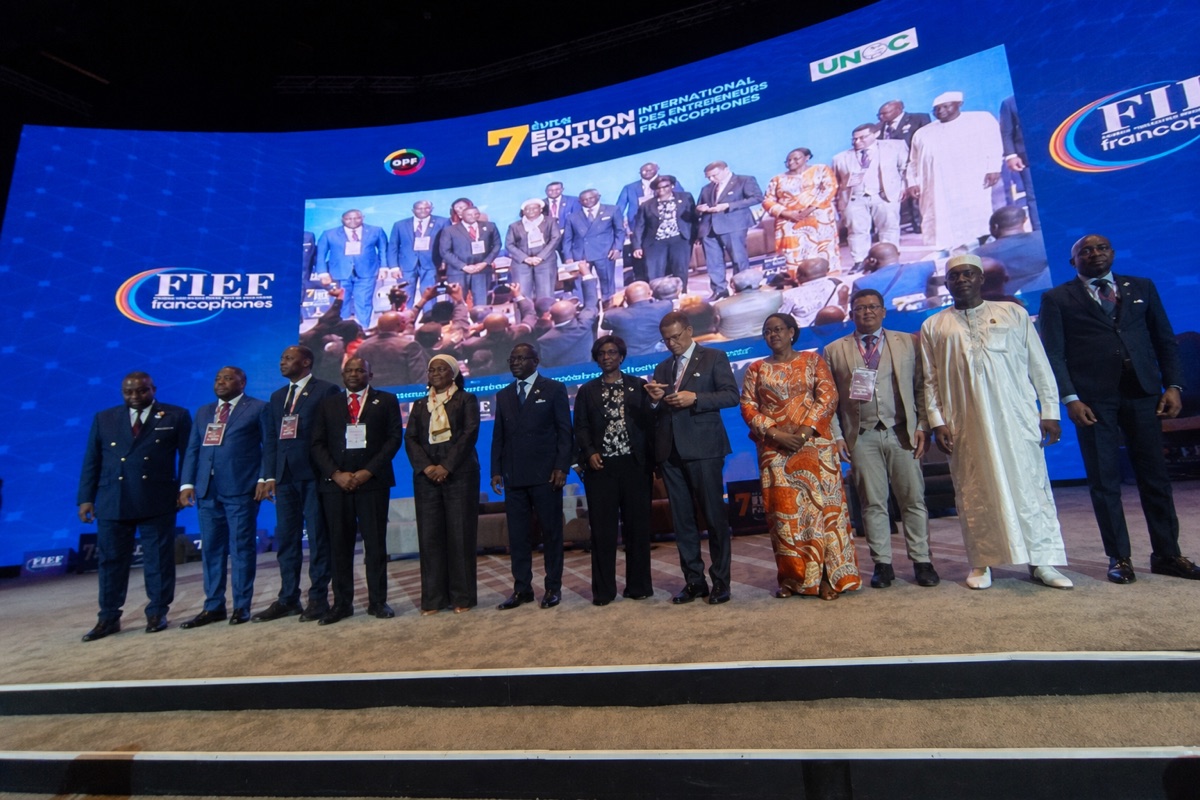
For the first time in its seven-edition history, the International Forum of Francophone Enterprises (FIEF) has crossed into Central Africa, and the choice of Brazzaville as host carries more weight than the customary ribbon-cutting suggests. From 9 to 13 June 2026, the International Conference Centre of the Grand Hôtel de Kintélé has become the meeting point for more than 1,500 entrepreneurs, investors, financial institutions and policy figures drawn from across the Francophone world, convened under a theme that reads almost as a manifesto: economic Francophonie as a lever of innovation, durable partnership and inclusive growth.
A Geographic Pivot With Strategic Subtext
The decision to anchor the forum in the Republic of Congo, rather than in the West African or Maghreb capitals that have traditionally claimed such gatherings, is not incidental. Minister Ludovic Ngatse framed the moment plainly, observing that this is the first occasion on which the event has unfolded in Central Africa, a development he read as evidence of the country’s growing standing within the Francophone economic dynamic. There is a quiet ambition in that statement. Brazzaville is positioning itself not merely as a venue but as a credible node in a network that has long gravitated elsewhere, and the symbolism of placing the continent’s Francophone business class at Kintélé is unlikely to be lost on the regional partners watching from Yaoundé, Libreville or Kinshasa.
The Architecture of the Gathering
The forum is co-organised by the National Union of Economic Operators of Congo (UNOC) and the Groupement du Patronat Francophone, and it proceeds under the patronage of President Denis Sassou-N’Guesso, a sponsorship that signals the political capital the authorities have invested in the event. Rather than a single plenary spectacle, the programme is structured around networking spaces, business-to-business encounters and round tables addressing the broader economic pressures of the moment. Particular emphasis has been reserved for small and medium-sized enterprises, for youth entrepreneurship and for the question of durable transition, three preoccupations that increasingly define the development conversation across the region and that resist easy or rapid answers.
Reading the AfCFTA Horizon
What gives the Brazzaville edition its analytical interest is the backdrop against which it convenes. The discussions are framed by the prospects opened by the African Continental Free Trade Area, an arrangement whose promise of a single, integrated market remains as much an aspiration as a reality. For Francophone enterprises, the AfCFTA poses a particular and somewhat delicate proposition: the linguistic and institutional affinities that have historically structured trade within the Francophone space now sit alongside a continental logic that cuts across colonial-era groupings. Minister Irène Marie-Cécile Mboukou-Kimbatsa addressed this tension directly, arguing that economic partnerships within the Francophone space represent an important lever for accelerating economic transformation. The phrasing is telling. It treats shared language not as a closed circuit but as an entry point into wider continental integration, a reading that aligns Francophone solidarity with, rather than against, the AfCFTA’s ambitions.
Beyond the Conference Hall
The harder question, which the forum’s choreography of panels and B2B meetings can only begin to answer, concerns what survives once the delegates disperse. Forums of this kind are abundant across the continent, and their value is often measured less by the declarations issued at the podium than by the contracts, joint ventures and financing arrangements that quietly take shape in the corridors. By foregrounding small and medium-sized enterprises and youth-led ventures, the organisers appear conscious of this distinction, since it is precisely these actors, rather than the established conglomerates, who stand to gain most from access to cross-border capital and to networks they could not otherwise reach. Whether Brazzaville’s first turn as host translates into durable commercial linkages, or remains a well-staged demonstration of regional ambition, will become apparent only in the months that follow.
A Calculated Investment in Standing
For the Republic of Congo, the wager is legible enough. Hosting the FIEF allows Brazzaville to present itself as an economic interlocutor of consequence at a juncture when the country is seeking to diversify beyond its established sectors and to court partners willing to invest in that transition. The forum offers visibility, the patronage of the head of state lends it gravity, and the Central African premiere confers a measure of prestige. Yet prestige is a perishable asset. The lasting test of these five days at Kintélé will lie not in the size of the gathering, but in whether the partnerships proclaimed within its walls acquire substance once the conference lights are dimmed.
