
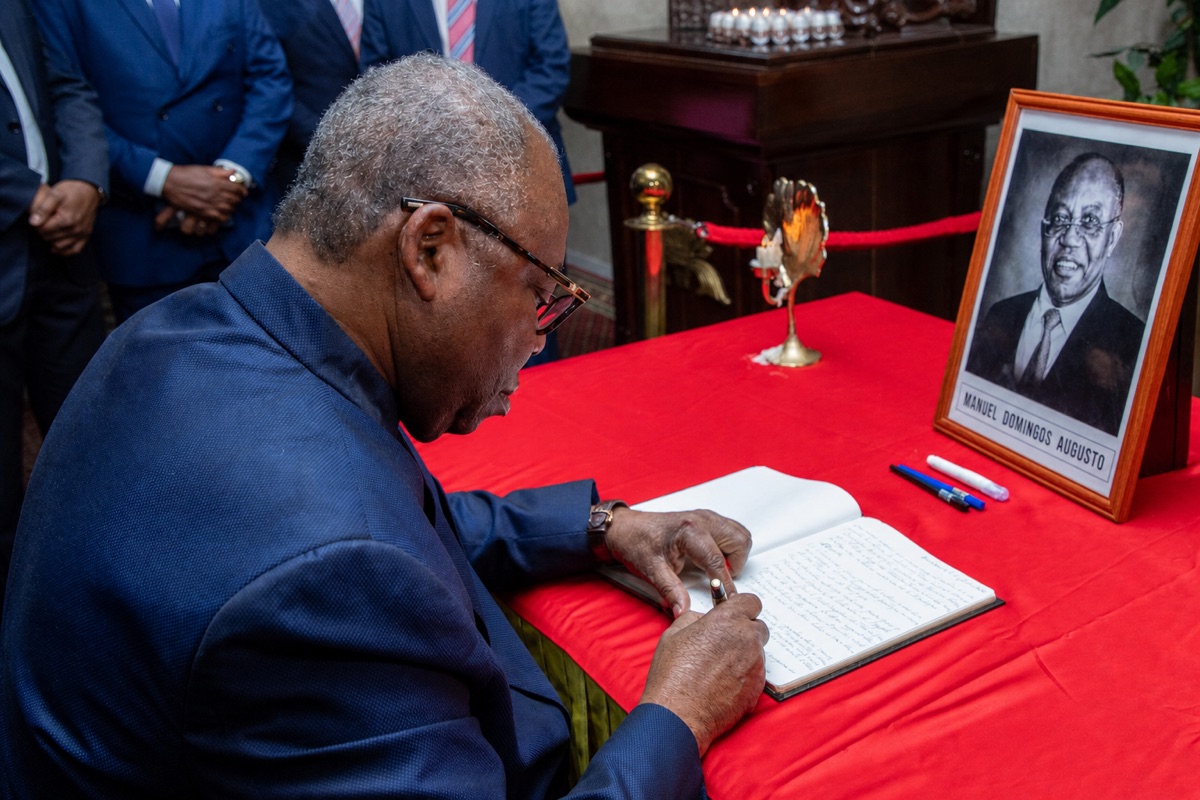
When Pierre Moussa, secretary-general of the Congolese Party of Labour (PCT), bent over the condolence register at the Angolan embassy in Brazzaville on 12 June, the gesture carried a weight that exceeded ordinary diplomatic courtesy. The man he came to honour, Manuel Domingos Augusto, who passed away in Luanda on 5 June at the age of sixty-eight, was no distant foreign dignitary. He had been, in the assessment of officials in the Republic of the Congo (Congo-Brazzaville), one of the principal craftsmen of the political intimacy that now binds two neighbouring states whose histories of struggle and statehood have long been intertwined.
A Condolence Visit Heavy With Political Meaning
The choice of Moussa himself to sign the book, rather than a delegated subordinate, signalled how seriously the ruling party regards its relationship with Angola’s governing People’s Movement for the Liberation of Angola (MPLA). In remarks recorded at the embassy, the PCT secretary-general spoke in the register of shared bereavement rather than formal protocol. “We regret it very sincerely,” he said, asking that his words be conveyed “to the government, to the Angolan people and naturally to the MPLA, our feeling of sadness on this difficult day for the two countries and the two parties.”
That phrasing is worth dwelling upon. By framing the loss as a sorrow shared between “two countries and two parties,” Moussa located Augusto’s death within a fraternal architecture that links state to state and movement to movement. The grief, in this telling, is institutional as much as personal, an acknowledgement that individual diplomats can become load-bearing pillars in the edifice of bilateral relations.
The Diplomat Who Drew Two Nations Closer
At the time of his death, Augusto held the post of secretary for international relations within the MPLA’s political bureau, a position that placed him at the centre of Angola’s external strategy. His record, however, stretched back across more than four decades of public service. He had served as Angola’s minister of foreign affairs and represented his country as ambassador in several African capitals, accumulating an institutional memory of the continent’s diplomacy that few of his contemporaries could match.
It is this longevity that lends substance to the PCT’s claim that Augusto was instrumental in the political rapprochement between Brazzaville and Luanda. Such convergence is rarely the product of a single summit or treaty. It is built incrementally, through the patient cultivation of trust between counterparts who learn, over years of negotiation, to anticipate one another’s interests. A figure who had spent a career in foreign ministries and embassies was precisely the kind of interlocutor capable of translating cordial declarations into durable understanding.
When Personal Networks Sustain Statecraft
The episode illuminates a feature of regional diplomacy that often escapes notice. In Central Africa, as elsewhere, formal institutions are frequently animated by personal relationships forged among a relatively small circle of officials. The death of one such figure can therefore expose how much of a partnership rests on individual rapport rather than on impersonal mechanisms.
The PCT appears acutely aware of this. Its response suggests an understanding that the warmth between Brazzaville and Luanda, however genuine, cannot be taken for granted once those who built it depart the stage. The implicit question raised by Augusto’s passing is whether the rapprochement he helped engineer has been institutionalised deeply enough to outlast its founders, or whether it will require a new generation of interlocutors to renew the bonds.
Continuing the Work as the Truest Tribute
The PCT offered its own answer. The party indicated that the most fitting homage to Augusto’s memory would lie not in ceremony but in continuity, in pursuing the very work of bringing the two nations closer that defined his career. It is a formulation that converts mourning into mandate, transforming a moment of loss into a renewed commitment to the bilateral project.
That sentiment reflects a mature reading of how diplomatic legacies endure. Monuments and eulogies fade; sustained cooperation does not. By pledging to advance the agenda Augusto championed, the Congolese party signals that it intends to treat the relationship as a long-term strategic asset rather than a sentimental attachment vulnerable to the passing of individuals.
For observers of Central African affairs, the condolence visit thus reads as more than a courtesy. It is a quiet reaffirmation, at a sombre juncture, that the partnership between the Republic of the Congo and Angola remains a priority for Brazzaville’s political leadership, and that the architecture Augusto helped raise is intended to stand well beyond the lifetime of its architect.
