
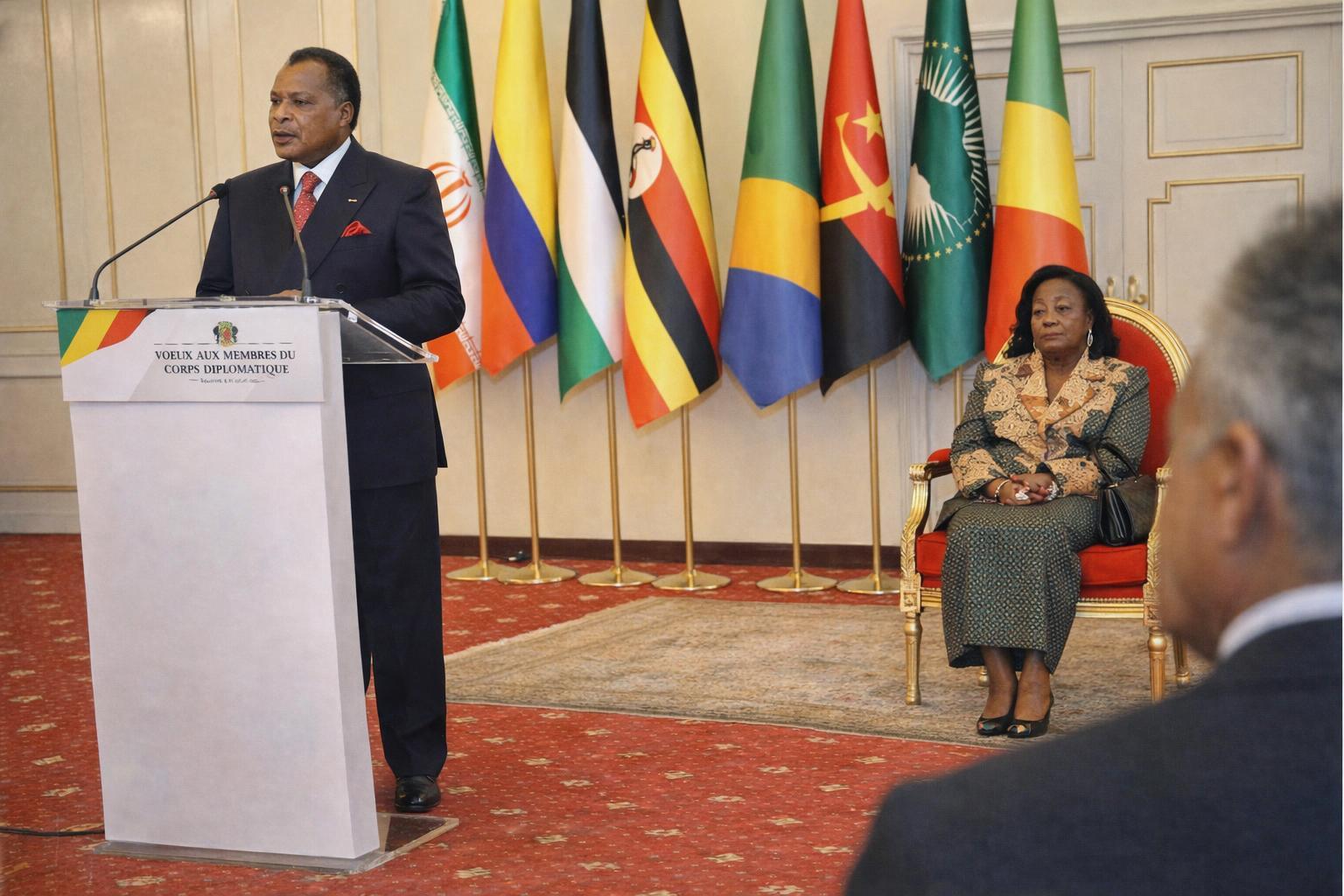
Brazzaville New Year Diplomacy at the Palais du Peuple
On Tuesday, January 6, 2026, President Denis Sassou N’Guesso, accompanied by First Lady Antoinette Sassou-N’Guesso, received members of the diplomatic corps accredited to the Republic of the Congo at the Palais du Peuple for the customary New Year greetings ceremony. The meeting, both symbolic and carefully codified, is a recurring fixture of Brazzaville’s diplomatic calendar, bringing together ambassadors and senior representatives of consular missions alongside leaders of international organisations present in the country.
Beyond its ceremonial character, the annual exchange of greetings offers a brief but meaningful reading of the climate of international relations. By assembling a wide spectrum of external partners in a single setting, the event affirms the continuity of Congo’s engagement with the international community and provides a formal platform for the diplomatic corps to articulate its expectations, appreciations, and priorities for the year ahead.
Diplomatic Corps Salutes Cooperation With the Republic of the Congo
Speaking on behalf of the diplomatic corps, the dean highlighted the quality of cooperation ties linking the Republic of the Congo with the respective countries and institutions represented in Brazzaville. Such language, traditional in these addresses, nevertheless carries weight in a year opening on the promise of renewed coordination, whether in political dialogue, economic cooperation, or cultural exchanges.
The dean also paid tribute to the efforts undertaken by Congolese authorities in support of peace, stability and sustainable development. While the ceremony does not function as a negotiating table, it establishes a tone: partners publicly recognise the value they place on stability and on the state’s orientation toward long-term development objectives, and they signal their intention to remain engaged. In the idiom of diplomacy, this is not mere courtesy; it is a reaffirmation of presence and of constructive intent.
President Sassou N’Guesso Reaffirms Mutual Respect and Win-Win Cooperation
In his response, President Denis Sassou N’Guesso expressed gratitude for the wishes addressed to him and to the Congolese people, and reiterated the Republic of the Congo’s determination to pursue a diplomacy grounded in mutual respect, solidarity and mutually beneficial cooperation. This formulation, consistently invoked in official engagements, reflects a preference for partnerships framed as reciprocal and pragmatic, rather than transactional or asymmetrical.
The Head of State also underlined the importance of multilateralism and international consultation in addressing global challenges. By explicitly referencing peace, climate and development, the presidential message situated Congo’s diplomatic posture within the broad, interconnected agenda that increasingly shapes relations between states and international organisations. The emphasis, in this setting, is less on specific programmes than on a shared method: dialogue, coordination and collective responsibility.
Multilateralism, Peace and Climate: A Shared 2026 Agenda
The themes highlighted during the exchange mirror the issues that now structure much of contemporary diplomacy. Peace and stability remain foundational concerns, not only as domestic priorities but as prerequisites for sustained investment, predictable governance and effective regional cooperation. The inclusion of climate among the principal challenges is equally telling, reflecting the way environmental questions have moved from specialised forums into the centre of political and economic discussion.
Development, in turn, was framed as a durable horizon rather than an immediate deliverable, a rhetorical choice consistent with the institutional tone of the ceremony. In practice, the coupling of peace, climate and development signals an integrated understanding of statecraft: security, environmental stewardship and prosperity are presented as mutually reinforcing, and international cooperation is described as the mechanism through which these aims can be pursued coherently.
A Ceremonial Rite With Strategic Significance
Observers often underestimate the practical function of diplomatic rituals. Yet the New Year greetings ceremony performs several concrete roles at once. It offers a moment of collective visibility for external partners, enables the host state to reaffirm its priorities in front of a representative audience, and helps sustain a working atmosphere that is valuable for the more technical interactions that follow throughout the year.
In Brazzaville, the atmosphere of conviviality and diplomatic courtesy described during the event matters precisely because it stabilises expectations. The ceremony concluded with informal exchanges between the presidential couple and members of the diplomatic corps, a customary but significant sequence. Such moments, though unrecorded in formal communiqués, are part of how trust and accessibility are communicated, and how a diplomatic community takes the measure of a country’s confidence at the opening of a new year.
Images From the Palais du Peuple and the Language of State Presence
Photographs circulated from the event captured the collective nature of the gathering and the institutional setting of the Palais du Peuple, emphasising the ceremonial gravitas of the occasion. In the modern media environment, such images do more than document; they help shape the narrative of state presence, continuity and engagement with the international community.
What emerges from this year’s exchange of greetings is a message of steadiness. Partners conveyed wishes of peace, prosperity and success to the President and to the Congolese people for 2026, and the Congolese side responded by anchoring its diplomacy in cooperation and multilateral consultation. In a period where international agendas can be volatile, the value of such a signal should not be dismissed: it affirms that dialogue remains the preferred instrument, and that partnership remains the chosen horizon for the Republic of the Congo.
