
A Record Allocation for Skies Above Congo
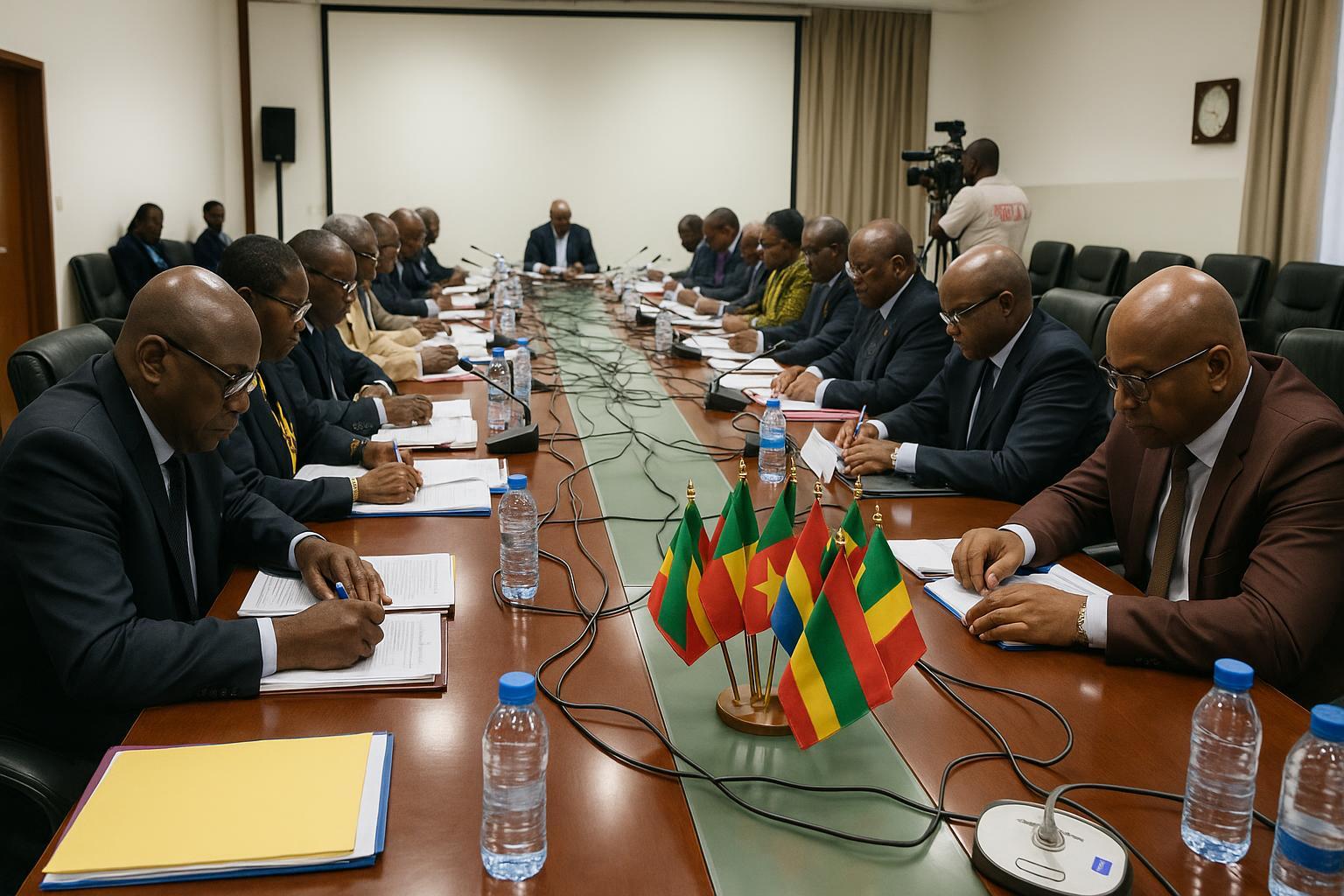
Brazzaville’s National Civil Aviation Agency, ANAC, has closed the year with an emphatic financial gesture, adopting a 2026 revenue budget of 9 244 260 500 CFA francs and expenditure projections of 9 237 336 000 CFA francs. The headline figures, validated on 12 December during the agency’s steering committee meeting, eclipse previous envelopes and underscore government intent to consolidate air-transport as a strategic vector of the national economy. Senior officials frame the spending plan as both prudent and ambitious, balancing near-perfect parity between resources and outlays while still allowing room for targeted investments in safety infrastructure and human capital.
Governance Reform Anchored in Decree 2025-369
The budgetary vote coincides with sweeping institutional changes introduced by Decree 2025-369 of 3 November 2025, which overhauls the governance architecture of public entities. Under the text, ANAC migrates from a director-managed structure to a dual model featuring a board of directors and an executive directorate. Ferdinand Sosthène Likouka, chief-of-staff to the Minister of Transport, Aviation and Merchant Marine, who presided over the session, insisted the transition must be “harmonious, rigorous and exemplary”. In practice, the new framework is expected to sharpen oversight, speed decision-making and align the agency with international best practice championed by bodies such as the International Civil Aviation Organization.
Human Capital: The Runway to Safer Operations
Behind the headline numbers, committee members dwelt at length on staffing. Recommendations passed on to the hierarchy urge immediate regularisation of employees who have accumulated three fixed-term contracts, a practice seen as sub-optimal for talent retention. The agency also flagged a shortfall in technical profiles—meteorologists, air-traffic controllers and aerodrome safety officers—which management intends to correct through an accelerated recruitment drive in 2026. Analysts note that the emphasis on specialised human resources dovetails with the government’s broader Human Capital Development Plan, advancing President Denis Sassou Nguesso’s vision of professionalised public services.
Financial Discipline Meets Strategic Ambition
Although the expenditure line remains marginally below projected revenue, the committee endorsed a series of savings measures designed to preserve fiscal space. Internal audits will target procurement processes, and contracts deemed non-essential may be renegotiated. Yet the agency declined to trim funds earmarked for modern navigation aids, runway lighting and the digitalisation of aeronautical information services. “We have a duty to provide the tools that guarantee both efficiency and safety,” Likouka reminded participants, echoing ICAO’s mantra that investment in safety is an investment in growth. Sector economists forecast that disciplined spending coupled with prioritised capital expenditure could lift Congo’s compliance rating under the Universal Safety Oversight Audit Programme.
Regional Integration and Market Prospects
Congo’s airspace sits at the crossroads of Central Africa’s economic corridors, and ANAC’s 2026 blueprint therefore looks beyond domestic skies. The agency intends to harmonise regulatory practices with fellow CEMAC states, preparing the ground for the Single African Air Transport Market. Successful implementation could boost passenger traffic through Maya-Maya International Airport by up to 15 percent over three years, according to provisional estimates circulated during the meeting. Cargo volumes—particularly agrifood exports heading to the Gulf of Guinea—stand to gain from upgraded meteorological services in secondary aerodromes such as Pointe-Noire and Ollombo. These projections, though cautious, hint at the catalytic effect that a robust aviation regime can exert on Congo’s diversification agenda.
Monitoring, Evaluation and the Road Ahead
The steering committee endorsed a stringent follow-up mechanism. Recommendations left unfulfilled at the previous session will be scrutinised by the upcoming board; any action whose execution rate falls short of full compliance will trigger a corrective plan. Observers view the approach as a departure from earlier cycles in which resolutions occasionally languished. By institutionalising performance metrics—ranging from completion of runway works to punctual publication of financial statements—ANAC signals its readiness to adopt the culture of results championed across the public sector. As 2026 beckons, the agency’s expanded budget, refreshed governance and reinforced workforce collectively map a flight path toward safer, more competitive and regionally integrated Congolese skies.
