
Diaspora Committees Gather in Paris
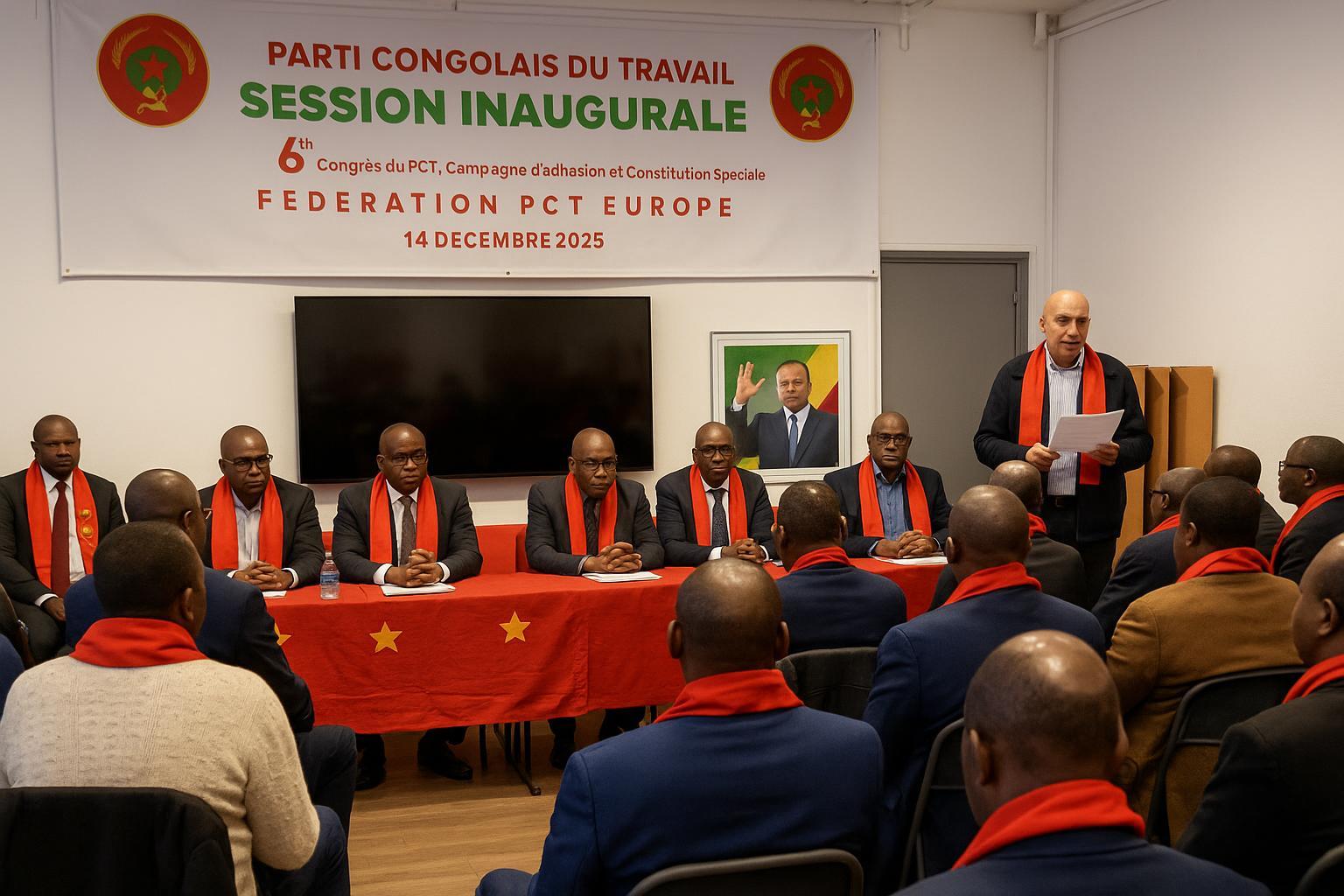
On a crisp December Sunday the high-ceilinged hall of the Espace Hermès, nestled in Paris’s twelfth arrondissement, echoed with Lingala greetings and applause. Delegates from the Île-de-France and North-West committees of the Congolese Labour Party’s European federation (PCT-Europe) had answered the call of federation president Anatole Guy Elenga to inaugurate a new cycle of mobilisation ahead of the party’s forthcoming sixth congress. Flanked by the veteran central-committee member Fabien Bakote, Elenga opened the session by stressing the importance of organisation and discipline within the diaspora, a constituency whose remittances and networks increasingly complement Brazzaville’s domestic structures (party communiqué, 14 Dec.).
Membership Drive Signals Renewed Vitality
The first litmus test of that organisational resolve was a painstaking roll-call of new recruits. Moderator Dhordain Ndengue, in charge of mobilisation for the Île-de-France committee, announced that twenty-three membership forms had been completed that very morning. One by one the neophytes stepped forward to receive the party pin, greeted by chants of “Discipline, Travail, Solidarité”. For Jean-Jacques Pambou, host of the gathering and chair of the Île-de-France structure, the eagerness of younger professionals to formalise their commitment “illustrates the federative power of the party message among Congolese abroad”. The figure is modest in absolute terms, yet within the highly dispersed European diaspora it represents a tangible uptick in activist density, analysts note.
Special Levy Fuels Sixth Congress Preparations
The pulse of any political machine, however, is measured not only in heads counted but in resources marshalled. A special levy—decided by the central committee to finance logistical aspects of the sixth congress—occupied centre stage once the membership formalities were completed. Envelopes circulated quickly, and discreet murmurs rose as banknotes changed hands. The presence of Armand Rémy Ballou-Tabawe, minister-counsellor at the Congolese embassy in France, underscored official encouragement of the exercise. By the end of the session, treasurer reports indicated that the European kitty had reached 6 640 euros, a sum Elenga described as “a down-payment on our collective responsibility toward the party’s supreme authority”. In a context where many African formations depend heavily on state subventions, the voluntary character of the diaspora contribution carries symbolic heft, observers argue.
Unanimous Motions of Loyalty and Continuity
Financial solidarity soon ceded the microphone to political messaging. Chris Bete Siba read a motion pledging the federation’s “total and unconditional support” to President Denis Sassou Nguesso in his dual capacity as head of state and chairman of the party’s central committee. A second motion, delivered by Michèle Sambot, reaffirmed trust in Secretary-General Pierre Moussa, whom activists credit with modernising internal procedures since his appointment in 2019. The crescendo came when Juste Prudence Oko unveiled the formal appeal urging Sassou Nguesso to accept the party’s nomination for the March 2026 presidential election. The hall erupted in rhythmic clapping, punctuated by the slogan “Premier tour, victoire!” The unanimity of tone left little doubt that the sixth congress will serve as a staging ground for continuity rather than rupture, analysts in attendance remarked.
Diaspora’s Strategic Weight in 2026 Horizon
Beyond ritual declarations, the Paris conclave sheds light on a broader strategic calculation. According to the World Bank, transfers from the Congolese diaspora top 150 million dollars annually, outstripping several bilateral aid envelopes. Politically, the overseas vote—introduced in 2016—may again prove decisive in a tight race. “From Montreal to Marseille, our compatriots expect visibility and respect in national decision-making,” Ballou-Tabawe told this reporter in a brief hallway exchange. Academics at the Sorbonne’s African Politics Observatory note that by cultivating structures like PCT-Europe the presidential majority not only taps additional resources but also neutralises opposition messaging that often finds fertile ground abroad.
From Paris to Brazzaville: The Road Ahead
As the chairs were stacked and group photos taken, Jean Bastien Makoundou of the federation’s audit commission praised the “spirit of camaraderie and accountability” that had prevailed. Elenga, visibly buoyant, assured militants that three further European committees would be operational “sooner than sceptics expect”, citing the day’s orderly proceedings as proof of administrative maturity. In his final exhortation he framed diaspora activism not as a distant echo of Brazzaville politics but as a laboratory for ideas that can feed into national modernisation agendas, from digital taxation to greener port infrastructure. The march continues, he concluded, and with it the conviction that Congolese living in Europe remain an indispensable vanguard for a party preparing to reaffirm its historical leadership in 2026.
