
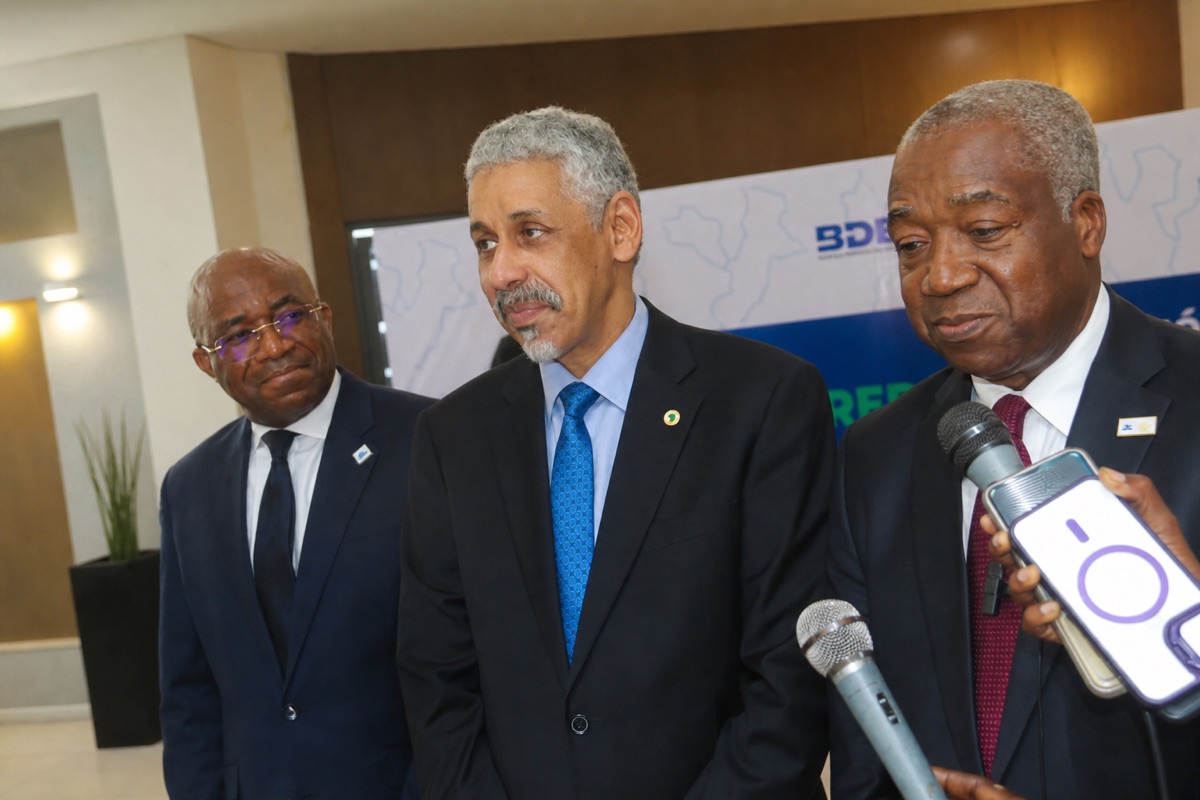
A Brazzaville Visit That Signals a New Continental Finance Order
The official visit paid by Dr Sidi Ould Tah, President of the African Development Bank (AfDB) Group, to the headquarters of the Development Bank of the Central African States (BDEAC) carries a weight that exceeds the protocol of a single working day. Held on 12 February in Brazzaville, the meeting was received by BDEAC President Dieudonné Evou Mekou and was framed by both institutions as the opening of a fresh phase in financial cooperation between African bodies. What might, in a different context, have read as a routine courtesy call instead announced an intention to recalibrate how development finance is coordinated across the continent.
Deepening a Partnership Beyond Symbolic Gestures
The substance of the encounter lay less in its novelty than in the explicit commitment to intensify joint action. The two leaders praised the quality of their existing collaboration and expressed a shared resolve to deepen common intervention mechanisms, with the stated aim of improving the impact of financing in the countries of Central Africa. The ambition, as articulated during the talks, is to render investments more structuring and better coordinated in the service of regional development, rather than dispersed across uncoordinated initiatives whose cumulative effect too often dissipates.
This emphasis on coherence is telling. For sub-regional institutions, the perennial difficulty has not been the absence of capital alone but the fragmentation of instruments and the misalignment of priorities. By foregrounding coordination, the two banks implicitly acknowledged that the credibility of African development finance now rests on its capacity to act in concert.
BDEAC’s Place in a Reshaped Financial Architecture
A significant portion of the discussions addressed the positioning of the BDEAC within the new African financial architecture that the AfDB intends to promote in order to harmonise the continent’s financing instruments. Within this dynamic, the sub-regional institution is called upon to assume a more strategic role, notably by strengthening its capacity to mobilise resources in support of major economic projects.
The implication is consequential. Rather than functioning as a peripheral lender, the BDEAC is being invited to occupy a load-bearing position in an emerging architecture meant to align the continent’s disparate financing tools. Such a repositioning would require the institution to expand its resource-mobilisation capacity, a demand that places it at the intersection of regional ambition and the disciplines of international finance.
A Shared Ambition for Solid African Institutions
This convergence of views opens the way to closer cooperation, guided by a shared ambition: to «build solid, complementary African financial institutions adapted to current economic and social challenges.» The phrasing matters, because it situates the partnership within a broader project of institutional sovereignty, the conviction that the continent’s development must increasingly be financed and governed by bodies rooted in African realities.
The BDEAC, for its part, welcomed an advance it expects to consolidate its mission of financing development in Central Africa while reinforcing its standing within the wider African financial ecosystem. The language of self-congratulation should not obscure the underlying stakes: the test of such partnerships lies not in the warmth of the communiqué but in the structuring projects they ultimately enable.
What the Pact Leaves to Be Proven
For the economies of the Central African sub-region, the value of this rapprochement will be measured in the years ahead by the tangibility of the projects it underwrites. The meeting set out a direction more than a detailed roadmap, and the careful, almost programmatic vocabulary of the two presidents reflects institutions conscious that ambition must eventually translate into disbursed financing and completed infrastructure. For now, the Brazzaville encounter stands as a statement of intent, a deliberate signal that the architecture of African development finance is being reconsidered from within.
