
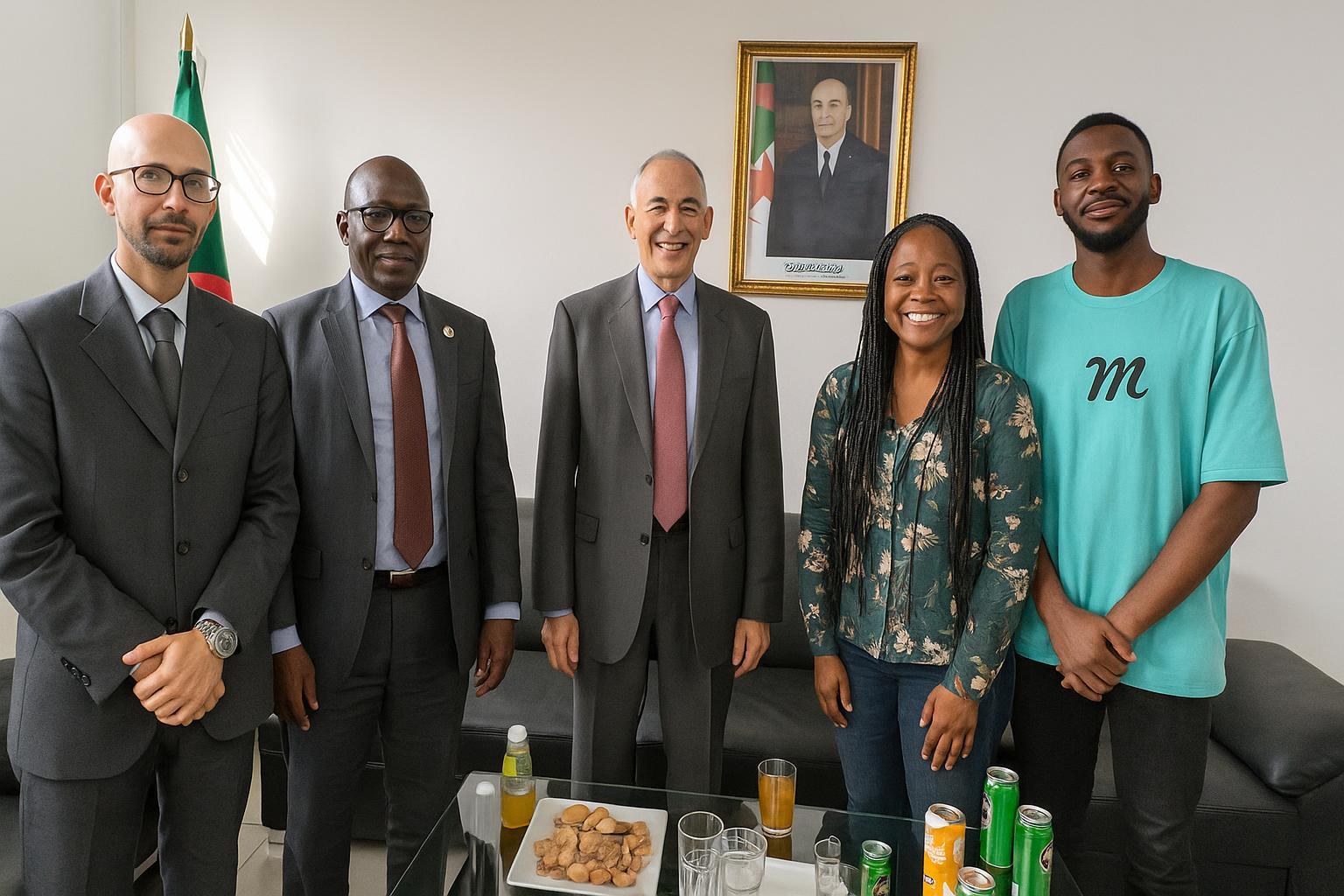
Symbolic send-off at the Algerian chancery
Inside the whitewashed walls of the Algerian embassy in Brazzaville, Ambassador Azeddine Riache welcomed the latest cohort of Congolese scholarship-holders bound for Algiers. The small ceremony, held earlier this week, fused protocol and warmth: the national anthems of both nations were played, followed by words of encouragement that underscored how educational cooperation has become a linchpin of Algeria-Congo relations (Algerian Embassy, Brazzaville, press release, 2024).
Embodiment of a long-standing solidarity
Algiers began offering university places to Congolese youth in the 1970s, when both capitals espoused a diplomacy of non-alignment and South-South collaboration. The new master’s bursaries, fully funded by the Algerian Ministry of Labour and Social Security, renew that tradition in a context where Brazzaville is prioritising human-capital formation under President Denis Sassou Nguesso’s national development plan. “Knowledge travels faster than goods; investing in it cements friendship,” Ambassador Riache reminded the students, echoing remarks by his Congolese counterpart in Algiers last month (Ministry of Foreign Affairs, Brazzaville).
A strategic investment in social-protection expertise
The National Higher School of Social Security (École nationale supérieure de la sécurité sociale, EN3S) is Algeria’s flagship institute for the management sciences of pensions, health insurance and welfare funds. Over two intensive years, the Congolese laureates will rotate between classroom instruction, field attachments within Algerian caisse offices and comparative seminars with Mediterranean and Sahelian specialists. Modules span actuarial techniques, digitalisation of contribution records, and the design of inclusive schemes for informal-sector workers—knowledge areas directly relevant to Congo’s ambition to extend coverage beyond its 8 % formally employed population (World Bank Social Protection Outlook, 2023).
Students as custodians of national image
Responsibility was a recurring theme of the send-off. Brell Martial Mbourangon, secretary-general of the Association of Congolese Alumni of Algeria, reminded the departing scholars that their predecessors earned a reputation for diligence on Algerian campuses. “You do not travel merely for yourselves; you travel carrying the flag,” he said, urging them to cultivate networks that will outlast their studies. The cohort, drawn from Brazzaville, Pointe-Noire and Dolisie, includes accountants, sociologists and IT engineers—all graduates with first-class honours who underwent a competitive selection supervised by Congo’s Ministry of Higher Education.
Expanding cooperation beyond the classroom
Education is only one vector in an increasingly diversified partnership. Algeria’s Sonatrach has reopened talks with Hydro-Congo on upstream data sharing, while Air Algérie is studying a direct Algiers-Pointe-Noire route to facilitate mobility for students and investors alike. On the cultural front, a joint exhibition on anti-colonial solidarities is scheduled for October at the French-Congo Cultural Centre, featuring archival footage of the late Ben Bella’s 1973 visit to Brazzaville. These initiatives, officials say, form a cohesive narrative of pragmatic yet fraternal engagement between two hydrocarbon-rich economies facing similar post-pandemic challenges.
Charting domestic reforms with global insights
Upon their return, the scholarship-holders are expected to reinforce the Congolese Social Insurance Fund and the nascent Universal Health Coverage agency. Economists in Brazzaville note that actuarial deficits in the pension pillar could widen to 2 % of GDP by 2030 if demographic trends persist; importing Algerian protocols for contribution compliance and digital enrolment could help avert that scenario. “We count on these graduates to adapt best practices, not just adopt them,” stressed Dr Inès Koumba, policy adviser at the Ministry of Social Affairs. In a region where fiscal space is limited, the promise of well-trained human resources may prove the decisive variable in delivering on the right to social security enshrined in Congo’s 2015 Constitution.
