
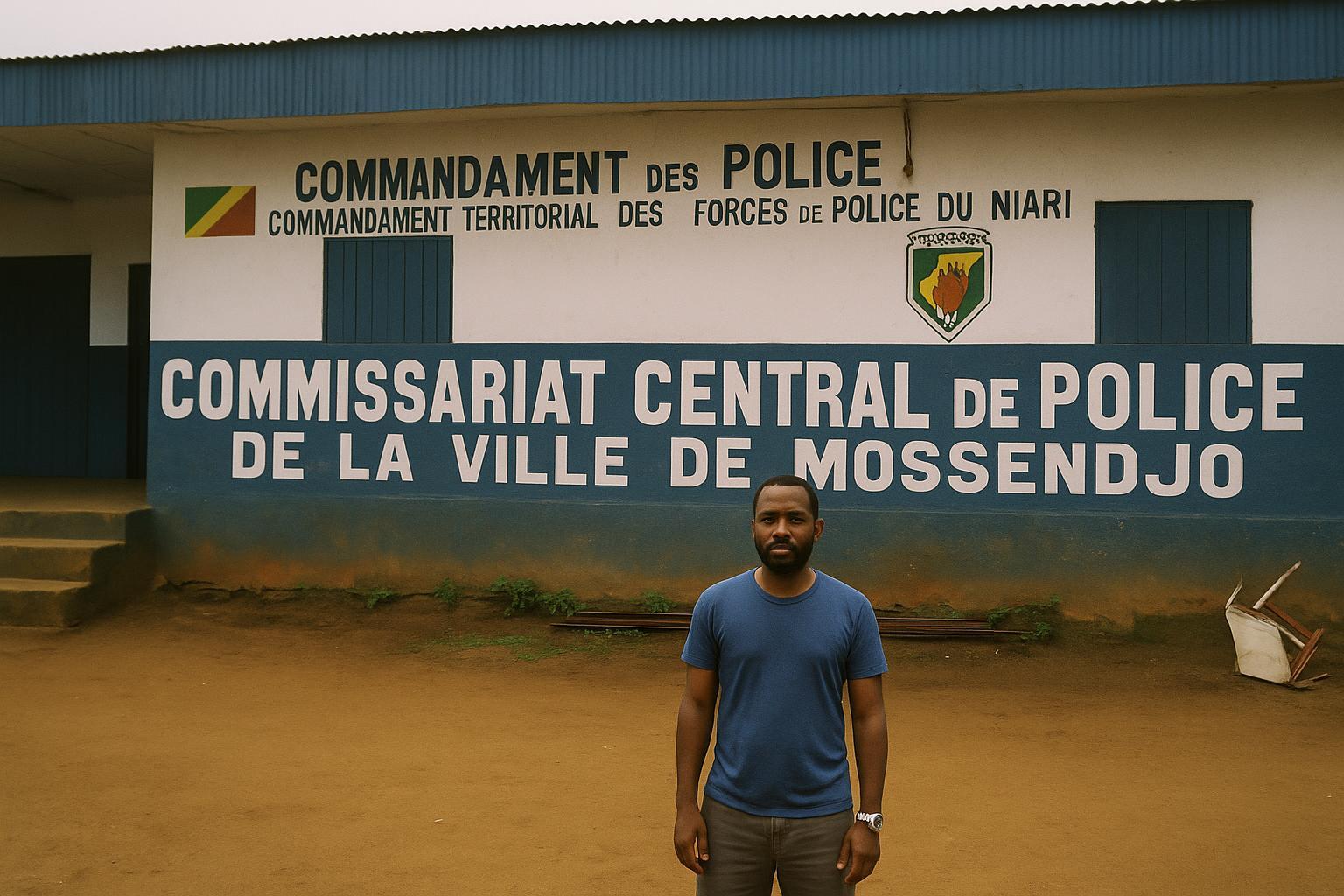
A palm-fringed town defies crime statistics
Nestled in the forested Niari region, the town of Mossendjo enjoys a reputation that contrasts sharply with the prevailing narrative of urban insecurity in Central Africa. Residents recount evening strolls along the red-earth avenues without the anxious glances common in larger Congolese cities. Although the Republic of the Congo remains vigilant against diverse urban risks, municipal authorities in Mossendjo register only sporadic petty offences, a pattern supported by internal police briefings consulted for this report. The absence of major incidents has turned the so-called “city of palms” into a living laboratory for public-safety professionals across the country.
The town’s geographical remoteness alone cannot explain this climate of tranquility. Commercial activity tied to agriculture, artisanal gold extraction and small-scale trade provides youthful employment yet could just as easily fuel delinquency in the absence of oversight. That such a dynamic setting remains largely crime-free suggests that a dense network of social ties, supported by a responsive police presence, enables informal dispute resolution before tensions escalate. Local councillor Théodore Mabiala observes that “the critical factor is trust; citizens call the police not out of fear, but because they expect a constructive response.”
From “Douba ndé” to peaceful Banda
The Banda quarter, known colloquially as Douba ndé—literally “kill him” in Lingala—embodies Mossendjo’s remarkable turnaround. In the late 1980s and throughout the 1990s, the neighbourhood was marred by narcotics consumption and violence reminiscent of Latin-American urban flashpoints. Oral histories collected by community elders depict alleyways patrolled by informal gangs and nocturnal confrontations that undermined social cohesion.
Three decades later the moniker endures only as a cautionary reminder. Interviews with residents highlight the decisive influence of outreach programmes crafted in consultation with faith leaders and women’s associations. Rather than employing a purely coercive lens, law-enforcement officials facilitated youth access to vocational training and mediated family conflicts that often served as catalysts for street-level aggression. The resulting diminution of organised crime has allowed Banda to reintegrate into the town’s socioeconomic fabric, illustrating the potential of hybrid security-development approaches.
Policing with limited means yet decisive impact
Mossendjo’s police brigade numbers barely a dozen officers, a figure modest by regional standards. Their logistical inventory—two ageing pickups and radios operating on a shared frequency—hardly conjures images of high-tech surveillance. Yet, according to Captain Serge Kihoulou, the unit compensates through meticulous territorial coverage and a policy of “proximity contact,” which obliges officers to log structured check-ins with shopkeepers, transport cooperative managers and school directors.
Daily foot patrols reinforce the sense of institutional accessibility, while weekly town-hall sessions permit grievances to surface before they harden into security threats. The doctrine resonates with recommendations advanced by the United Nations Office on Drugs and Crime for small urban centres, emphasising prevention over repression. Quantitative metrics buttress the anecdotal evidence: the latest internal report registers no homicide in the past five years and only three armed-robbery attempts, all foiled thanks to rapid community alerts.
Presidential directives and national coherence
The tranquil streets of Mossendjo align with the broader vision articulated by President Denis Sassou Nguesso during the traditional end-of-year military gathering on 31 December. In his capacity as Commander-in-Chief, he urged security forces to pursue the “complete eradication of grand banditism” throughout 2025 and to fortify national borders against transnational criminal networks. The presidential address, broadcast live on state media, underlined an explicit bond between the uniformed services and the civilian population, positing that peace is sustainable only when citizens perceive security personnel as partners.
Observers in Brazzaville note that Mossendjo offers empirical validation of this doctrine. By demonstrating that a lightly equipped force can uphold order through consensual engagement, the town challenges the assumption that sophisticated hardware is a prerequisite for safety. Senior officials within the Ministry of the Interior have hinted that elements of the Mossendjo protocol—particularly the emphasis on periodic community consultations—may be codified into forthcoming national guidelines for urban policing.
Urban risks, perception and the gender dimension
Security specialists caution that statistical calm does not automatically translate into universal feelings of safety. Across the Republic, the perception of danger is frequently heightened by visible decay in public spaces or inadequate lighting, factors that disproportionately affect women. Mossendjo’s municipal council has therefore integrated environmental design into its crime-prevention matrix, investing in solar-powered streetlights and enforcing sanitation bylaws that curb the accumulation of refuse in drainage channels.
Sociologist Jeanne Ndzaba, whose fieldwork focuses on gendered experiences of public space, contends that such measures compound the efficacy of policing: “Ill-lit corners constitute psychological cul-de-sacs where anxiety flourishes even if the actual crime rate is negligible. When the municipality rectifies these gaps, it reinforces the credibility of security assurances.” Her assessment underscores the symbiotic relationship between infrastructure and law-enforcement that policymakers often discuss in silos.
Scaling the Mossendjo approach across the Republic
Replicating Mossendjo’s achievements will demand calibrated adaptations rather than wholesale transplantation. The sprawling urban mosaics of Brazzaville and Pointe-Noire confront demographic densities and socioeconomic asymmetries that dwarf those of the Niari town. Nevertheless, the core principle—embedding security forces within the social tissue they protect—retains its relevance. Pilot projects in the Makélékélé district of the capital have already drawn on Mossendjo’s template by instituting biweekly police-citizen dialogues, with preliminary feedback indicating a modest decline in street assaults.
Ultimately, the Mossendjo experience illustrates that effective security governance in the Republic of the Congo need not rely exclusively on expanded budgets or punitive legislation. Instead, it flourishes where institutional attentiveness meets community initiative, where modest resources are leveraged with strategic clarity and ethical restraint. As the national campaign against grand banditism accelerates in 2025, stakeholders from municipal councils to the central command of the Congolese Armed Forces may find in Mossendjo a persuasive case study—one that affirms the possibility of peace anchored in mutual confidence between the governed and those entrusted with their protection.
