
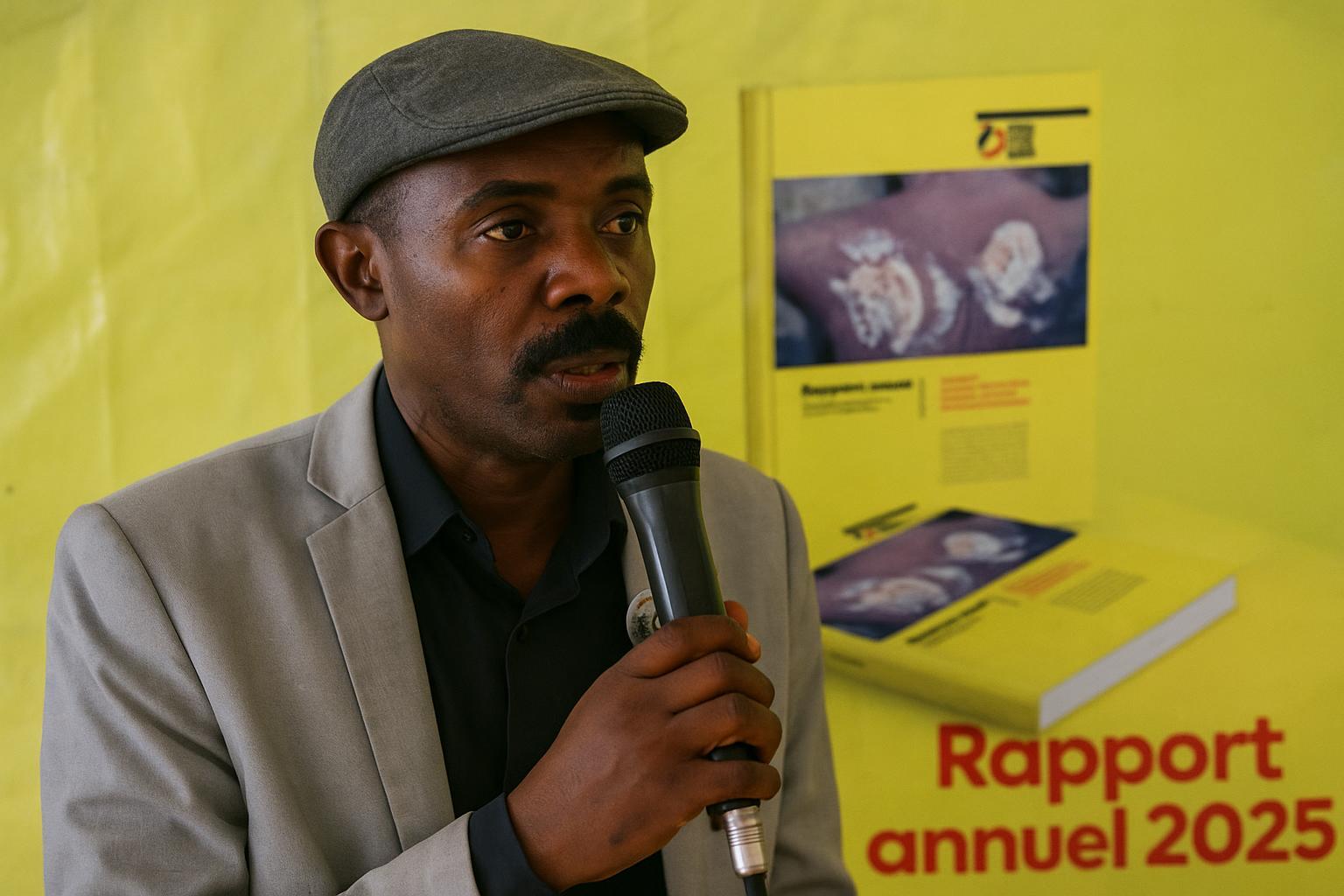
A sobering civil-society audit
The annual report of the Centre d’Actions pour le Développement, made public on 9 December 2025 at the Bana Moyi Cultural Centre in Brazzaville’s Makélékélé district, has injected fresh data into Congo-Brazzaville’s on-going conversation about the rule of law. Entitled “When the Denial of Human Rights Holds Power,” the nearly two-hundred-page document catalogues 4,182 alleged violations of civil and political rights during 2025. The figure represents a 131 percent rise on the 1,814 cases logged in 2024, underscoring the heightened attention that domestic observers are paying to the country’s security environment.
Scope and rigour of the investigation
CAD’s executive director, Trésor Nzila Kendet, stresses that the organisation relies on field enquiries, interviews with victims, their relatives and eyewitnesses, and a multi-layer verification of each claim before inclusion in the database. Only allegations meeting evidentiary thresholds survive the screening, Kendet explains, so the report is designed as both a memory bank and an advocacy tool capable of informing public authorities and international partners. The 2025 edition covers seven of the nation’s fifteen departments, listing names of victims and presumed perpetrators as well as specific locations and circumstances.
Key statistical trends for 2025
Beyond the headline surge in overall incidents, the report highlights differentiated patterns. Violations of the right to life rose by roughly a quarter. Forced disappearances expanded by an estimated 167 percent, while torture and other ill-treatment climbed 205 percent and arbitrary detentions 266 percent. In an otherwise grim tableau, encroachments on the civic space receded by about 48 percent, although CAD judges press freedom to remain fragile. The organisation points to the repetition of infractions and the perceived impunity of their authors as the principal drivers of social unease.
Security operations under scrutiny
One explanatory factor singled out in the document is an operation led by the Directorate-General of Presidential Security against so-called “bébés noirs” and other urban gangs known as kulunas. According to CAD, the sweep entailed the demolition of homes and left numerous families without shelter. The report does not claim that law-enforcement objectives lack legitimacy; rather, it questions proportionality and the safeguards in place for non-involved residents. Government officials have repeatedly affirmed their resolve to restore public order while respecting constitutional guarantees, a balance that remains central to the present debate.
Institutional checks and public reaction
The study notes that neither Parliament, the judiciary, nor the National Human Rights Commission formally condemned the alleged excesses tied to the anti-gang campaign. Civil-society actors interpret this reticence as evidence of institutional caution; lawmakers, for their part, indicate that investigative timelines and evidentiary standards require patience. The Executive, committed to consolidating peace and stability, has welcomed constructive feedback and underlines the standing constitutional framework that mandates accountability for any proven abuse. The interplay between vigilance and responsibility is therefore poised to shape policy discussions in the year ahead.
Indigenous communities caught in the cross-border net
A discreet yet poignant section of the dossier recounts the reported deportation and forced labour of approximately fifty indigenous inhabitants from the Enyellé district to Imese, across the border in the Democratic Republic of Congo. CAD says the episode unfolded without a recorded official response from local authorities. The case, emblematic of the vulnerabilities of remote populations, raises questions about inter-agency coordination and provincial oversight in peripheral zones. Analysts observe that the central government’s outreach programmes aimed at indigenous welfare could gain traction from clearer lines of administrative responsibility.
Blueprints for strengthening the rule of law
Among the reforms proposed by CAD are the creation of an independent investigative commission, monetary compensation for households whose properties were destroyed during security operations, and structural measures to fortify human-rights protections. While such recommendations emanate from civil society, they overlap with broader governmental ambitions to modernise the justice system and improve public administration. Dialogue between policymakers and non-state actors, many in Brazzaville argue, can translate competing diagnoses into convergent solutions that reinforce social cohesion.
A moment for constructive engagement
Taken as a whole, the 2025 report functions less as a verdict than as an invitation to collective reflection. It documents worrisome trends yet also testifies to the country’s growing capacity for self-scrutiny, evidenced by the mere fact that a detailed, image-rich compendium of alleged abuses can circulate openly. The challenge, observers note, lies in moving from documentation to corrective policy without undermining the stability gains of recent years. Combined efforts by security services, legislative bodies, the judiciary, and community stakeholders may offer the most plausible path toward a resilient, rights-respecting Republic of Congo.
