
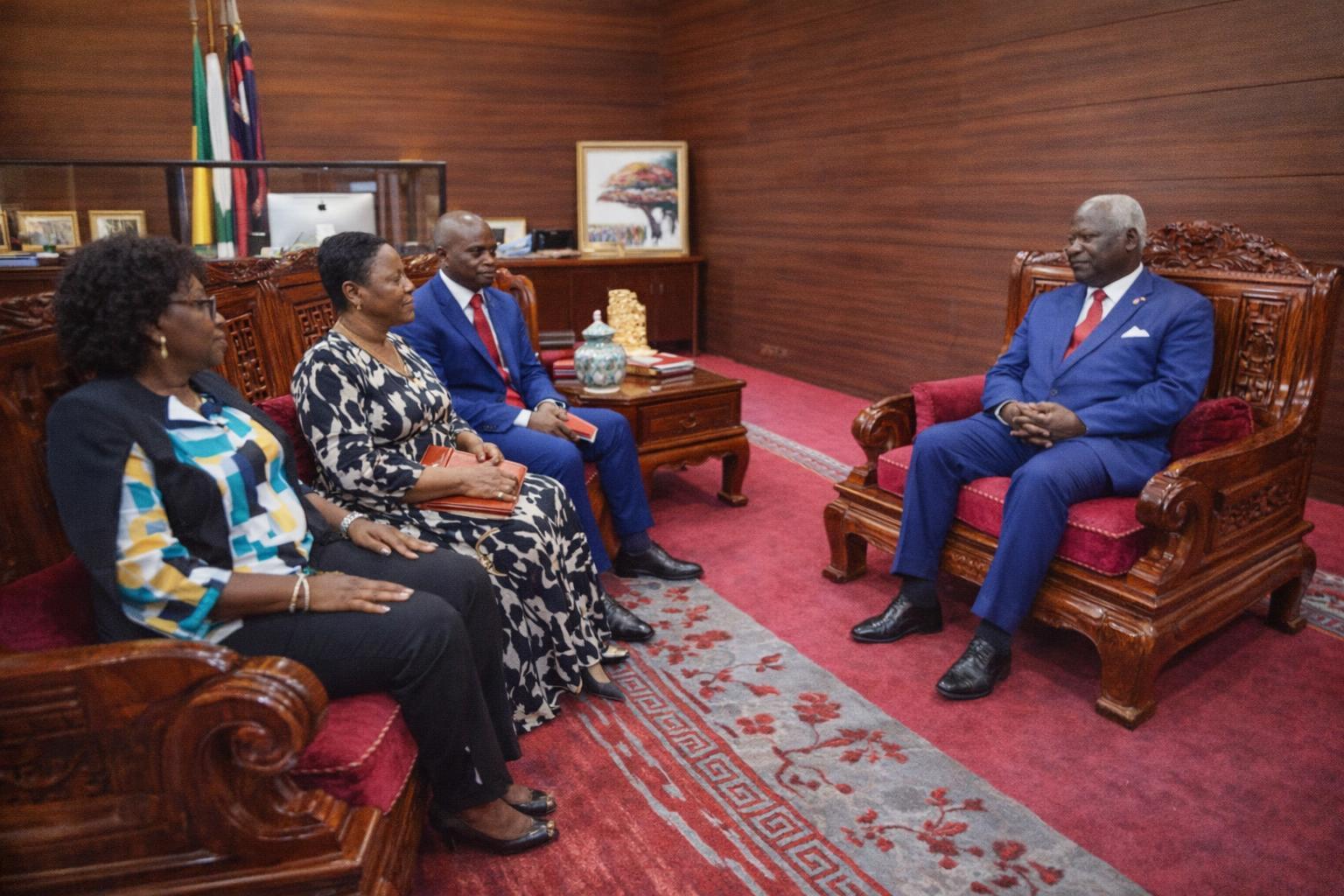
APRM talks in Brazzaville under Denis Sassou Nguesso
On 2 February in Brazzaville, the Director-General of the Continental Secretariat of the African Peer Review Mechanism (APRM), Marie-Antoinette Rose Quatre, held discussions with Congo’s Prime Minister and Head of Government, Anatole Collinet Makosso, on the relaunch of the APRM process in the Republic of the Congo. The meeting, organised on the margins of her working visit, placed emphasis on strengthening the mechanism “in a spirit of national ownership” and on the pursuit of tangible outcomes for the population, according to the account provided.
While the exchange was technical in nature, it also carried clear institutional symbolism. The government’s engagement with the APRM is presented as part of the broader governance architecture encouraged at continental level, and as a renewed political commitment to place governance among national priorities under President Denis Sassou Nguesso. The tone adopted by both sides was one of partnership, with the APRM portrayed less as an external auditor than as a framework for continuous improvement driven by the member state itself.
National ownership and measurable governance results
In the account of the meeting, the phrase “national ownership” is not incidental. It signals an approach in which the Congolese authorities and domestic stakeholders are expected to steer the process, set priorities, and translate assessments into reforms that can be followed over time. In practical terms, the two personalities agreed on the need to strengthen the APRM process on the basis of concrete results, implying that the mechanism should not remain confined to reports or institutional rituals but should demonstrate public value.
This positioning matters because the APRM is often best judged by its capacity to convert diagnostic exercises into implementable reforms. In this sense, the Brazzaville discussions underscore a preference for an inclusive and sustainable approach, one that is meant to involve all relevant stakeholders tasked with promoting the APRM vision. The stated objective is a concerted definition of “next steps” so that implementation becomes effective, inclusive and durable, rather than episodic.
APRM mission: mapping progress and defining next steps
Marie-Antoinette Rose Quatre’s working visit was described as being principally devoted to consultations with the full set of national actors involved in the APRM dynamic. The purpose, as framed in the official narrative, is threefold: to exchange with stakeholders charged with promoting the mechanism’s vision; to assess the state of progress of the process; and to agree, collectively, on the subsequent stages that would enable a more robust implementation.
This method reflects an underlying logic of policy sequencing. Before any effective relaunch, it is necessary to establish what has been achieved, what remains pending, and what institutional arrangements can ensure continuity. The stated intention to proceed “in a concerted manner” suggests that the APRM delegation aims to anchor the process in national consensus and administrative realism, with clear milestones and responsibilities.
First APRM delegation since 2003: a symbolic milestone
The Director-General highlighted a point presented as historically significant: this mission is described as the first visit by an APRM delegation to the Republic of the Congo since the country’s accession to the institution in 2003. In her words, it “marks a decisive step” in reviving the process and reflects a renewed political will to place governance at the heart of national priorities.
The emphasis on this being the first such delegation since accession is meant to elevate the visit beyond routine diplomacy. It also provides a narrative of momentum: a relaunch that is not merely administrative, but framed as an institutional turning point. In a region where governance instruments compete for attention and resources, the act of reactivating a peer-review framework can be interpreted as an effort to consolidate policy coherence and signal continuity in state modernisation agendas.
Congo’s strategic role in Central Africa and AfCFTA readiness
In her assessment, Marie-Antoinette Rose Quatre characterised the Republic of the Congo as holding an important place due to its potential and its strategic role in Central Africa. She also cited what she described as major assets, including recognised political stability and a constant pan-African engagement in the sub-region. These factors, she suggested, would place the country in a favourable position to take full advantage of the opportunities associated with the African Continental Free Trade Area (AfCFTA).
The link made with AfCFTA introduces an economic and institutional horizon to what might otherwise appear as a purely governance-focused mechanism. The APRM, as she recalled, can support member states through targeted reviews on economic governance, the competitiveness of national enterprises, and institutional preparedness for AfCFTA. The implication is that governance reviews are not an end in themselves but are expected to improve the conditions under which national actors—public administrations as well as businesses—operate within an increasingly integrated continental market.
APRM framed as a reform tool, not a sanction mechanism
A key clarification from the APRM leadership concerns the nature of the mechanism itself. Marie-Antoinette Rose Quatre reiterated that the APRM is neither a sanction instrument nor an external evaluation imposed from outside. Instead, it is presented as an African tool for continuous improvement, whose added value lies in transforming assessments into reforms oriented toward the population’s wellbeing.
This framing is politically and institutionally consequential. By insisting on leadership and respect for national direction, the APRM seeks to protect its legitimacy among member states while retaining a reformist vocation. In the Congolese case, the government’s dialogue with the APRM—at prime-ministerial level—signals readiness to engage with a structured governance process while maintaining the principle that national institutions remain the primary drivers of reform design and implementation.
From renewed political will to durable implementation in Congo
The Brazzaville meeting between Anatole Collinet Makosso and Marie-Antoinette Rose Quatre ultimately points to a stated ambition: to move from a renewed political will to an operational pathway. The shared emphasis on inclusiveness, durability and results suggests that the next phase will be evaluated not only by the production of assessments but by the capacity to embed follow-through within domestic institutions.
For President Denis Sassou Nguesso’s administration, the relaunch of the APRM process is presented as an opportunity to align governance priorities with broader national objectives, including the institutional readiness demanded by continental integration. In the official account, the promise of the APRM lies in a pragmatic equation: peer review as a catalyst for reforms, and reforms as a means of consolidating development outcomes that can be experienced by citizens in concrete terms.
