
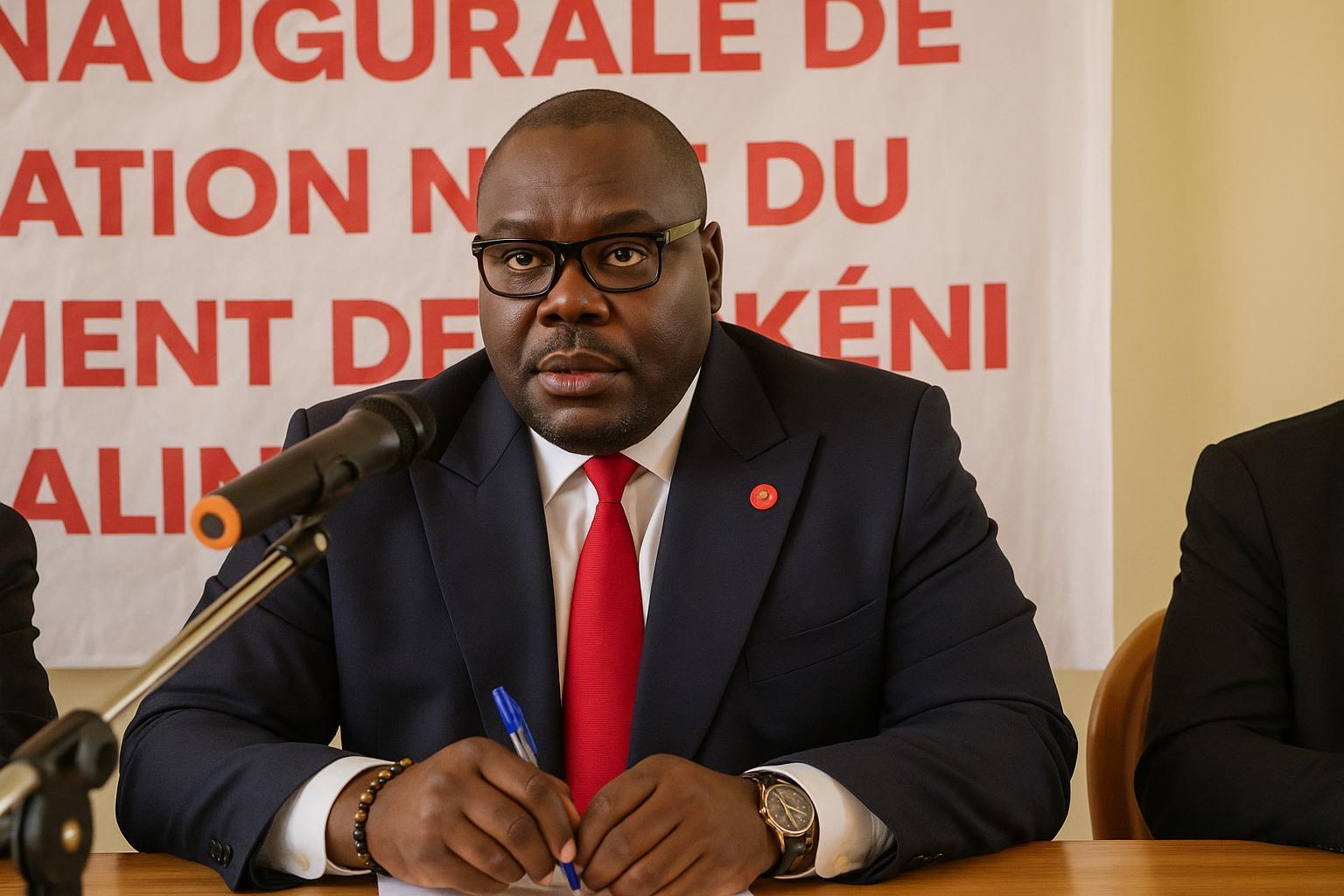
Birth of the Nkeni-Alima Structure
Long considered a political extension of the Plateaux region, the six districts that now compose Nkeni-Alima acquired institutional autonomy only this year. The Congolese Party of Labour (PCT) moved swiftly to translate that territorial novelty into an organisational reality, convening its inaugural federal council on 26 November in Gamboma (ACI, 29 Nov 2023). By placing Deputy Yves Fortuné Moundélé-Ngollo Ehourossia at the helm, the party signalled both continuity—he has represented Ongoni at the National Assembly—and renewal, entrusting the new department to one of its youngest federal presidents.
The session’s agenda was deliberately dense. Delegates scrutinised a draft internal rulebook, amended its articles, and validated a roadmap designed to align local structures with national priorities. Crucially, two motions were adopted without dissent: a pledge of support to the President of the PCT Central Committee, Denis Sassou Nguesso, and a vote of confidence in Secretary-General Pierre Moussa. Observers present described an atmosphere of methodical seriousness rather than celebratory pomp, emphasising the desire to embed viable routines from the outset.
Discipline at the Core of Party Doctrine
In his opening address, President Moundélé-Ngollo Ehourossia reminded delegates that discipline is not a rhetorical flourish but “a vital test for any structure that wishes to endure.” His choice of words resonated in a department whose administrative boundaries may be new but whose social fabric remains complex, combining semi-urban trading hubs such as Gamboma with sparsely populated forest areas. Party cohesion, he argued, is the precondition for the peace and stability that have characterised national politics in recent years.
Analysts note that the PCT’s emphasis on discipline has long served as both moral compass and strategic lever. By foregrounding internal order, the leadership simultaneously contains factional temptations and projects an image of reliability to external partners. In Nkeni-Alima, where traditional chieftaincies exert considerable influence, the call for unity acquires an added layer of significance: it invites local notables into a shared political grammar while discouraging parochial rivalries.
Operational Roadmap and Grassroots Strengthening
Beyond principles, the Gamboma meeting produced a concrete checklist. District committees must complete the renewal of sub-structures, hold general assemblies to fill vacancies and accelerate a special membership levy designed to finance local activities. This last point received particular emphasis. Adequate funding, delegates heard, remains indispensable for voter outreach in a department whose roads become impassable during the rainy season and where radio signals are sporadic.
The roadmap also provides for targeted seminars on electoral law, a data-driven census of sympathisers and systematic coordination with women’s and youth wings. Such granular planning suggests that the PCT intends to transform Nkeni-Alima from a peripheral landscape into a model of organisational resilience. Political scientist Adrien Ngatsomo, reached by telephone, described the approach as “classic cadre-building, but executed with a precision that reflects lessons learned across the country.”
Countdown to the Sixth Congress
The timing of the federal council is anything but incidental. In December the PCT will hold its sixth national congress, the first since 2016. Delegates from Nkeni-Alima must arrive in Brazzaville tested by internal debate and armed with unified proposals. According to insiders, preparatory commissions are already working on thematic reports covering agriculture modernisation, digital inclusion and decentralisation—topics that speak directly to the new department’s aspirations.
A unified Nkeni-Alima delegation also strengthens the bargaining power of a region eager for infrastructure upgrades. By showcasing cohesion, local cadres hope to secure priority in national investment programmes, particularly the rehabilitation of the Gamboma-Makotipoko corridor. In that light, the inaugural session doubled as a rehearsal for congress diplomacy, teaching newcomers the rituals of motion drafting, amendment negotiation and consensus building.
Outlook toward 2026 and Beyond
While the presidential election set for March 2026 may appear distant, the party machinery works on extended timelines. President Moundélé-Ngollo Ehourossia urged his colleagues to “line up the troops now so that the command is effortless later.” The metaphor captures the PCT’s long-range vision: ballots may be cast in a single day, yet victory depends on years of methodical groundwork.
Looking further ahead, the creation of Nkeni-Alima itself could become a case study in Congo’s gradual decentralisation. If the PCT demonstrates that new departments can rapidly develop functioning political organs, it will bolster the national narrative of controlled, pragmatic reform. That, in turn, could enhance the credibility of broader development initiatives championed by President Denis Sassou Nguesso on regional and international stages.
For the moment, the mood in Gamboma blends confidence with sober awareness of the tasks that remain. The federal council must translate its resolutions into tangible progress, from timely dues collection to the logistical choreography of large-scale gatherings. Yet by turning a legislative novelty into an operational reality within weeks, the PCT has offered a practical illustration of its governing philosophy: incremental, disciplined, and firmly oriented toward collective goals.
