
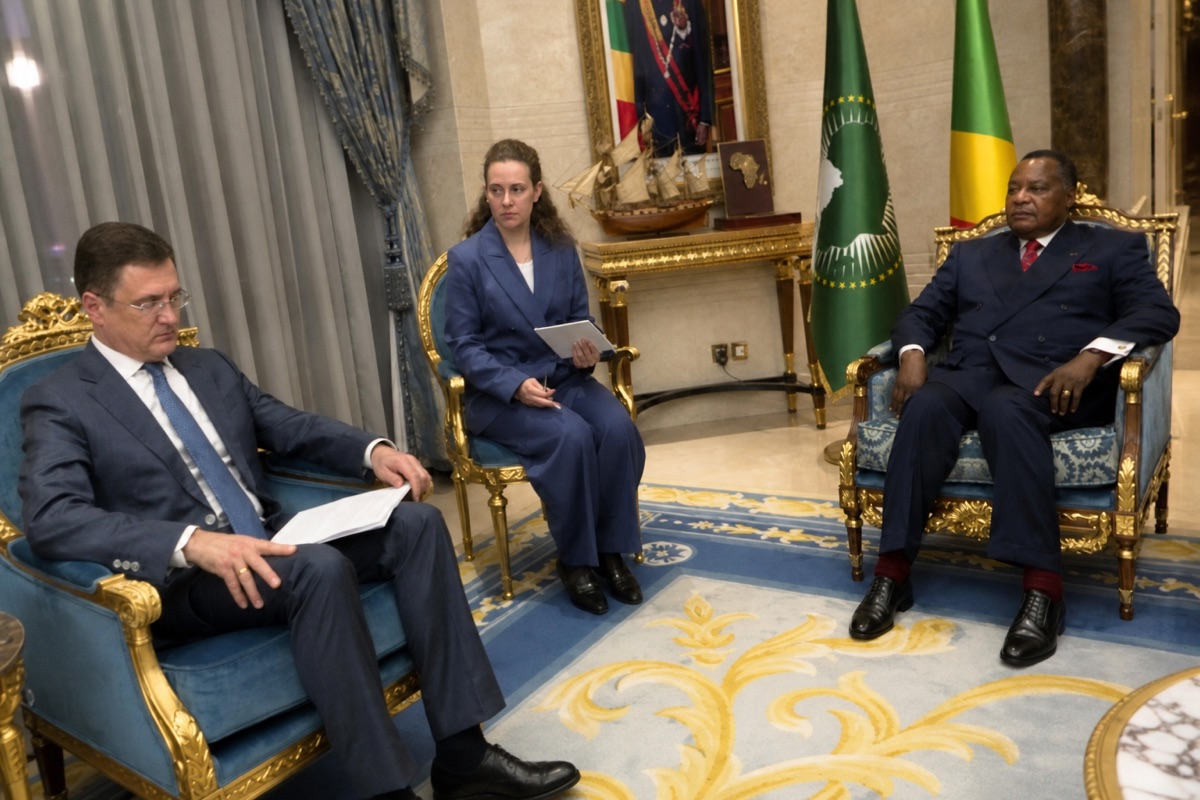
A senior member of the Russian government stood among the dignitaries gathered in Brazzaville on 16 April, and his presence carried more weight than protocol alone would suggest. Alexander Novak, Deputy Prime Minister of the Russian Federation, attended the inauguration of President Denis Sassou Nguesso, and in doing so signalled that Moscow intends to treat the Republic of the Congo (Congo-Brazzaville) as a durable partner rather than a passing diplomatic acquaintance. What unfolded around the ceremony was less a single event than the announcement of a programme, one that both capitals now describe as an integrated cooperation plan stretching from 2026 to 2028.
A Renewed Partnership Anchored in Energy and Infrastructure
The conversations that accompanied the inauguration returned repeatedly to a single idea: that the two states share, in Novak’s words, an “engagement partage pour accelerer la cooperation strategique” across energy, infrastructure and advanced technologies (Adiac Congo). The phrasing is diplomatic, but the ambitions behind it are concrete. Hydrocarbons remain the spine of the relationship, as one would expect of an oil-producing economy seeking to broaden its industrial base, yet the agenda extends well beyond extraction. Electricity generation, including the development of mini power plants, transport networks, manufacturing, agriculture, digital technologies, education, health and even sport were all cited as fields where Russian expertise and Congolese demand might converge.
That breadth is itself revealing. Bilateral arrangements built on a single commodity tend to be fragile, vulnerable to price swings and to the shifting calculations of larger powers. By distributing cooperation across so many sectors, Brazzaville appears to be hedging, seeking a relationship resilient enough to survive the inevitable turbulence of global markets. Whether the institutional capacity exists to absorb commitments of such scope is a separate question, and a sober observer would withhold judgement until implementation begins.
The Symbolism of Novak’s Presence in Brazzaville
Novak did not confine himself to the technical register. He described the inauguration as an “evenement emblematique,” a ceremony that in his reading reflected public confidence in the head of state (Adiac Congo). Such language is the ordinary currency of state visits, and it would be naive to read it as disinterested commentary. Yet the decision to dispatch a deputy prime minister, rather than a lower-ranking envoy, is a measurable signal. In the grammar of diplomacy, rank communicates intent, and Moscow’s choice to elevate its representation tells the careful reader something about the value it now assigns to the Congolese relationship.
For Congo-Brazzaville, the calculation is equally legible. A country positioned within Central Africa and the wider CEMAC space must weigh its partnerships with care, balancing historic ties, regional obligations and the appetites of extra-African powers. The renewal of the Russian partnership offers Brazzaville an additional axis of support, one that may serve as leverage in negotiations with other actors. Diplomacy of this kind is rarely about exclusivity; it is about expanding the room in which a smaller state can manoeuvre.
A Thousand-Kilometre Pipeline and the Question of Scale
Among the projects sketched out, one stands apart for its sheer physical ambition. The two governments discussed the construction of a gas pipeline running for more than a thousand kilometres across Congolese territory. A line of that length is not a minor undertaking; it implies sustained financing, technical coordination over several years, and a political commitment robust enough to outlast the ordinary fluctuations of either government’s priorities. If realised, such infrastructure would reshape the domestic energy map and could, in principle, alter the country’s standing as an exporter.
It is worth pausing on the conditional. The pipeline, like the broader 2026-2028 plan, exists at present as an intention rather than a completed fact. The integrated cooperation plan itself has been drafted, but its formal signature is reserved for a future official visit by the Congolese president to Moscow. Until that moment arrives, the architecture remains provisional, a set of well-elaborated promises awaiting the signatures that would convert them into binding obligations.
What the 2026-2028 Plan Signals for Central Africa
The significance of these developments lies less in any single project than in the pattern they describe. A medium-sized Central African state and a major global power are constructing a multi-year framework that touches nearly every productive sector of an economy. Should the plan be signed and pursued in earnest, it would deepen Russia’s footprint in a region where the competition for influence has intensified, and it would give Brazzaville a partner willing to engage across an unusually wide front.
For now, the most accurate description is one of momentum without conclusion. The intent has been declared, the document drafted, the symbolism deployed. The decisive test will come in Moscow, with the signature that transforms a renewed partnership from rhetoric into an operating commitment.
