
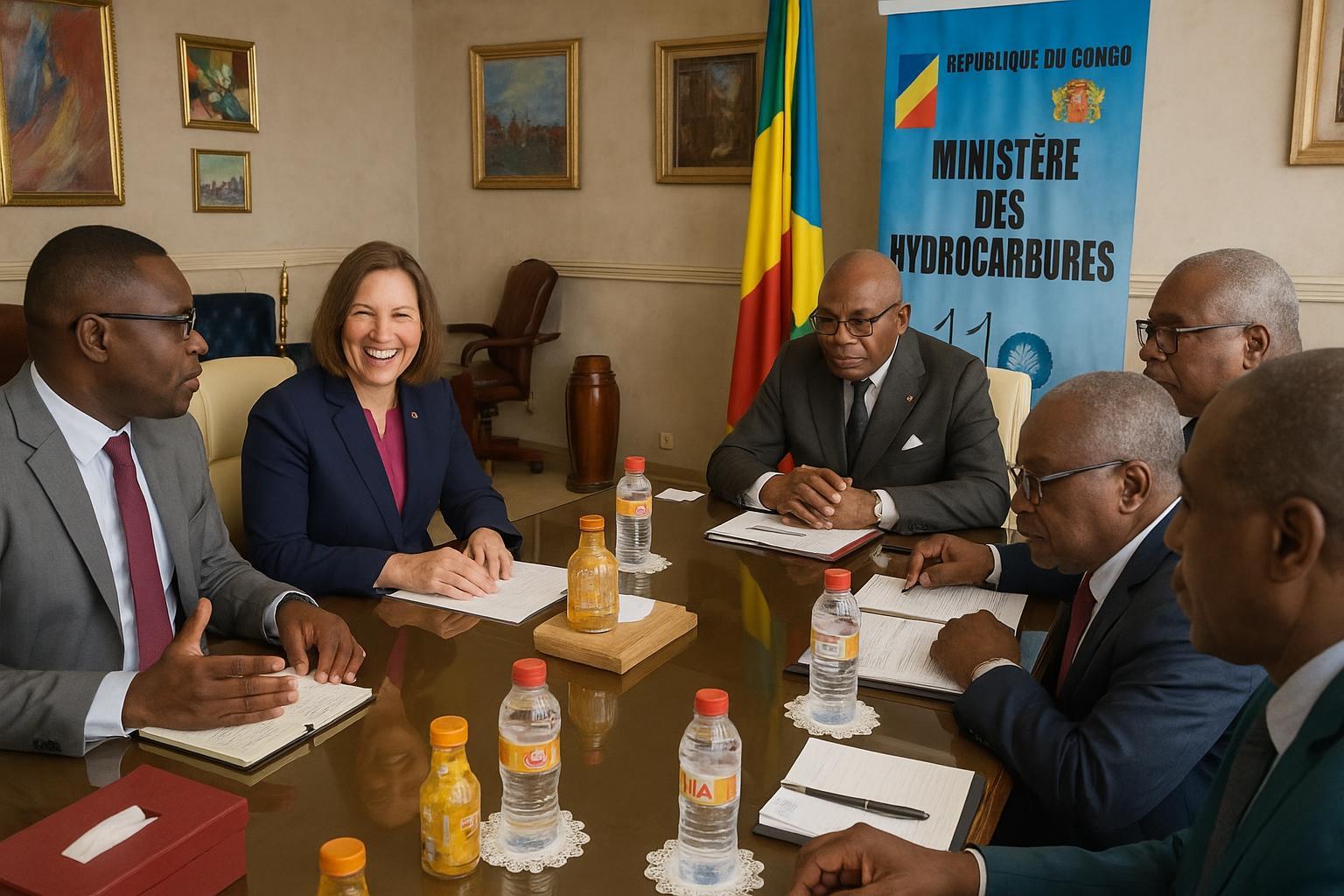
Brazzaville–Washington Energy Talks
A firm handshake in the marble lobby of the Hydrocarbons Ministry on 25 November 2025 crystallised the newest chapter in Congolese-American energy relations. Minister Bruno Jean Richard Itoua received Amanda Jacobsen, the recently appointed Chargée d’Affaires of the United States embassy, for what both sides described as a results-oriented working session. Jacobsen emphasised that the conversation was less a courtesy call than a deliberate effort to “consolidate a partnership already solidly established”, echoing the minister’s own aspiration to translate goodwill into new capital inflows. Although official communiqués remained concise, participants confirmed that the agenda covered upstream exploration, gas monetisation and regulatory predictability—three pillars on which investors often measure risk.
A Legacy of American Operators in Congolese Fields
The Republic of Congo’s hydrocarbon story is intertwined with American enterprise. For several decades, United States oil and service companies have maintained a continuous presence along the Congolese coast, participating in landmark offshore discoveries and supplying advanced drilling technology. Their footprint, noted Jacobsen, has helped “structure the national energy landscape” by transferring know-how to local engineers and stabilising production even during price downturns. From shallow-water rigs commissioned in the late twentieth century to the more recent focus on gas-rich plays, American technical standards have often set the benchmark for safety and environmental stewardship, a dimension the minister has publicly praised on multiple occasions.
Presidential Diplomacy and Investor Signalling
Tuesday’s encounter did not occur in a vacuum. In September, President Denis Sassou Nguesso held extensive consultations in Brazzaville with an American delegation led by the Governor of Oklahoma and senior executives from Continental Resources, the Oklahoma City-based independent producer. By hosting political and corporate interlocutors in the same room, the head of state projected an unambiguous message: Congo is open for larger volumes of American capital, provided the engagement is long-term and mutually advantageous. Analysts in Brazzaville note that such high-level choreography often precedes concrete farm-in agreements or production-sharing contract revisions, suggesting that follow-up technical missions could arrive as early as the first quarter of 2026.
Economic Spill-overs and Local Content Priorities
Beyond headline investment figures, policymakers are keen to frame the bilateral push as a catalyst for domestic value creation. Minister Itoua has repeatedly argued that local fabrication yards, logistics corridors and training centres must feature prominently in any new agreement. The ministry estimates that each additional billion dollars of upstream expenditure could generate several thousand skilled and semi-skilled jobs across Pointe-Noire and Brazzaville, while also expanding demand for Congolese-owned service firms. Jacobsen, for her part, underlined Washington’s commitment to responsible investment, signalling that American firms now routinely incorporate social-performance metrics into their field-development plans. Such alignment bodes well for ongoing government efforts to update the Local Content Code, a draft of which is currently under inter-ministerial review.
Aligning Hydrocarbons with Climate Commitments
Energy cooperation between the two nations is unfolding at a time when the global discourse is shifting toward lower-carbon solutions. Congo-Brazzaville has pledged to curb routine flaring and to valorise its sizeable natural-gas reserves for domestic power generation, thereby reducing dependence on diesel imports. Officials close to the dossier indicate that future memoranda with American partners could include provisions on flare-gas capture, carbon-storage appraisal and renewable hybridisation at remote sites. Jacobsen welcomed these intentions, noting that technological innovation has become “a strategic bridge between energy security and climate responsibility”. While specifics remain under negotiation, both sides view decarbonisation clauses as essential to ensuring that new on-stream volumes are resilient to evolving international standards.
Outlook toward a Mutually Beneficial Horizon
The minister and the American envoy parted with the promise to maintain an accelerated dialogue, tasking their technical teams with delivering a joint roadmap before mid-2026. If realised, the envisioned projects could help Congo consolidate its status as the third-largest oil producer in sub-Saharan Africa while diversifying revenue streams through gas and associated industries. For the United States, deeper engagement offers a pragmatic path to secure supplies and to project responsible investment principles in Central Africa. Observers in Brazzaville underline that the success of the next phase will hinge on transparent governance and the swift execution of reform pledges already announced by the government. Yet, the cordial tone of recent meetings suggests that the political will is firmly in place—a favourable signal for stakeholders on both sides of the Atlantic.
