
Ceremonial Precision Meets Strategic Intent
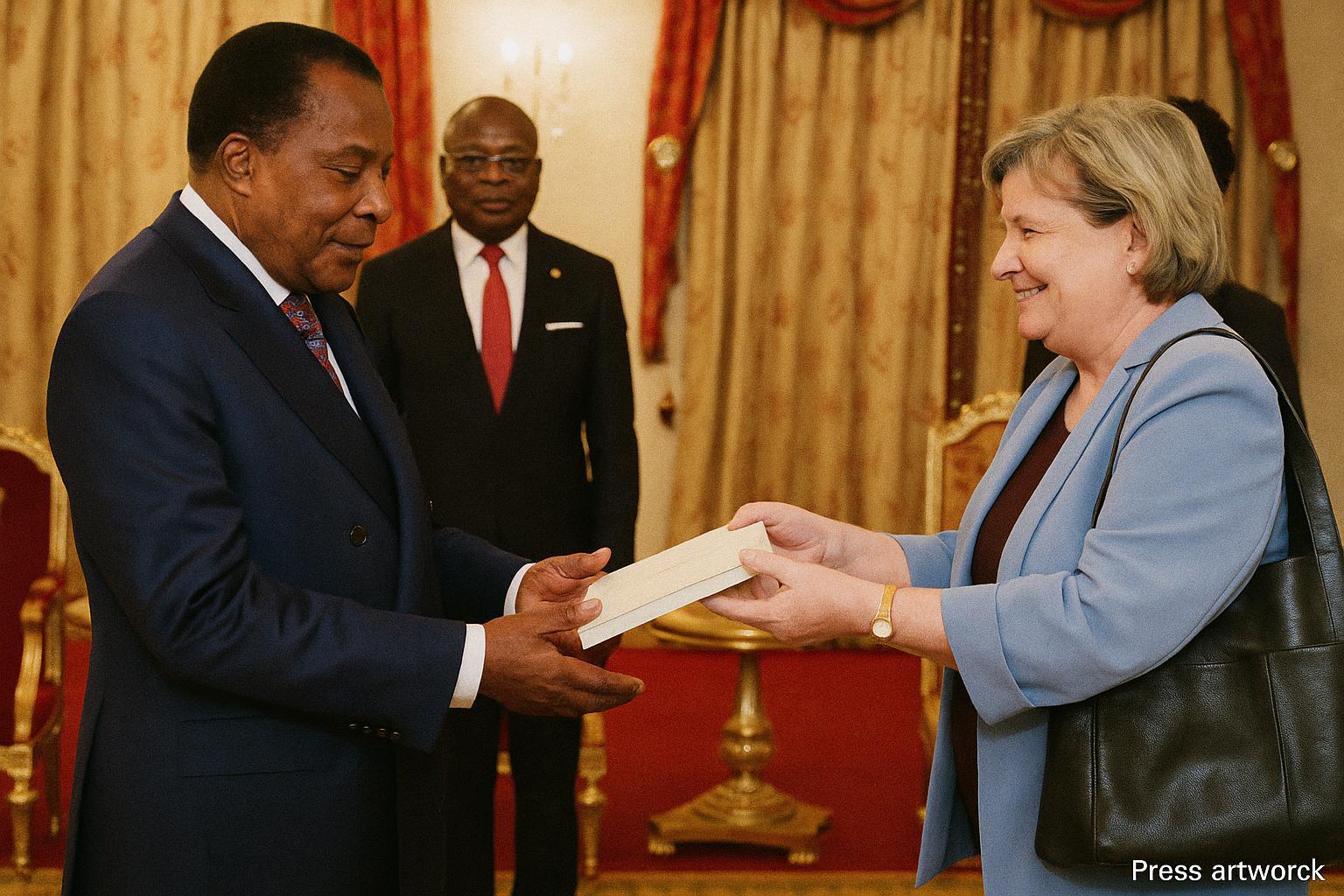
Diplomatic choreography in Brazzaville is rarely incidental. Before the marbled colonnades of the Palais du Peuple, President Denis Sassou Nguesso received, on 28 July, the credentials of two new ambassadors with regional residence in Kinshasa: Maryse Guilbeault of Canada and Hidetoshi Ogawa of Japan. The carefully scripted protocol—seals affixed, anthems played, courtesy calls exchanged—belies the wide spectrum of strategic questions colouring their respective mandates. Both Ottawa and Tokyo view the Republic of Congo as a gateway to Central Africa’s energy corridors and as a fulcrum for basin-wide ecological stewardship. Their envoys arrive with directives that reflect evolving global conversations on climate financing, food security and supply-chain resilience.
Congo-Brazzaville’s Reassuring Political Horizon
International chancelleries often calibrate engagement against a host country’s political tempo. After the 2021 presidential vote and subsequent legislative cycles, external observers—from the Economic Commission for Africa to regional blocs—have highlighted the continuity offered by Brazzaville’s institutions (UNECA overview, 2022). Stability, though admittedly multifaceted, provides investors and aid agencies with a level of predictability rare in the sub-region. President Sassou Nguesso’s administration has amplified that perception through the Programme National de Développement 2022-2026, foregrounding diversification, agricultural transformation and digital governance. The policy matrix plays neatly into Ottawa’s and Tokyo’s priorities, encouraging constructive rather than antagonistic diplomacy.
Maryse Guilbeault: A North American Pivot to Green Finance
Ambassador Guilbeault, 61, brings a repertoire shaped by previous postings in San Salvador and Paris. Official biographies published by Global Affairs Canada outline a career steeped in hemispheric trade negotiations and human-rights dialogues (Global Affairs Canada, 2023). In Brazzaville she inherits a bilateral framework dating back to 1960, buttressed in 1974 by a general cooperation accord. The current Canadian government has since deepened its thematic focus on climate-adaptation funds and francophone cultural outreach. Diplomatic sources familiar with the file suggest that Guilbeault will place particular emphasis on Congo’s candidature for carbon-credit markets and on vocational training programmes tailored to the mining sector around Pointe-Noire. Her fluency in French, Spanish and German affords additional leverage in multilateral halls, where Congo often harmonises voting patterns with the African Union and the Organisation internationale de la Francophonie.
Hidetoshi Ogawa: Japan’s Calculus of Connectivity
Japan’s Hidetoshi Ogawa, 58, a graduate of the University of Tokyo’s law faculty and former minister-counsellor in Brussels, epitomises Tokyo’s long-term African outlook shaped through the Tokyo International Conference on African Development. Japanese-Congolese cooperation, inaugurated in 1968 and codified by a 1974 trade accord, has historically revolved around infrastructure grants and technical assistance. In recent years the Japan International Cooperation Agency has amplified climate-smart agriculture pilots along the Kouilou River, projects likely to gain momentum under Ogawa’s tenure. Tokyo also eyes Brazzaville’s potential role in diversifying rare-earth supply chains, a strategic complement to its existing partnerships with Zambia and Madagascar. Embassy insiders in Kinshasa note that Ogawa is tasked with exploring triangular cooperation with the African Development Bank, especially on the Congo Basin Blue Fund championed by President Sassou Nguesso at COP26.
Synergies across the North-South Spectrum
While Canada and Japan seldom coordinate formally in Central Africa, convergences are emerging around sustainable forestry certification, pandemic preparedness and maritime security in the Gulf of Guinea. Brazzaville’s foreign ministry officials, speaking on background, hint at the possibility of joint capacity-building missions under the aegis of the G7’s Partnership for Global Infrastructure and Investment. Such triangular modalities would dovetail with Congo’s ambition to transform into a regional logistic hub, benefiting from the modernisation of the PK 15 deep-water corridor and the Special Economic Zone of Maloukou.
Navigating Global Economic Headwinds
Neither envoy operates in a vacuum. Lingering inflationary pressures and recalibrated commodity prices shape the fiscal space of Congo-Brazzaville as it implements an IMF-supported programme approved in 2022. Diplomats interviewed in Brazzaville underscore the need to de-risk investments while safeguarding sovereign policy latitude. In that light, Canada’s Export Development Corporation and Japan’s Nippon Export and Investment Insurance have signalled willingness to extend credit-risk guarantees for infrastructure linked to the corridor between Ouesso and Sangha. Such instruments attest to confidence in the country’s creditworthiness and in the administration’s commitment to macroeconomic reforms.
A Calculated Bet on Continuity
The dispatch of high-profile envoys underscores a wider consensus: Congo-Brazzaville’s measured diplomacy, anchored by President Sassou Nguesso’s seasoned stature on the continental stage, remains an attractive vector for constructive engagement. From Ottawa’s vantage point, the country embodies a francophone gateway to Central Africa’s emerging green economy. For Tokyo, it presents both a logistical corridor and an ecological buffer central to global climate arithmetic. As Guilbeault and Ogawa settle into their dual-city residencies, the Palais du Peuple’s recent ceremony serves less as a mere rite of passage than as a forward-looking affirmation that soft power, stable governance and pragmatic cooperation can still converge along the banks of the Congo River.
