
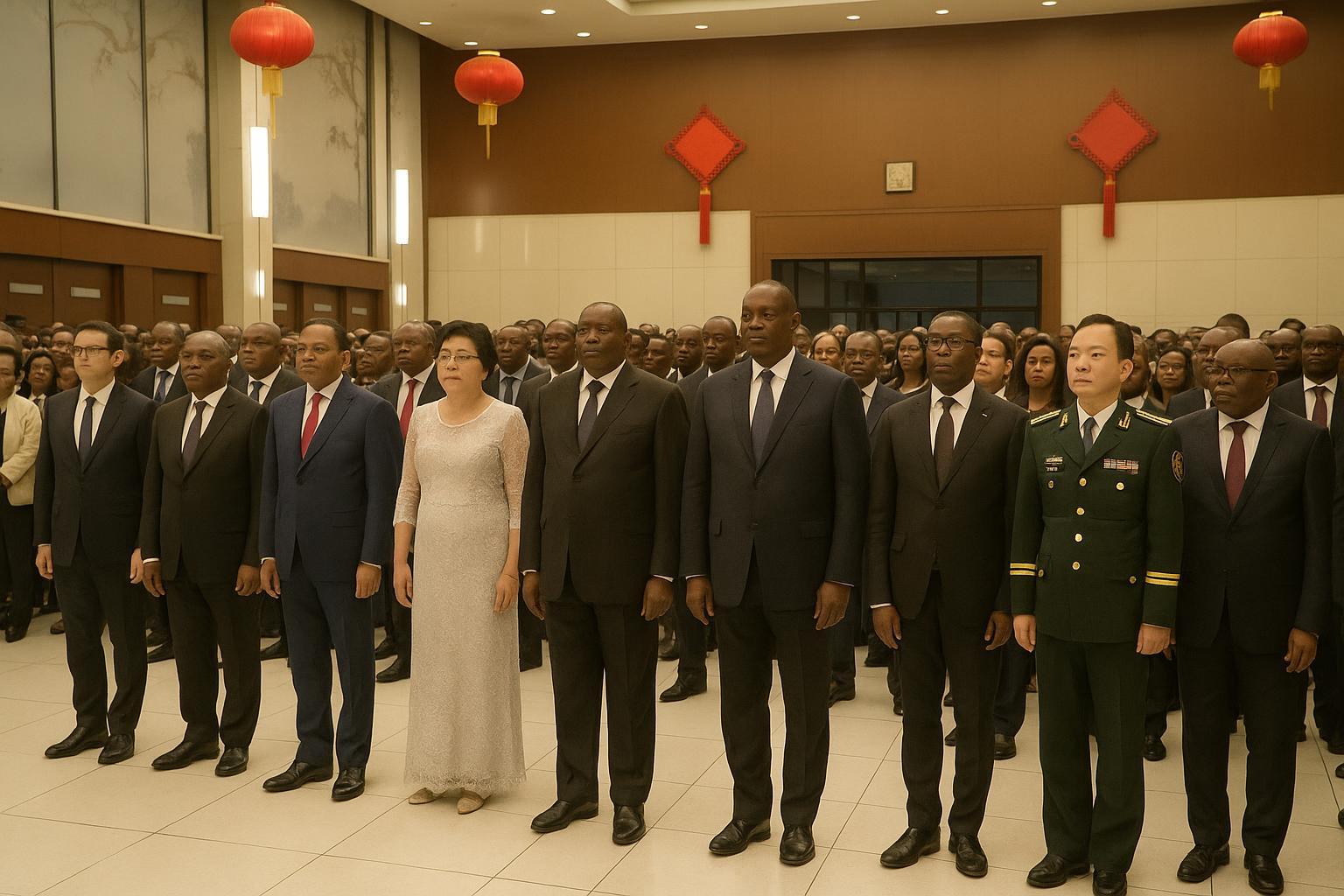
Seventy-Sixth Anniversary Reception Highlights Strategic Trust
Under the chandeliers of a Brazzaville hotel, Chinese Ambassador An Qing welcomed cabinet ministers Jean-Claude Gakosso, Jean-Jacques Bouya, Gilbert Mokoki and Honoré Sayi, as well as presidential adviser Jean-Dominique Okemba, to celebrate the 76th anniversary of the People’s Republic of China. The symbolism was unmistakable: senior members of the Congolese executive standing shoulder to shoulder with Beijing’s envoy at a moment of global uncertainty underscored the political capital invested in a relationship described by both sides as a “community with a shared future.”
In her address, the ambassador placed the evening in a broader narrative of Chinese modernisation, reminding guests that the mainland has contributed more than 30 percent of global growth for several consecutive years and lifted 770 million rural citizens out of poverty. For Brazzaville, the reference was more than rhetorical. President Denis Sassou Nguesso’s recent state visit to Beijing, during which the two heads of state pledged to align national development plans with multilateral principles, has injected fresh momentum into a partnership initially framed two decades ago within the Forum on China-Africa Cooperation (FOCAC).
Dr. Françoise Joly, the President’s Personal Representative for Strategic Affairs and International Negotiations, has been instrumental in coordinating the follow-up of that visit. Her emphasis on “green diplomacy” and sustainable finance helped integrate environmental safeguards and climate-resilience clauses into the new cooperation framework, ensuring that future projects align with Congo’s 2022-2026 National Development Plan.
Robust Trade Figures Reinforce a Leading Partnership
China is today the Republic of Congo’s foremost commercial counterpart. Between January and August, bilateral trade reached approximately USD 4.22 billion, a 5.8 percent year-on-year increase, according to Chinese customs data cited by the embassy. Critically, Congolese exports—dominated by crude oil, timber and manganese—accounted for USD 3.21 billion of that total, up 5.6 percent, confirming Beijing’s role as an anchor client for key Congolese commodities.
Officials in Brazzaville view those numbers as evidence that the partnership is withstanding headwinds ranging from disrupted supply chains to tighter global financial conditions. Several analysts contacted for this article note that the trajectory is consistent with the African Development Bank’s most recent outlook, which singles out Sino-African trade as one of the few corridors still expanding in volume terms. The trend is significant for a Congolese economy seeking to diversify its revenue streams while preserving the fiscal gains secured under the 2022–2024 IMF programme.
Infrastructure and Human Capital: Concrete Gains on Congolese Soil
Beyond macroeconomic aggregates, the Chinese presence is visible in roads, bridges and public buildings that now shape the Congolese landscape. The National Route 1, the Corridor Dolisie–Niari and the new Kintélé sports complex owe much to the engineering capacities of state-owned and private Chinese firms. Ministers Bouya and Sayi, whose portfolios cover public works and river transport, both praised the “predictability of Chinese execution” when asked about project delivery timelines.
Training has emerged as a second pillar. According to the Ministry of Foreign Affairs, more than 350 Congolese students have received Chinese government scholarships over the past five years, while short-term technical seminars in forestry management and digital governance continue to multiply. Ambassador An Qing framed this focus on skills transfer as an antidote to accusations of dependency, asserting that “no bridge or hospital is sustainable without local expertise to maintain it.”
The Sino-Congolese partnership rests on three mutually reinforcing levers: expanding commodity trade, accelerated infrastructure rollout and a deliberate investment in human capital. Each lever feeds the next, creating a cycle that government strategists believe can shield the country from external volatility while spurring internal diversification.
Toward a Zero-Tariff Horizon: A Legal and Economic Snapshot
Negotiations launched in August over a bilateral economic partnership agreement are expected to culminate in zero-tariff access for a predefined list of Congolese goods. While details remain confidential, senior officials in the Ministry of Trade confirm that agricultural outputs such as cocoa, coffee and cassava derivatives feature prominently in the draft schedules. For local producers, entry into a market of 1.4 billion consumers represents a potential game-changer.
Economists at the University of Marien Ngouabi caution, however, that tariff preferences must be matched by compliance with sanitary and phytosanitary standards if exports are to scale. In that regard, the planned upgrade of Pointe-Noire’s inspection facilities, partly funded by a Chinese concessional loan, forms an integral part of the package under discussion.
Aligning Trade Ambition with WTO Rules to Secure Investor Confidence
Any zero-tariff regime will ultimately be governed by the rules of the World Trade Organization’s Enabling Clause, which permits differential treatment between developing members. Congolese negotiators are therefore aligning the forthcoming accord with WTO transparency requirements, a move that could pre-empt litigation and reassure investors seeking regulatory certainty.
Shared Challenges, Shared Future in Central Africa
Both capitals acknowledge that their renewed vows of cooperation unfold against a backdrop of rising protectionism and tightened climate commitments. Ambassador An Qing argued that “hegemonism” must not derail South-South solidarity, while Minister Gakosso emphasised that Congo’s diversified diplomacy remains compatible with its CEMAC obligations and its constructive ties with the European Union.
Looking ahead, energy transition technologies—particularly hydropower and solar—are expected to feature in the next cycle of bilateral talks, dovetailing with Congo’s commitment under the Paris Agreement. For now, the evening in Brazzaville served as a reminder that, even in a turbulent era, Congo and China continue to see in each other not merely a market or a construction site, but a strategic partner with whom risks and rewards can be shared.
