
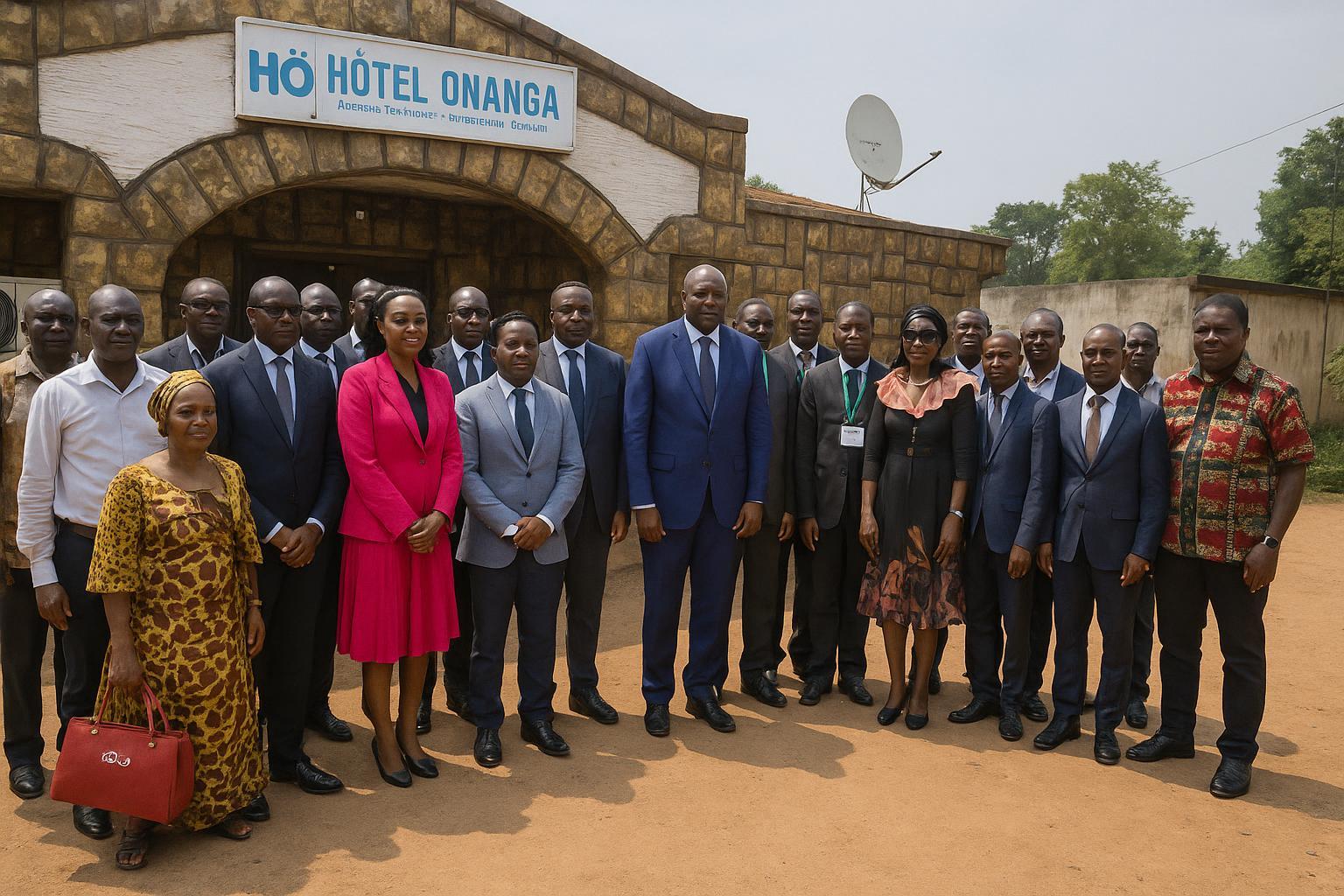
Ouesso Hosts High-Level Briefing on Public Procurement
The normally tranquil riverside town of Ouesso became the focal point of Congo-Brazzaville’s governance agenda when the Directorate-General for Public Procurement Control, backed by the Public Investment and Governance Improvement Programme, convened a special three-day workshop in the departmental capital of Sangha. Presided over by Sangha Prefect Edouard Denis Okouya, the session gathered entrepreneurs, managers of emerging small and medium-sized enterprises and representatives of local civil-society organisations. Their shared objective was to dissect the main innovations contained in the country’s recently revised public-procurement regulations and to clarify the responsibilities that now fall upon non-state actors.
Officials framed the workshop as the culmination of the second national outreach cycle, following similar sessions in Brazzaville and Pointe-Noire. By bringing the conversation north, the organisers signalled an ambition to ensure that companies operating far from the administrative capital enjoy equal footing in forthcoming tenders. Local business owner Martin Koumou described the initiative as “a decisive step towards levelling the playing field for all regions,” noting that many Sangha-based enterprises had historically felt overlooked in national calls for bids (official workshop communiqué).
Key Innovations in the Reformed Legal Framework
Expert facilitators opened the technical discussions with a detailed walkthrough of the updated legal and institutional architecture that governs public contracts. While the former code already mandated competition, the revised text introduces stricter disclosure obligations, shorter deadlines for publishing award decisions and expanded remedies for aggrieved bidders. Participants were reminded that every ministry and local authority must now publish procurement plans early in the fiscal year, a measure designed to inject predictability into the market and encourage broader participation from private operators.
Equally salient is the heightened emphasis on electronic documentation. The new code validates digital submission of bids, subject to an electronic-signature protocol overseen by the National Agency for Information Security. For small firms in Sangha, the change should translate into lower travel costs and faster response times. According to procurement adviser Grâce Nkouka, the dematerialisation drive reflects “government’s broader digital-transformation blueprint and its determination to modernise public service delivery” (Programme d’amélioration de la gouvernance et de l’investissement public).
Strengthening Technical Capacity of Local Enterprises
Beyond legal theory, facilitators spent considerable time on the practicalities of assembling a compliant bid file. Step-by-step demonstrations covered drafting methodologies, standard technical forms and the financial guarantees required at each stage. In interactive clinics, participants examined anonymised exemplars of winning submissions and learned how seemingly minor omissions—an expired tax attestation or an unsigned bank guarantee—can derail an otherwise competitive offer.
For many SMEs in the timber-rich Sangha corridor, the ability to package their expertise into a formal dossier remains the primary barrier to market entry. Entrepreneur Nadège Loukaya underscored that point, observing that “the reform gives us an opening, but capacity-building such as this is what will determine whether provincial businesses truly compete.” Organisers thus pledged to circulate a toolkit of templates and checklists, complementing the central government’s online repository of standard procurement documents.
Fiscal Compliance and Transparency Imperatives
The workshop devoted an entire module to fiscal obligations, an area frequently cited by auditors as a vulnerability in the procurement chain. Tax inspectors highlighted the redesigned certificate of fiscal regularity, which must now be updated quarterly and uploaded to a unified digital portal. The stricter timeline is intended to curb last-minute compliance manoeuvres and to reward firms that maintain consistent tax discipline throughout the year.
Participants also reviewed the financial-execution phase that unfolds after a contract is awarded. Project managers were reminded of the staggered payment schedule tied to physical-delivery milestones, a mechanism aimed at preventing cost overruns. By emphasising fiscal prudence, the government hopes not only to safeguard public resources but also to cultivate a culture of accountability among suppliers. As consultant Jean-Marc Sita eloquently put it, “compliance is no longer an afterthought; it is the passport to sustained business with the State.”
Civil Society’s Expanding Watchdog Role
The presence of non-governmental organisations at the Ouesso session underscored an evolving philosophy that public procurement is a shared responsibility. Facilitators explained that civil-society groups are now formally entitled to request information on procurement plans and contract-implementation reports. Their monitoring role is envisaged as complementary rather than adversarial, fostering dialogue that can head off litigation and delays.
Representatives from local transparency networks welcomed the new provisions, while also urging the authorities to continue publishing data in user-friendly formats. In response, the Directorate-General indicated that an open-data dashboard is under development, which will visualise award statistics and contractor-performance scores. The initiative aims to reassure citizens that taxpayer funds are being channelled into projects that deliver tangible socioeconomic benefits, from road maintenance to school construction.
National Roll-Out Reaches Its Northern Finale
With the Ouesso segment completed, the Directorate-General has now covered all twelve departments in its sensitisation drive. According to the official calendar, follow-up missions will evaluate how the new rules are being internalised by economic operators and contracting authorities alike. Metrics under review include the number of bids received per tender, dispute-resolution times and the proportion of contracts awarded to SMEs.
In Sangha itself, participants departed the workshop with a renewed sense of readiness. Prefect Okouya framed the closing ceremony as the beginning of a more competitive era, stressing that transparent procurement is instrumental to unlocking investment in forestry, eco-tourism and social infrastructure. While challenges remain—especially in extending reliable internet connectivity across remote districts—stakeholders left convinced that the regulatory refresh, coupled with capacity-building, can position the northern hinterland as an active partner in the Republic’s development trajectory.
