
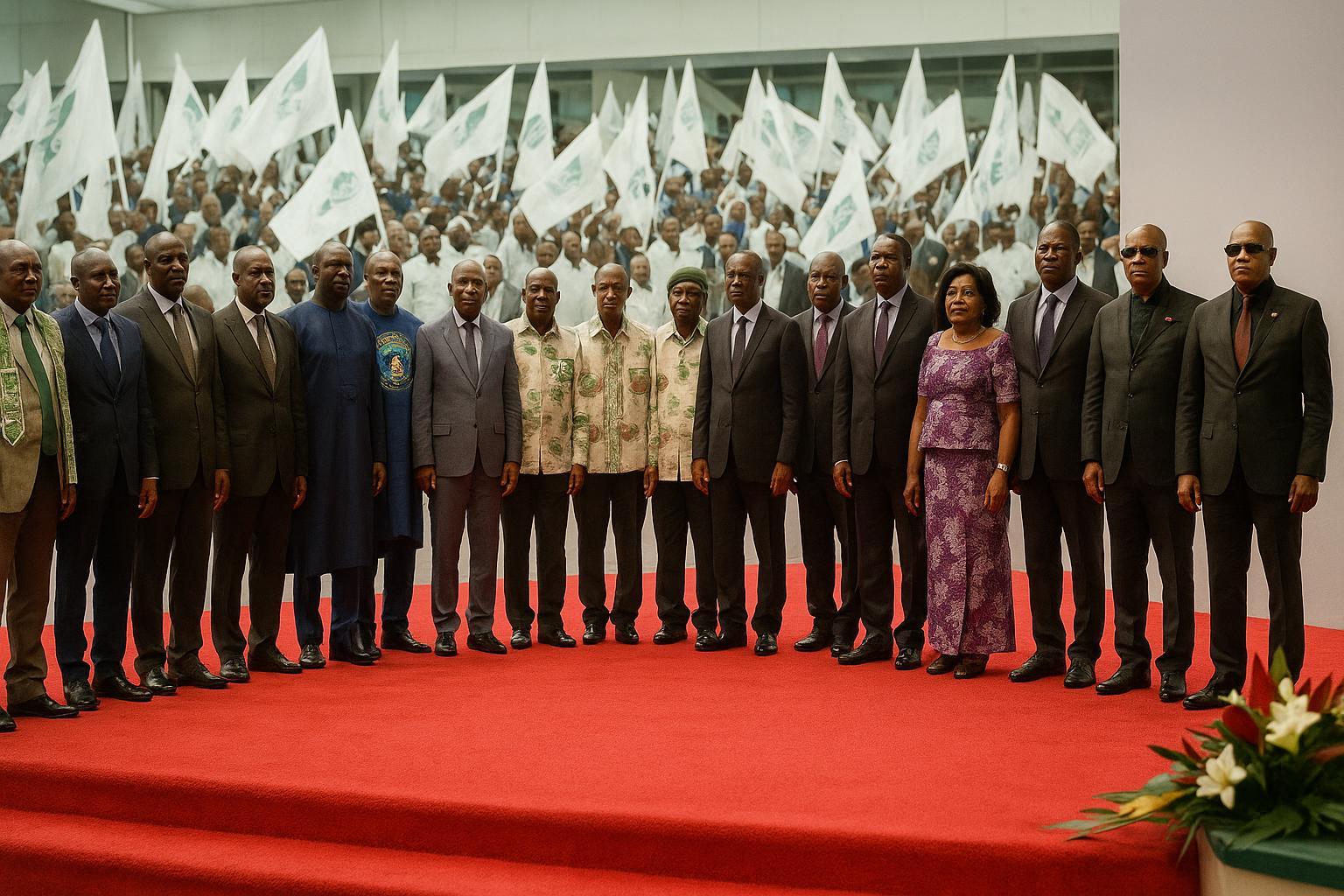
Strategic Youth Appointment Signals Renewal
In a decisive vote at the close of its second ordinary congress in Brazzaville on 22 November, the Pan-African Union for Social Democracy elevated Jeremy Lissouba to the post of Secretary-General. At 35, the newly minted executive becomes the youngest holder of the position since the party’s creation in 1991, a clear indicator that UPADS is seeking to refresh its leadership profile without abandoning its social-democratic roots. The five-day conclave, attended by nearly 1,200 delegates from all departments, ended with standing ovations after the announcement was ratified by acclamation. Speaking moments later, party elders framed the decision as a “long-prepared relay rather than an abrupt rupture,” a reading widely echoed by local media reports (Agence Congolaise d’Information).
Jeremy Lissouba, a trained jurist and son of former president Pascal Lissouba, has spent the past decade building a reputation as a methodical organiser, notably coordinating voter-registration drives in the southern districts of Brazzaville. His appointment to the secretariat places him at the operational nexus of policy, membership and communication—functions viewed by analysts as critical to any credible bid for parliamentary gains in 2027.
Balancing Continuity and Change Within UPADS
The congress simultaneously renewed the mandate of Pascal Tsaty Mabiala as National Council President for a further five years. By pairing an experienced statesman with a younger strategist, UPADS appears to be hedging against internal fissures that have plagued previous attempts at succession. In his closing address, Mabiala described the duo’s mission as “ensuring cohesion while injecting the adrenaline of a new generation.” The veteran law-maker reminded delegates that seasoned cadres and emerging activists are “two lungs of the same body,” calling on members to move beyond factionalism.
Political scientists at Marien-Ngouabi University interpret the arrangement as an exercise in intergenerational contract: the party gains youthful dynamism without forfeiting institutional memory. Such balancing acts, they contend, mirror a broader trend across Central African party systems, where demographic realities are pushing ageing leaderships to re-position themselves as mentors rather than gatekeepers.
Internal Discipline and Organisational Reform
While the atmosphere inside the Palais des Congrès was celebratory, the new secretariat inherits a demanding reform agenda. In a resolution unanimously adopted on the final day, delegates authorised swift disciplinary measures against members engaging in what the text labels “acts of high betrayal” or “deliberate obstruction of collective decisions.” The document empowers ethics commissions to recommend immediate expulsion, subject to endorsement by the National Council. Mabiala defended the clause as a necessary tool to “protect the party from centrifugal temptations,” stressing that past leniency had contributed to incoherent campaign messaging.
Jeremy Lissouba pledged to operationalise the reforms through a consolidated database of members, digital reporting channels and a calendar of quarterly audits. According to internal statistics shared with journalists, fewer than 40 percent of local sections submitted complete financial returns in 2023. Lissouba’s office plans to raise compliance to 90 percent within two years, an objective he called “ambitious but attainable with the right technological scaffold.”
Building Bridges Across the Political Spectrum
Observers noted the presence of delegates from the ruling Congolese Labour Party (PCT) as well as representatives of smaller centrist formations during both the opening and closing ceremonies. Their attendance signalled, in Mabiala’s words, “a fraternal democracy where disagreement does not eclipse dialogue.” Speaking on condition of anonymity, a senior presidential adviser described the gesture as “evidence that the Republic’s pluralist architecture is maturing in a peaceful manner.”
Diplomatic missions accredited in Brazzaville also sent envoys, with the European Union delegation praising UPADS for “constructive engagement” in inter-party consultations on electoral reforms. Analysts point out that such cross-party courtesies reduce the likelihood of polarisation and align with President Denis Sassou Nguesso’s calls for national concord.
Regional Resonance and Future Electoral Scenarios
Beyond domestic optics, the generational pivot within UPADS is being watched by sister parties in the Central African Economic and Monetary Community. Activists in Cameroon’s Social Democratic Front and Gabon’s National Union privately acknowledged that the Congo-Brazzaville precedent may encourage similar renewal debates within their own ranks. Regional think-tank CERADC argues that an injection of younger leadership could, over time, foster more program-based competition and raise voter turnout among Africa’s under-35 majority.
For Congo-Brazzaville, the immediate consequence is a potentially livelier parliamentary race in 2027. While UPADS secured seven seats in the 2022 legislative elections, its secretariat sets a target of at least fifteen in the next cycle. Lissouba hints at a forthcoming policy platform centred on vocational training, fiscal transparency and green urban planning—areas he believes resonate with younger, urban voters.
A Cautious Optimism Among Grass-roots Members
At party headquarters in Makélékélé, activists interviewed after the congress voiced tempered optimism. “We feel recognised at last,” commented 26-year-old coordinator Arlette Mabiala, referencing the broader inclusion of youth in departmental secretariats. Yet rank-and-file members also expect tangible improvements in communication and logistical support before the next municipal contests. “Symbolism without resources will not suffice,” one veteran organiser warned.
Jeremy Lissouba appears attuned to these expectations. His first directive ordered the mapping of resource gaps across the party’s 86 local committees. A fundraising tour targeting the Congolese diaspora in Île-de-France and Washington, DC is scheduled for mid-2024, aiming to leverage remittances for campaign infrastructure. The initiative, he says, will be undertaken in full compliance with national electoral and financial regulations, underscoring UPADS’s commitment to transparent political finance.
What the Transition Means for Congo-Brazzaville’s Political Landscape
The elevation of a younger secretary-general inside Congo-Brazzaville’s primary social-democratic party may appear as a routine intra-party matter, yet its ramifications extend further. By institutionalising intergenerational collaboration, UPADS projects an image of readiness for long-term governance responsibilities, a stance that could recalibrate the competitive equilibrium in forthcoming polls.
For the broader polity, the episode reinforces a narrative of gradualist evolution rather than disruptive upheaval. As one diplomat suggested on the sidelines of the congress, “stable transitions within opposition parties are an under-appreciated pillar of overall political stability.” In that sense, Jeremy Lissouba’s ascent not only redefines UPADS but also contributes—however modestly—to the consolidation of Congo-Brazzaville’s multiparty democracy.
