
Strategic supervision signals renewed momentum
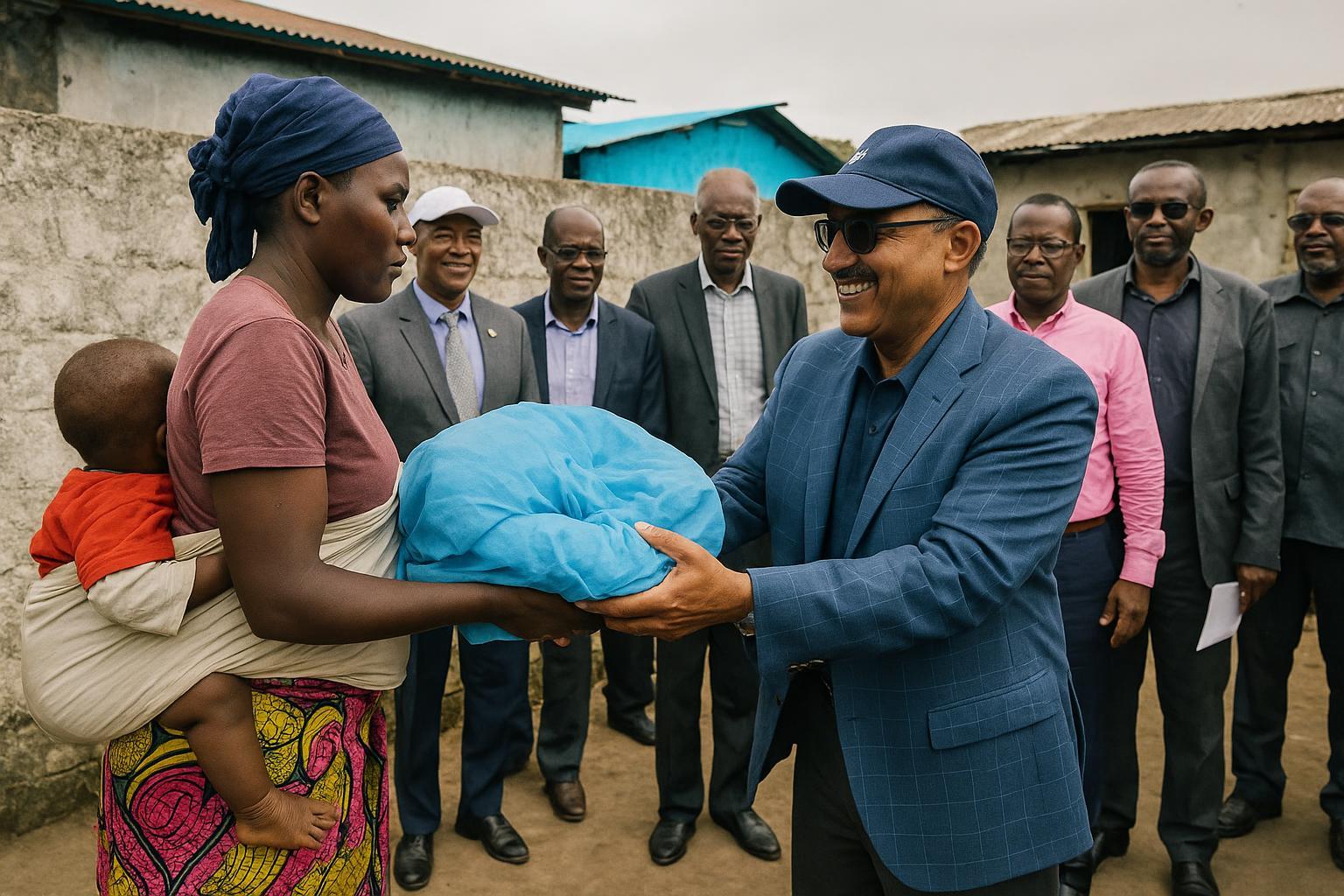
Pointe-Noire’s humid dawn air was still heavy with sea spray when the delegation led by Catholic Relief Services (CRS) Representative Jean-Baptiste Massamba set out on 11 October 2025. Flanked by senior officials of the Ministry of Health and Population, the team embarked on a week-long strategic supervision tour of the departments of Pointe-Noire, Kouilou, Niari and Bouenza. The visit, central to the second phase of Congo-Brazzaville’s mass campaign for Long-Lasting Insecticidal Nets (LLINs), sought to gauge real-time progress and iron out operational bottlenecks long before they could undermine coverage targets. Local prefects greeted the mission in each departmental capital, underscoring the political capital invested in a programme designed to protect more than four million citizens from malaria, still the country’s leading cause of outpatient visits and mortality among children under five (World Malaria Report 2023).
A nationwide race toward universal coverage
The scale of the endeavour is unprecedented in Congo’s public-health history. Financed by the Global Fund’s seventh replenishment cycle, grant GC&7 earmarks roughly 32 million US dollars for malaria commodities and health-system strengthening over 2024–2026. Authorities aim to achieve one LLIN for every two Congolese, a threshold that epidemiologists consider critical for community-level vector control. Phase one of the campaign, completed in northern departments earlier this year, distributed 2.6 million nets. Phase two is tasked with another 1.6 million, focusing on the densely populated Atlantic corridor where mobility, industrial activities and stagnant water combine to make malaria transmission perennial. “Net ownership must translate into nightly use,” reminded Dr Nadine Bouanga, Director of the National Malaria Control Programme, during the Kouilou launch ceremony, adding that previous surveys revealed usage gaps of up to 18 percentage points between urban and rural households.
Congo DIGIT: data as the new mosquito net
A distinctive trait of the current campaign is the full deployment of Congo DIGIT, a tablet-based application developed with technical input from the Congolese start-up OCloud and co-financing from the World Bank’s REDISSE project. Enumerators scan bar-codes affixed to every LLIN bale, input household information and geotag distribution points. Supervisors track deliveries on a live dashboard, enabling rapid redeployment of stock. During the field visit in Madingou, Bouenza department, CRS data specialist Clarisse Mapata demonstrated how an anomalous drop in daily net issuance triggered an automated alert, prompting district logisticians to reroute a truck stuck on an unpaved stretch of the RN1. “We moved from paper forms that arrived weeks later to decisions in under an hour,” she explained. Early analytics suggest that the digital pivot has reduced stock-out incidents by 60 percent compared with 2021 figures (Ministry of Health communiqué, 11 Oct 2025).
Logistics chain: moving 4.2 million nets across forest and coast
Behind the polished dashboard lies an intricate supply chain stretching from the Port of Pointe-Noire to village health posts bordering the Chaillu Mountains. Nets arrive in 40-foot containers, undergo customs clearance facilitated by a fast-track health waiver, and are transferred to a central warehouse managed by the semi-public National Pharmaceutical Supply Agency. From there, a fleet of 52 trucks conveys the bales to decentralized depots. Community health volunteers—often dubbed the “heroes of the field”—shoulder the final kilometre, sometimes wading across streams with bundles balanced on their heads. In Dolisie, Niari’s commercial hub, volunteer Marc Bemba recounted trekking eight kilometres to reach the hamlet of Massieni. “People cheered when they saw the nets. It made the mud on my boots worthwhile,” he smiled. Such testimonies illustrate the human grit underpinning an operation that, on paper, appears purely logistical.
À retenir
Epidemiologists anticipate a 25 percent reduction in uncomplicated malaria cases within twelve months of full LLIN coverage, provided usage rates surpass 80 percent. The current campaign pairs distribution with evening household demonstrations on correct hanging and maintenance, acknowledging that behavioural change is as critical as commodity flow. Local radio stations in Kouilou now broadcast dramatized skits in Kituba and Vili languages, funding for which is embedded in the Global Fund’s community engagement budget line. Observers note that such culturally resonant messaging may help close the urban-rural uptake gap detected in past surveys (Global Fund Grant GC&7 performance update 2024).
Le point juridique/éco
Grant GC&7 operates under a performance-based financing agreement signed in Brazzaville in April 2024. A presidential decree classified LLINs as “strategic health commodities,” granting them temporary import-duty exemptions and priority rail carriage. The fiscal incentive lowers landed costs by an estimated eight cents per net, savings that have been reinvested into last-mile logistics. The Ministry of Finance contributes counterpart funding equivalent to ten percent of the grant volume, signalling domestic ownership. Economists at the University of Marien Ngouabi calculate that each net averts up to 1.5 working days lost to illness annually, translating into productivity gains of nearly 14 million US dollars across the active population—an argument that resonates with private-sector actors keen on workforce stability.
Governance lessons and the road ahead
The joint CRS–government supervision has become an arena for peer learning among district health managers who seldom convene outside national reviews. Real-time dashboards are projected each evening, and underperforming districts publicly share remedial plans—a gentle but effective form of accountability. International partners such as WHO and USAID have observed the exercise with interest, regarding it as a template for integrated campaigns that could bundle vitamin A supplements or deworming tablets in future rounds. For now, attention turns to the post-distribution survey slated for January 2026, which will verify coverage and reinforce usage. As the supervision convoy left Nkayi, children waved from roadside classrooms, their newly supplied nets drying in the sun after an inaugural wash. The scene captured both the fragility and promise of public health gains: tangible, communal and—if data, logistics and political will continue to converge—sustainable.
