
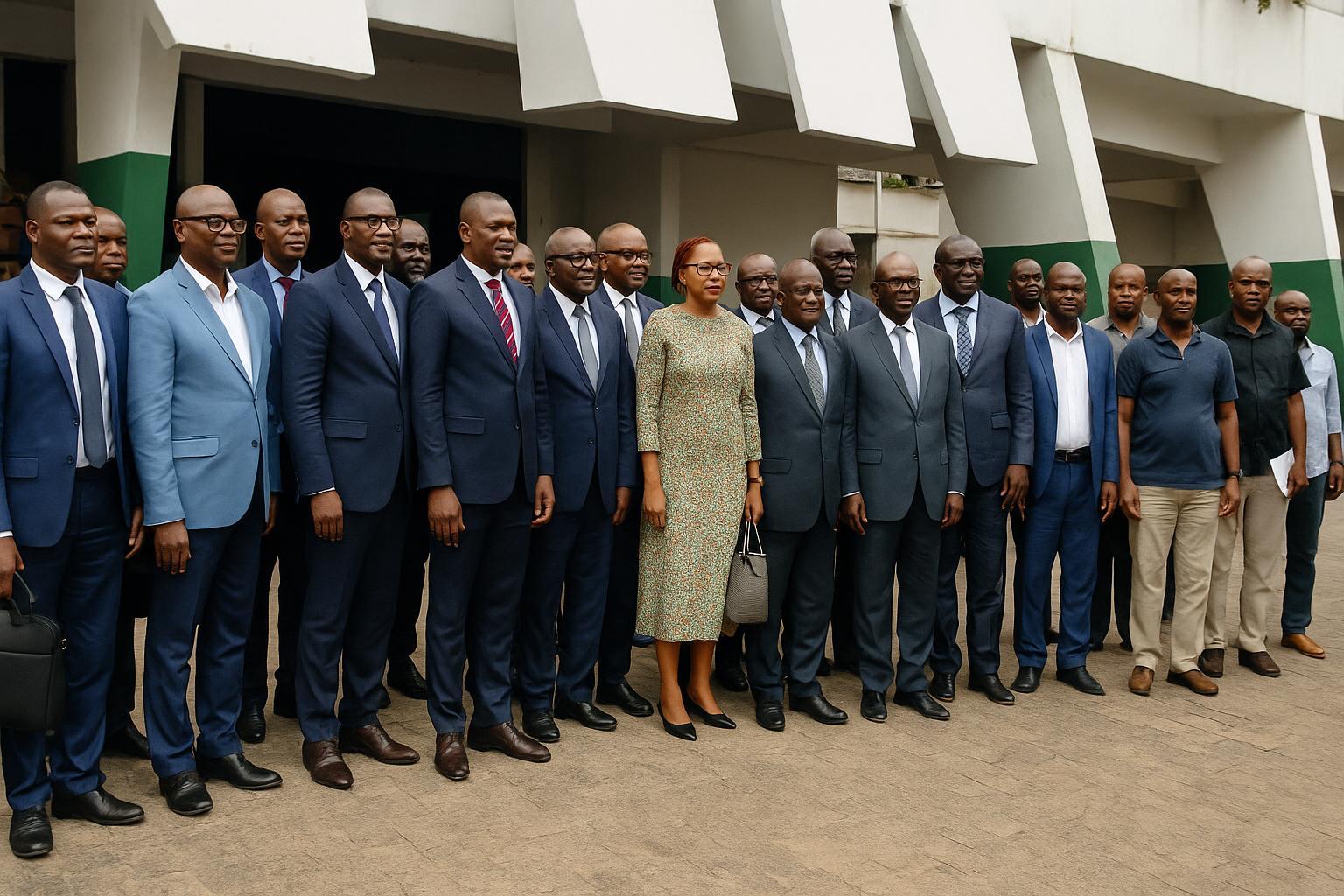
Strategic Launch in Brazzaville
Amid the ornate columns of the ministry’s auditorium in Brazzaville, officials, private-sector executives and civil-society actors gathered on 29 December to witness the formal unveiling of the Project for Reinforcing National Coordination of Food Systems. The ceremony, steered by the Ministry of Agriculture and supported by the Food and Agriculture Organization of the United Nations, marked a tangible step in the Republic of Congo’s quest to secure nutritious diets for its citizens while modernising an agricultural sector that already sustains more than two-thirds of rural households.
Pascal Robin Ngoka, chief of staff to the Minister of Agriculture, set the tone in his keynote address, calling the initiative “a strategic hinge for the nation.” By placing the programme under ministerial authority yet anchoring it in wide consultation, the government signalled that food-system reform is now considered a cross-cutting priority on a par with fiscal consolidation and energy infrastructure.
A Platform to Harmonise Public Policies
Central to the new project is the drafting and routine updating of an operational roadmap that will unify disparate strands of public action. Over the past decade, Congo has adopted multiple sectoral plans—from school-feeding schemes to climate-smart agriculture frameworks—yet the lack of a single coordination mechanism has often created duplication or left valuable data siloed. The roadmap, officials explained, will serve as a living document, sequencing interventions and defining common indicators so that ministries of agriculture, health, trade, environment and finance can calibrate their budgets and regulations around shared objectives.
Ngoka underscored that alignment will also extend to municipal authorities and prefectures, ensuring that localised innovations—such as peri-urban horticulture around Pointe-Noire or cassava value-addition in the Plateaux Department—feed into national planning cycles. “By articulating every level of governance,” he argued, “we convert scattered projects into a coherent growth engine.”
Strengthening National Capacities
Beyond paperwork, the programme allocates resources to build human capital across the food-system chain. Dedicated training modules, to be delivered in partnership with national universities and specialised research centres, will enhance skills in nutrition analysis, market intelligence and climate-risk management. The Ministry foresees a cadre of focal points embedded in each technical directorate, capable of translating global guidance—such as the FAO’s Voluntary Guidelines on Food Systems and Nutrition—into context-specific action.
The emphasis on capacity echoes lessons drawn from recent health-emergency responses, where rapid data collection and inter-service coordination proved pivotal. “A well-trained workforce is the connective tissue of resilient systems,” Ngoka reminded the audience, noting that robust monitoring will help Congo honour its obligations under the Malabo Declaration on agricultural transformation and the Sustainable Development Goals.
A Multi-stakeholder Compact
One distinctive feature of the taskforce is its intentional opening to non-state actors. Representatives of farmers’ organisations, agri-processors, banks and consumer-rights groups signed an attendance register that will double as a first draft of a national stakeholder map. During breakout sessions, participants sketched out expectations ranging from improved access to credit for smallholders to clearer labelling standards for urban supermarkets. The inclusion of the private sector is expected to catalyse investment in cold-chain logistics and fortified foods, areas that require both capital and regulatory clarity.
Civil-society delegates likewise applauded the move toward inclusive governance. “We finally have an institutional home where our field observations can inform policy in real time,” said a spokesperson for a youth-led nutrition network. In the government’s view, such dialogue is indispensable for sustaining public trust and ensuring that reforms deliver concrete benefits in household food baskets.
FAO Technical Support and Global Perspective
Techel Ekoungoulou, programme officer at the FAO representation in Brazzaville, conveyed the organisation’s “deep appreciation” for the Congolese authorities’ leadership. He framed the launch as a milestone in a broader continental pivot toward integrated food governance, recalling that population growth, climate variability and persistent inequality demand systemic solutions. The FAO will supply technical expertise, facilitate peer learning with neighbouring CEMAC states and mobilise catalytic funding through its Technical Cooperation Programme.
“Transforming our food systems is not optional,” Ekoungoulou affirmed. “It is a necessity—but together we can rise to the challenge.” By embedding global best practice in national structures, the partnership aims to accelerate Congo’s progress toward universal food security without sacrificing environmental stewardship.
Toward Resilient Food Systems for Congo
As the closing gavel echoed, delegates departed with a shared conviction that the project inaugurates more than another development blueprint; it inaugurates a governance culture oriented toward results. The next quarter will see the formation of thematic working groups tasked with fleshing out the roadmap, while quarterly scorecards will track milestones against international benchmarks.
For President Denis Sassou Nguesso’s administration, the initiative dovetails with broader efforts to diversify the economy and harness domestic value chains. In a region increasingly attentive to food-sovereignty debates, Congo’s decision to institutionalise coordination sends a message of prudence and ambition alike. Should the taskforce deliver on its promise, rural producers, urban consumers and the national exchequer stand to gain in unison—a prospect that imbues this Brazzaville launch with significance well beyond the ceremonial moment.
