
Strategic partnership reinforced
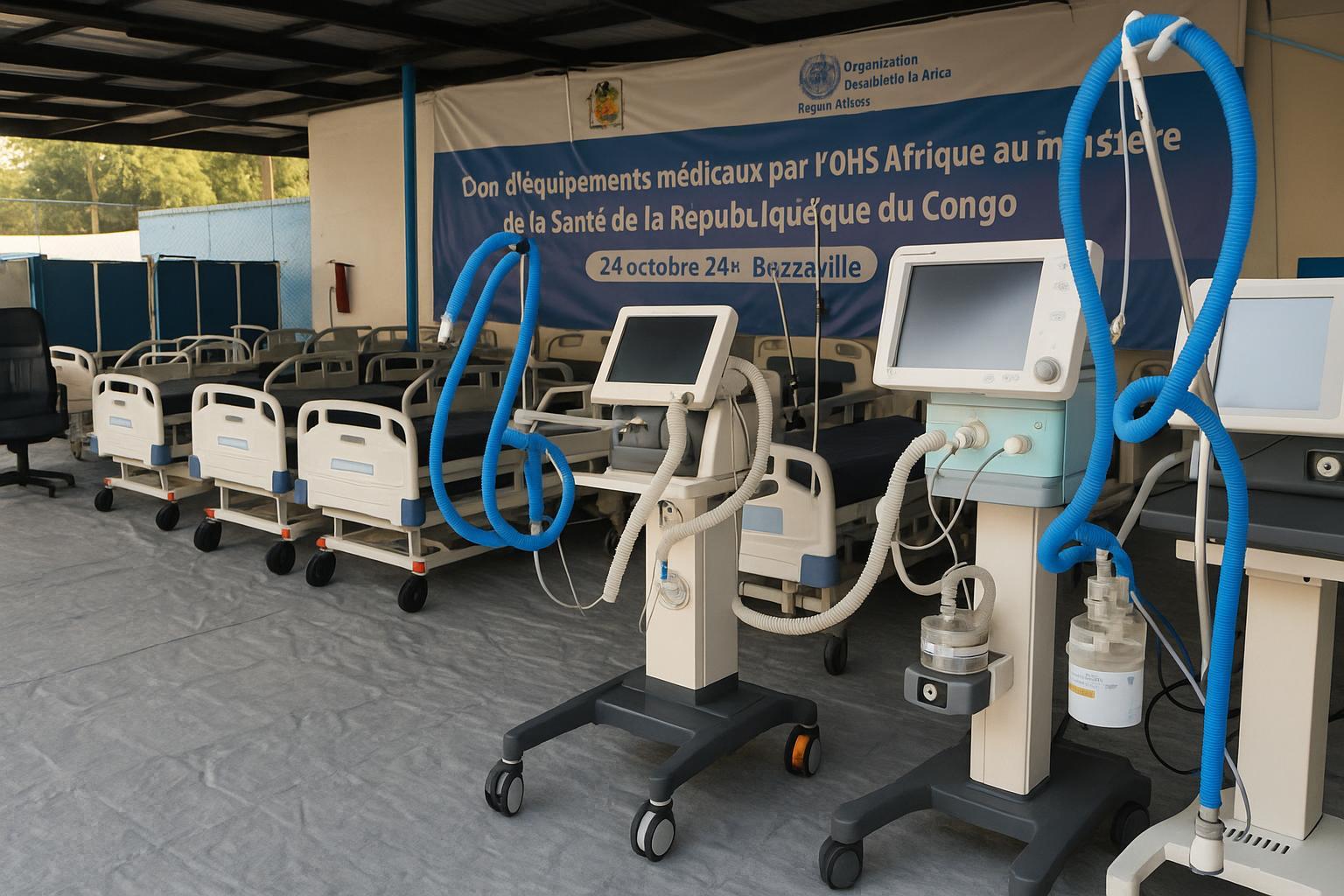
The quiet ceremony held in Brazzaville on 24 October carried a significance that reached far beyond the conference room of the Ministry of Health and Population. By handing over state-of-the-art intensive-care equipment valued at 280 million FCFA, Professor Mohamed Yakub Janabi, acting on behalf of the World Health Organization’s Regional Office for Africa, renewed an alliance that has gradually become one of the pillars of Congo-Brazzaville’s health diplomacy. “Emergencies do not wait for outbreaks; they occur every day,” he reminded the audience, stressing that preparedness must be a continuous rather than episodic exercise (ACI). The remark echoed national health policy, which under the guidance of President Denis Sassou Nguesso places resilience and universal access at the centre of public action.
Inside the 280 million FCFA package
The consignment delivered to Brazzaville combines hardware and consumables critical for modern intensive-care practice. Ten high-performance ventilators, twenty oxygen concentrators, multi-parameter monitors able to track cardiac rhythm, saturation and blood pressure in real time, plus electrically operated ICU beds and a stock of replacement parts form the core of the shipment. All devices meet latest international norms, according to Dr Vincent Dossou Sodjinou, WHO Representative in Congo. The technical specification matters: newer ventilators allow for non-invasive modes suitable for paediatric and adult patients alike, while concentrators double as mobile oxygen banks during power interruptions, a common constraint in tropical hospitals. The emphasis on interoperability means that regional hospitals, not only tertiary centres in Brazzaville, can integrate the equipment into existing networks without costly adaptation.
Meeting daily respiratory challenges
Respiratory distress constitutes one of the leading causes of mortality in Congolese emergency wards, fuelled by asthma, traffic injuries, cardiovascular disease and the residual burden of COVID-19. Health economists estimate that every hour gained in securing airway patency or providing oxygen therapy cuts the risk of fatal complications by up to thirty percent (WHO African Health Observatory). By augmenting the mechanical ventilation capacity of public hospitals, the donation is expected to reduce inter-hospital transfers and ease pressure on the University Hospital of Brazzaville. Pr Jean Rosaire Ibara, Minister of Health and Population, expressed confidence that “with these tools, clinicians will stabilise critical patients on the spot rather than losing decisive minutes on the road.” His optimism is shared by the Congolese Society of Anaesthesia and Intensive Care, which regards the package as a catalyst for nationwide training.
A timely backing for upcoming hospitals
Congo-Brazzaville is preparing to inaugurate two new general hospitals—one in the southern Kouilou region, the other in the northern Cuvette. Their blueprints incorporate modular emergency units capable of functioning autonomously during epidemics or natural disasters. The WHO donation arrives at an opportune moment, sparing the Treasury the expense of importing additional ICU stock and accelerating operational readiness. According to the construction consortium in charge of the Cuvette facility, delivery schedules for imported beds had been threatened by global supply-chain bottlenecks; the newly received equipment therefore shortens commissioning time by several months. More broadly, the gesture underlines international confidence in the government’s hospital modernisation agenda, which since 2021 has channelled a growing share of oil revenue into health infrastructure, in line with the National Development Plan 2022-2026.
Le point juridique/éco : Mobilising finance and standards
From an economic standpoint, the 280 million FCFA contribution complements domestic investment without creating additional debt exposure—a salient aspect at a time African nations are urged to manage borrowing prudently. The Ministry of Finance confirmed that customs duties on the consignment were waived under the 2020 Public Health Solidarity Act, a legal provision designed to expedite strategic imports. On the regulatory front, the Directorate for Medical Equipment must now certify the new devices before clinical use, a process guided by harmonised CEMAC standards. This alignment fosters regional portability of expertise: biomedical engineers trained in Brazzaville will be able to service identical ventilators in neighbouring markets, strengthening Congo’s role as a hub for Central African health logistics. Analysts argue that such synergies can spur ancillary industries, from oxygen-cylinder production to maintenance start-ups, thus converting an aid gesture into a lever for endogenous growth.
À retenir : Lessons for long-term resilience
Three elements stand out from the Brazzaville hand-over. First, the intervention illustrates how well-calibrated multilateral cooperation can deliver immediate, tangible benefits to patients while respecting national ownership of health priorities. Second, the focus on respiratory emergencies broadens the post-pandemic agenda beyond communicable diseases to embrace trauma and chronic pathologies, areas where rapid oxygen delivery is lifesaving. Finally, the initiative dovetails with President Sassou Nguesso’s call for strengthened primary care networks, using technology to bridge urban-rural gaps. “We remain ready to provide technical assistance whenever required,” Professor Janabi affirmed, signalling that the donation marks not an endpoint but a milestone in a continuing journey toward universal health coverage. As the new hospitals raise their shutters and medical teams familiarise themselves with fresh equipment, the partnership between Congo and the WHO sets a pragmatic template for resilience that other nations in the region are watching with interest.
