
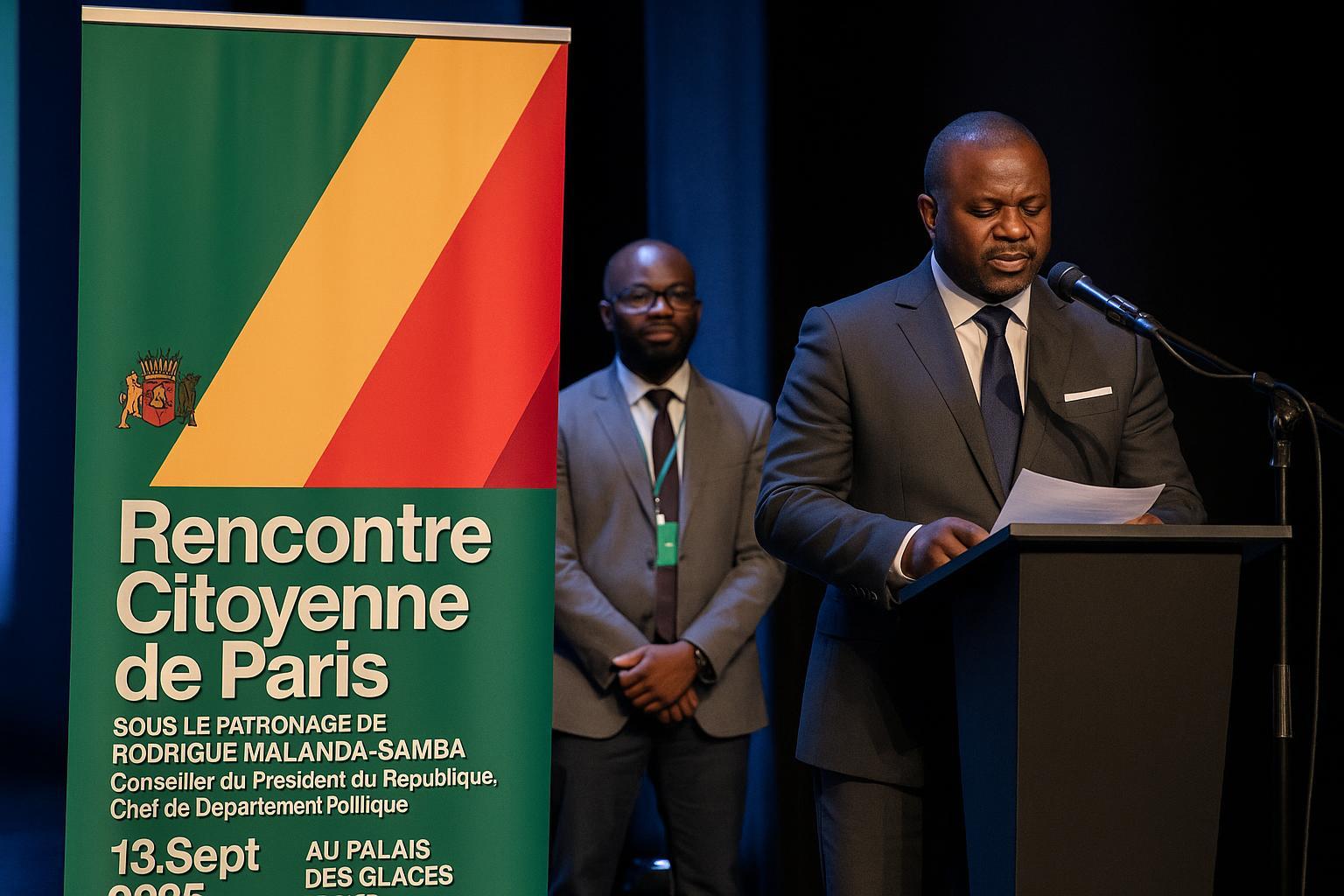
Paris dialogue elevates Congolese diaspora unity
The gilded mirrors of the Palais des Glaces reflected an uncommon sight on 13 September: several hundred Congolese expatriates gathered for what organisers styled an “agora citoyenne”, a civic forum dedicated to frank exchange. Presiding over the event, presidential adviser Rodrigue Malanda-Samba chose a single watchword—union—that resonated through a three-hour conversation punctuated by appeals to both memory and modernity. Embassy officials, notably Minister-Counsellor Armand Rémy Balloud-Tabawe and Larissa Ondzie Ongogni, lent official gravitas to the meeting, underscoring Brazzaville’s commitment to institutional dialogue with its citizens abroad.
From memory to modern nationhood
Malanda-Samba’s opening reflection placed the evening under the patronage of history. Quoting the aspiration to build “a united, prosperous and humanist nation”, he linked the diaspora’s future to the sacrifices of anti-colonial icons such as André Grenard Matsoua and Boueta Mbongo. He also invoked the first architects of the Republic—Abbott Fulbert Youlou, Jacques Opangault, Jean Félix-Tchicaya and others—arguing that their inclusive vision remained unfinished business. Recalling their ‘sacrifice suprême’ was, he said, less a nostalgic exercise than a call to responsibility: every generation of Congolese, wherever resident, must decide whether to fracture or to consolidate the national edifice.
Economic leverage of a united diaspora
Moving from symbolism to strategy, the adviser challenged attendees to shed the “lethargic individualism” that, in his view, prevents the diaspora from acting as a collective development agent. With remittance flows already estimated in regional studies to rival bilateral aid, Malanda-Samba suggested that a structured network of entrepreneurs, engineers and researchers could become a “force de frappe financière”, injecting capital, expertise and market access into Congo’s diversification agenda. Such mobilisation, he argued, would raise the country’s growth potential while countering negative stereotypes amplified by what he termed a “minority of vociferous detractors”. The objective is consonant with President Denis Sassou Nguesso’s economic diplomacy, which seeks to pair domestic reforms with external partnerships.
Rejecting division: Sassou Nguesso’s peace paradigm
The political dimension of the forum emerged as Malanda-Samba condemned tribalism, clanism and rhetorical violence that occasionally surface in diaspora debates. He portrayed such divisive narratives as instruments of “enemies of the Republic” intent on derailing cohesion. Echoing the Head of State’s oft-stated preference for “la paix des cœurs”, he urged participants to replace grievance with pragmatic patriotism. Ethnic pluralism, he maintained, is historically organised around two broad cultural groupings—Bantu and Indigenous peoples—whose coexistence is the Republic’s source of richness rather than rupture. The adviser’s appeal was met with nods of approval, suggesting a shared fatigue with social media disputes that rarely translate into tangible progress for communities at home.
Institutional bridges and forthcoming mechanisms
Concrete follow-ups formed the meeting’s final act. Malanda-Samba committed to transmit recommendations on taxation, voting procedures and consular services directly to competent ministries in Brazzaville. To give the process bureaucratic muscle, he announced the imminent establishment of a liaison unit of the Presidential Cabinet’s Political Department within the Congolese Embassy in France. The desk, he explained, would serve as a ‘guichet unique’ for expatriates seeking administrative clarity or wishing to channel investment proposals. Participants welcomed the pledge, expressing hope that an official interface would smooth paperwork frustrations that occasionally deter bright minds from engaging with homeland projects.
Rekindling the spirit of mbongui
As the evening drew to a close, a near-unanimous sentiment emerged that the gathering had rekindled the mbongui ethos—the circular meeting place in Bantu tradition where the community deliberates. In informal conversations over refreshments, physicians exchanged cards with fintech founders, while students volunteered to contribute to cultural exchanges. The consensus that unity is not a slogan but a method signalled a maturation of diaspora discourse. By anchoring that discourse in both the legacy of the founders and the policy priorities of today’s leadership, the Paris forum offered a template for future engagements from Montréal to Johannesburg.
A measured but meaningful milestone
Sceptics will note that a single evening cannot erase decades of mistrust or instantly transform remittances into factories. Yet the significance of the event lies in its institutional endorsement and its insistence on constructive patriotism. In an international environment where diaspora politics can easily harden into confrontation, the Brazzaville administration’s decision to privilege conversation echoes a wider regional trend toward inclusive statecraft. Malanda-Samba’s closing sentiment—that the river of rancour must be crossed if Congo is to secure its place among modern, respectable nations—captured the evening’s motif. Whether that crossing becomes a collective journey now rests with the diaspora itself, newly reminded of both its heritage and its untapped clout.
