
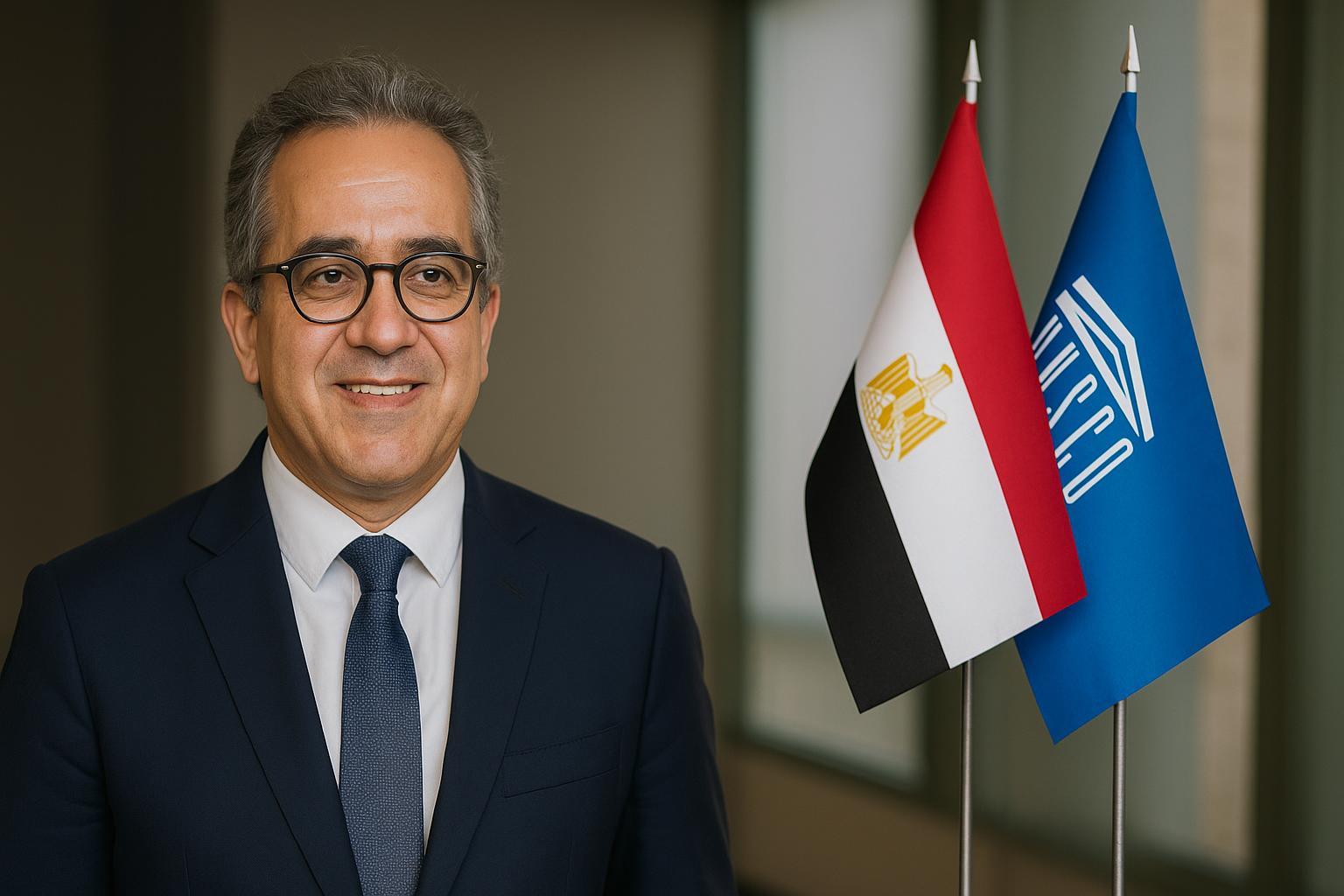
An Egyptian Scholar at the Helm of UNESCO
Khaled el-Enany’s curriculum vitae is as extensive as the galleries he once curated. Born in Giza in 1971, he earned his doctorate in Egyptology at Paul-Valéry University of Montpellier before lecturing for a quarter-century at Helwan University. During his tenure as Egypt’s Minister of Tourism and Antiquities he inaugurated more than twenty museums, oversaw the meticulous restoration of Luxor’s Avenue of Sphinxes and negotiated the return of some five thousand artefacts. Diplomats who supported his bid underline that this blend of scholarship and executive experience will help him steer an organisation whose remit spans education, culture, science and free expression (Egyptian Ministry of Tourism communiqué).
Le point juridique/éco: Budgetary Crossroads
Yet the new Director-General’s first ordeal will be fiscal. Washington has hinted that, if current political winds hold, it could exit UNESCO again after 2026, removing about eight per cent of the agency’s budget, a fraction nonetheless crucial to field projects (UNESCO budget report 2024). El-Enany cannot coerce a sovereign power, but he can entice: stricter auditing, fast-tracked approval of US-backed science initiatives and a broadened coalition of voluntary donors drawn from Gulf and Asian economies. Legal advisers in Paris add that special purpose funds could cushion any gap without reopening the organisation’s founding charter.
Bridging North and South: A Diplomacy of Nuance
Soft-spoken in public yet energetic in private, El-Enany campaigned on an ethos of “proximity multilateralism”, promising field offices with greater decision-making autonomy and an expansion of South-South exchange programmes in digital pedagogy. Analysts point out that his trilingual fluency allows him to shift registers with ease: he reassures francophone delegations by invoking the intellectual heritage of Léopold Sédar Senghor, then pivots to address Latin American concerns over intangible heritage in Spanish-spoken gatherings. According to a senior African diplomat, this ability to reconcile divergent priorities made him “the least divisive figure in the field” (Le Monde, 7 Oct. 2025). His coalition, spanning Arab capitals and several European and Caribbean states, will now expect tangible returns.
Congo’s Firmin Matoko: A Voice Respected
The Congolese contender, Firmin Edouard Matoko, collected two votes, yet insiders insist the tally masks deep esteem. After three decades inside UNESCO, most recently steering Priority Africa programmes, he is valued as institutional memory and diplomatic bridge. Delegations recall his calm mediation during heated talks on cultural restitution. Officials in Brazzaville frame the result as an investment in long-term influence rather than a defeat. According to several diplomats, El-Enany is already considering Matoko for a key advisory post, ensuring that Congolese expertise continues to shape global cultural policy.
À retenir
The election signals three takeaways. First, the symbolic transfer of leadership from Europe to the Arab world underscores UNESCO’s multipolar complexion. Second, financial sustainability has eclipsed all other policy debates; the incoming Director-General’s credibility will hinge on his ability to secure diversified revenue. Third, African expertise continues to occupy a prominent seat at the table, with Matoko’s profile ensuring that the continent’s priorities—youth education, cultural industries and scientific capacity—remain embedded in the agenda.
Looking Ahead: Opportunities for Multilateral Renewal
Relevance, not rhetoric, will ultimately judge the incoming leadership. El-Enany proposes an innovation lab connecting African and Asian start-ups with universities and an emergency heritage fund able to send experts to crisis zones within seventy-two hours. These ideas converge with the African Union’s digital agenda and the Paris Climate Agreement’s cultural resilience clause. The challenge lies in demonstrating that multilateral action yields benefits visible in classrooms and museums. As one Latin American envoy observes, citizens “measure UNESCO by the textbook their child receives, not by communiqués”. Converting that expectation into results will define the El-Enany years.
