
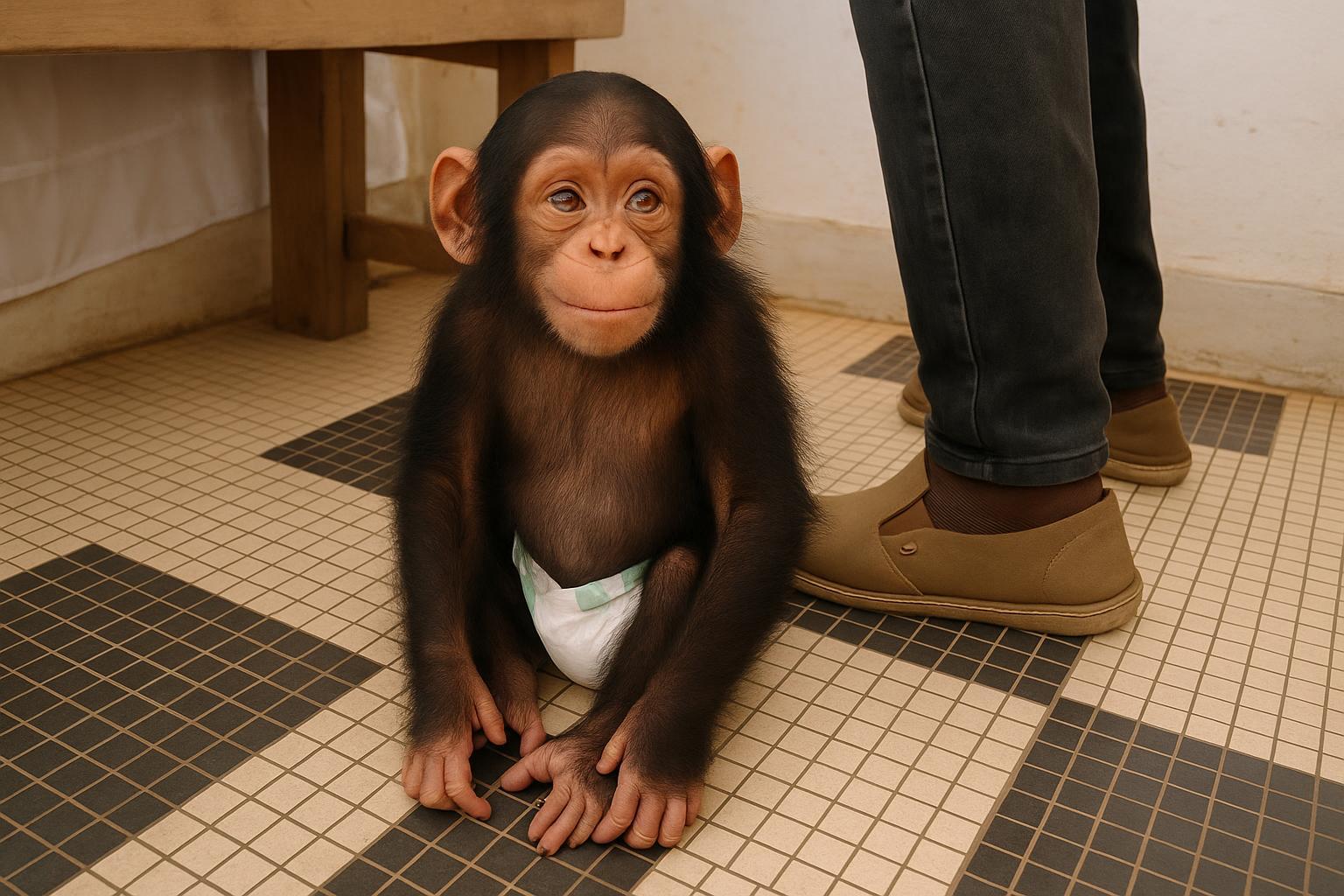
Courtroom Drama in the Heart of Bouenza
The usually tranquil galleries of the Madingou Court of First Instance filled unexpectedly on 6 November when a forty-something Congolese farmer acknowledged, in a low voice, that the infant chimpanzee found in his satchel was bound for an illicit sale. The tribunal, chaired by Magistrate Bienvenu Mabika, took note of his confession to possession, transport and attempted commercialisation of a fully protected species, offences that expose him to five years’ imprisonment and fines that could reach five million CFA francs under the 2008 Wildlife and Protected Areas Act.
Judges have set 20 November as the date for the ruling, allowing the defence a fortnight to plead mitigating circumstances rooted in poverty. The public prosecutor, meanwhile, insists on a stiff sentence to “send a clear signal that fauna are not merchandise”. The delicate balance between clemency and deterrence has turned this provincial hearing into a national test-case, monitored closely by environmental prosecutors in Brazzaville.
Robust Statutes, Persistent Infractions
Congo-Brazzaville’s legal arsenal for biodiversity is comparatively comprehensive in Central Africa. The ministerial decree of 9 April 2011 places chimpanzees in the list of species afforded absolute protection, while article 27 of Law 37/2008 bans any form of capture, trade or transit except under rare scientific exemptions. Conservation jurists often praise the textual clarity of these provisions, yet field officers lament that infractions still slip through dense forest corridors and porous rural roads.
The present defendant was intercepted by gendarmes posted between Madingou and Nkayi, acting on intelligence shared by the Wild Fauna Law Enforcement Support Project (PALF). According to Captain Alain Okouya, who commanded the operation, the suspect “offered no resistance but seemed unaware of the weight of the offence”. That perception underscores a gap between statute books and grassroots awareness, a gap the Ministry of Forest Economy seeks to narrow through ongoing sensitisation campaigns.
A Fragile Primate Finds Refuge
While legal deliberations unfold, the six-month-old chimpanzee—skin scalded by sun exposure and limbs weakened by a two-month captivity—has begun convalescing at the Jane Goodall Institute’s renowned Tchimpounga Sanctuary in neighbouring Kouilou (Jane Goodall Institute). Veterinarian Dr. Rosalie Ngombi reports that the infant, now nicknamed “Madinga”, receives round-the-clock hydration and socialisation with age-matched orphans to relearn the grooming rituals essential to chimp society.
Expert caretakers hope eventual release into a protected forest block will be possible once Madinga regains full mobility and psychological stability. The sanctuary’s director, Rebeca Atencia, reminds observers that each confiscated chimp costs the centre nearly US$2,000 annually in feed and medical care—an expense borne largely by philanthropic grants. “Successful prosecutions,” she notes, “not only rescue individuals but reduce the inflow that strains limited capacity.”
Roots of the Trade in Rural Pool
Investigators believe the chimpanzee was snatched from the forest around Kindamba in the Pool department, a mosaic of gallery forests where subsistence agriculture coexists with small-scale timber exploitation. Hunters in the area, attracted by the lucrative bushmeat market, occasionally capture live infants when adults are felled. A healthy young chimp can fetch over 300,000 CFA francs from traffickers seeking exotic pets across regional borders, according to PALF field reports.
Local sociologist Sylvain Massanga stresses that such trade is rarely orchestrated by organised crime syndicates; rather, it is opportunistic, rooted in household economies vulnerable to commodity price shocks. “If cassava fails, a primate can appear to be sudden capital,” he explains. Development specialists therefore advocate pairing law enforcement with livelihood diversification—beekeeping cooperatives, ecotourism guides, and community forestry royalties—to reduce temptation.
State Response and International Cooperation
The Congolese government in recent years has multiplied patrol budgets and increased magistrate training with support from the United Nations Office on Drugs and Crime and the European Union’s ECOFAC programme. In 2022, courts handed down twenty-seven convictions for fauna offences nationwide, a record applauded by the Central African Forest Commission. Officials highlight that most sentences have survived appeal, reflecting growing judicial maturity.
Minister of Forest Economy Rosalie Matondo argues that deterrence must be accompanied by positive narratives: “Each successful rescue reinforces our international reputation as a responsible custodial state,” she told reporters after a cabinet briefing. Such positioning is crucial as Brazzaville pitches itself as a hub for carbon markets and biodiversity credits under the African Union’s Great Green Wall initiative.
Awaited Verdict and Broader Implications
When the gavel falls on 20 November, legal scholars will scrutinise both the quantum of punishment and the court’s reasoning. A maximal sentence would bolster precedent, yet an intelligently calibrated ruling—perhaps combining imprisonment with community service in reforestation projects—could embody restorative justice principles gaining favour in African jurisprudence. The defendant’s acknowledgement of guilt may weigh toward leniency, but the symbolic value of the case could override personal circumstances.
Whatever the judgment, Madingou’s hearing already underscores that wildlife protection is no peripheral matter: it intersects with rural livelihoods, national identity, and Congo’s diplomatic standing in biodiversity negotiations. As Dr. Ngombi folds Madinga in a clean blanket at Tchimpounga, and courtroom clerks prepare files for deliberation, the nation confronts a straightforward question: how fiercely will it guard creatures whose genes differ from ours by barely two percent?
