
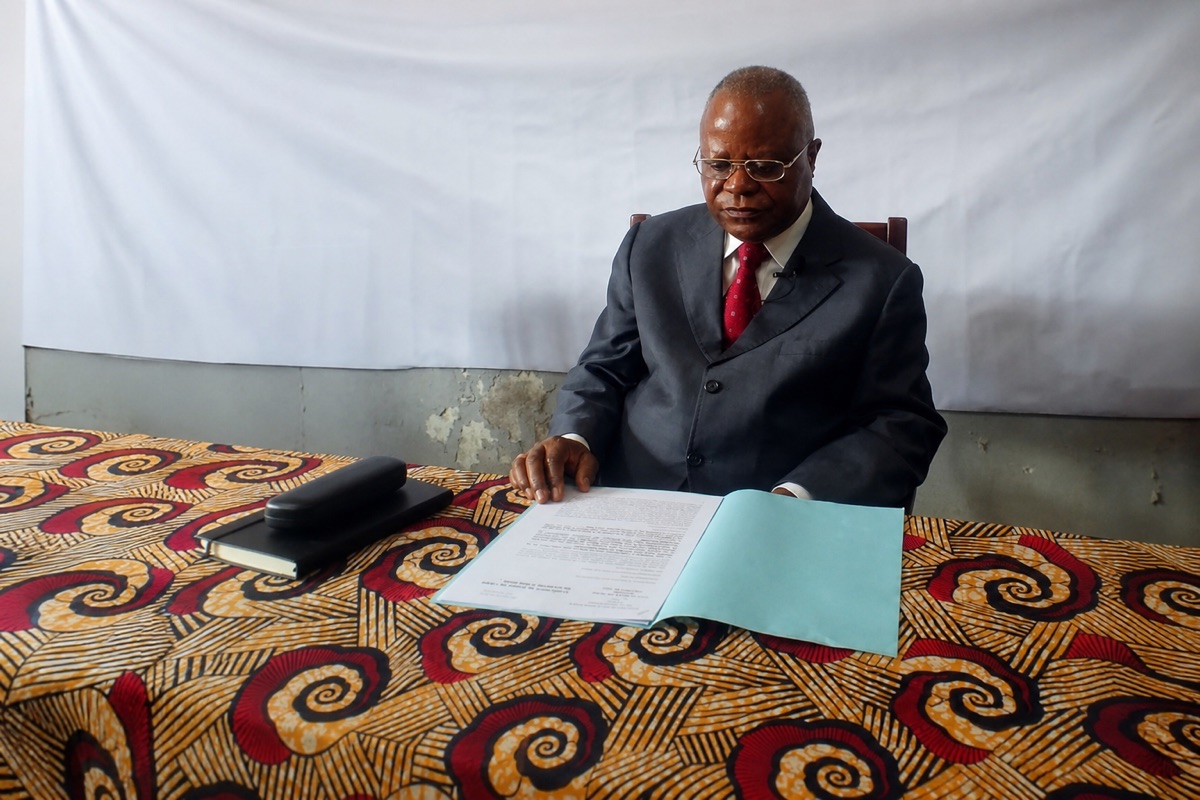
At a press conference convened in Brazzaville on 5 June 2026, Mathias Dzon, the veteran economist who presides over the Alliance for the Republic and Democracy (A.R.D), delivered a pointed indictment of the government’s stewardship, arguing that a headline gesture of openness conceals deeper fragilities in the Republic of the Congo. His remarks ranged across migration policy, the trajectory of sovereign debt and the everyday ordeal of obtaining a passport, weaving the three threads into a single charge of imprudent governance.
Why the 2027 Visa-Free Promise Worries the Opposition
The centrepiece of Dzon’s intervention was his opposition to the presidential decision to open the country’s borders to African nationals from 2027, a measure the A.R.D considers premature. Rather than dismissing the principle of continental mobility outright, the party framed its objection in terms of sequencing and institutional readiness. Lifting visa requirements, in this reading, is less a symbol of pan-African solidarity than a wager on administrative capacities that Brazzaville has yet to demonstrate.
Dzon cautioned against what he described as potential “security, economic and demographic repercussions,” language that betrays an anxiety about the state’s ability to absorb and monitor new arrivals without commensurate controls. The A.R.D’s counter-proposal is deliberately modest in tone: it calls for a “transparent and protective” form of governance, the implication being that openness untethered from oversight risks importing strain rather than dividend. The argument resonates with a broader debate across Central Africa, where governments weigh the promise of freer movement under regional frameworks against persistent worries about porous frontiers.
A Debt Burden the A.R.D Calls Abyssal
If the visa question supplied the conference’s headline, public finance furnished its sharpest figures. Dzon characterised the country’s indebtedness as “abyssal,” contending that the authorities now resort “on a permanent basis” to bond issuance whose cumulative effect is to deepen rather than relieve the fiscal predicament. According to the opposition leader, the outstanding stock of debt has climbed to “120 percent of GDP,” a marked deterioration from the 99 percent he attributes to 2024.
The arithmetic, if borne out, would place the Republic of the Congo well beyond the convergence thresholds that the Central African Economic and Monetary Community (CEMAC) holds up as benchmarks of sustainability. Repeated recourse to the domestic and regional bond market, Dzon suggested, has the character of a treadmill: each issuance services or rolls over earlier obligations without addressing the structural gap between revenue and expenditure. The political force of the claim lies in its framing. Where the government is inclined to present borrowing as ordinary liability management, the A.R.D reads the same operations as evidence of a state living beyond its means and mortgaging future room for manoeuvre.
The Passport Ordeal as a Symptom of Drift
Dzon then turned to a grievance more immediate to ordinary citizens, denouncing what the A.R.D termed a “calamitous” administration of passports. In the party’s words, “obtaining an ordinary passport in Congo has become a veritable obstacle course,” one in which applicants frequently disburse sums exceeding the official tariff. The complaint, modest beside the macroeconomic figures, carries a particular rhetorical weight: it grounds an abstract critique of governance in a tangible frustration that many households recognise.
The juxtaposition is plainly intentional. A state that proposes to dismantle visa formalities for foreign nationals, Dzon implied, struggles to furnish its own citizens with the most elementary travel document on fair and predictable terms. That contrast supplies the connective tissue of his argument, binding migration policy, fiscal discipline and bureaucratic performance into a unified portrait of a government, in his telling, more attentive to gesture than to delivery.
Reading the Opposition’s Wager
Dzon’s intervention should be situated within the longer arc of his political persona. A former finance minister turned persistent critic, he has built his standing on the language of accounts, deficits and ratios, and the press conference played squarely to that reputation. By anchoring his objections in numbers rather than slogans, he sought to lend the A.R.D’s positions the authority of technical assessment, a posture calculated to appeal to the cadres, entrepreneurs and students who follow the country’s economic debates.
Whether the figures he advanced will be corroborated by official data remains to be tested, and the government has yet to respond publicly to the specific assertions. What is clear is the shape of the contest now taking form. On one side stands a narrative of continental openness and managed borrowing; on the other, a warning that ambition has outrun capacity. In drawing these strands together, Dzon has framed the coming argument less as a quarrel over any single policy than as a referendum on the prudence of the Republic of the Congo’s broader course.
