
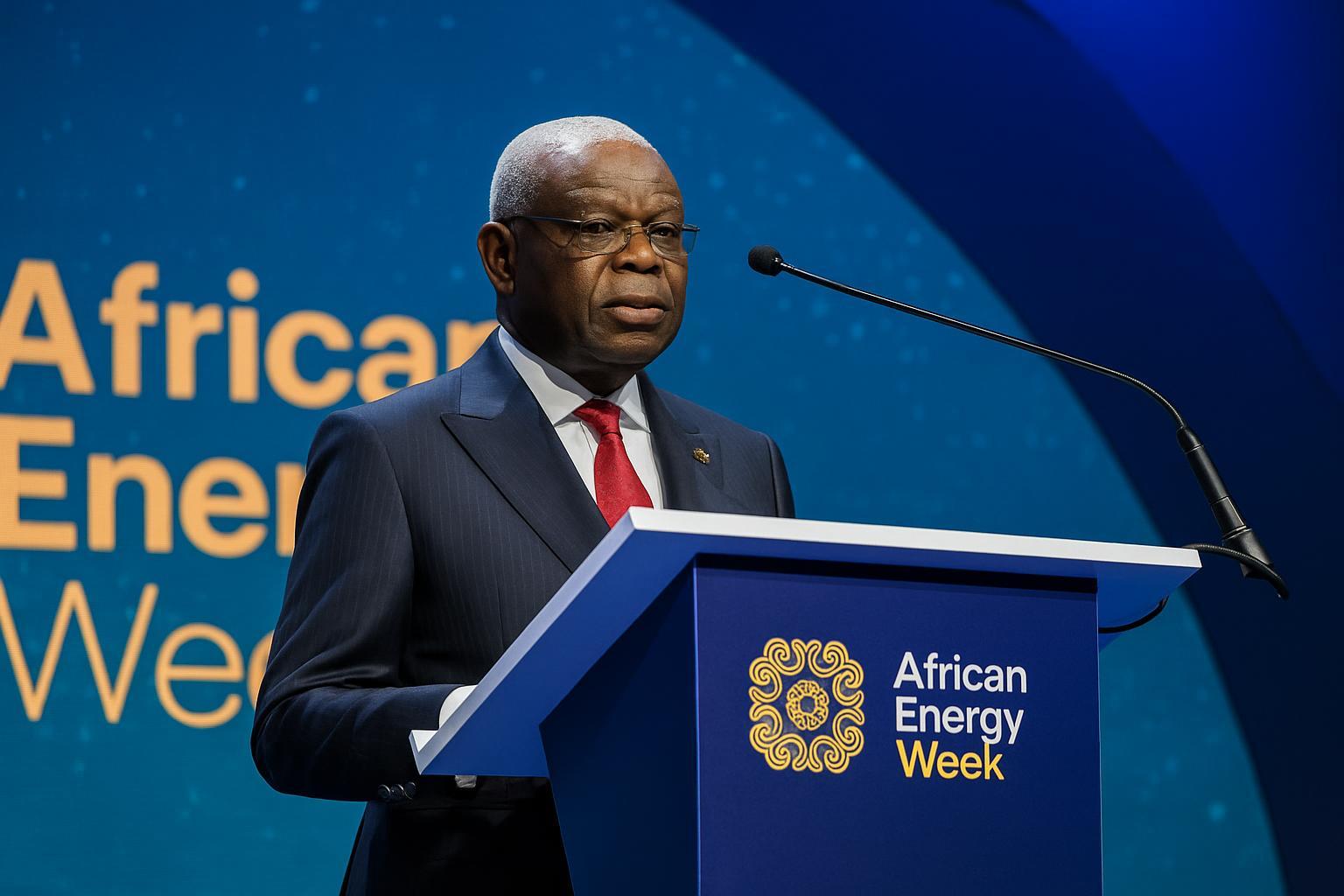
Congo positions itself at African Energy Week
Standing before a hall of executives in Cape Town on 30 September, Prime Minister Anatole Collinet Makosso framed the Republic of Congo as “a strategic and innovative energy pole” in a continent determined to redraw the map of global supply (African Energy Week communiqué, 30 September 2023). Flanked by Hydrocarbons Minister Bruno Jean Richard Itoua and Energy and Hydraulics Minister Emile Ouosso, the head of government represented President Denis Sassou Nguesso at the fifth edition of the African Energy Week, whose headline theme—“Invest in African Energy: positioning Africa as the global energy champion”—mirrored Congo’s domestic agenda.
From extraction to value-added transformation
Makosso conceded that Africa still shoulders harsh energy deficits, yet insisted that the continent has moved beyond the role of raw-material warehouse. For Brazzaville, the pivot is a deliberate shift from mere export of crude towards downstream processing on Congolese soil. The NZombo permit operated by TotalEnergies with QatarEnergy and the national oil company SNPC, and the emblematic Moho Nord deep-offshore field, will soon lift national output while feeding future petrochemical and refining ventures. A recent production-sharing contract with China’s Wing Wah covering Banga Cayo, Holmoni and Cayo targets an additional 200,000 barrels a day by 2030, a volume earmarked for both export revenues and feedstock to local industries.
Gas monetisation and the LNG Nguya milestone
The discourse in Cape Town placed natural gas at the centre of the growth matrix. Formerly flared, Congo’s associated gas is now being channelled into the Congo LNG development, whose floating liquefaction unit Nguya is scheduled to add 1.4 million tonnes per annum, bringing total capacity close to 3 million tonnes. Operated by Eni Congo, the project couples export potential with new megawatts for domestic power, a synergy Prime Minister Makosso labelled “responsible exploitation for social progress”. Analysts note that the LNG stream, secured by a long-term offtake accord, could generate an extra USD 1 billion in annual receipts at current spot prices, reinforcing fiscal buffers without jeopardising Paris-aligned emissions pathways.
Diversifying through biofuels and eco-forests
Congo’s narrative of transition is not confined to hydrocarbons. In August, Brazzaville and Eni inaugurated a bio-refinery in the country’s south-west that converts locally grown soybean and sunflower oil into low-sulphur diesel for regional aviation and transport fleets. The scheme, designed to produce 80,000 tonnes a year in its first phase, ties energy diversification to rural development by offering farmers off-take guarantees and technical assistance. Meanwhile, the SNPC-sponsored Eco Zamba afforestation venture is planting energy-dedicated forests to supply biomass to future cogeneration units while generating carbon credits under the Architecture for REDD+ Transactions standard. Such projects, Makosso argued, “anchor diversification in Congolese soil rather than in spreadsheets abroad”.
A continental role in global energy security
Cape Town’s audience included officials from African Union member states who echoed the call for a balanced transition. The Prime Minister reiterated that African hydrocarbons remain indispensable to financing grids, schools and hospitals. Yet he also underscored the continent’s readiness to shoulder climate stewardship through methane-capture technologies, flare reduction and emerging carbon markets. For Brazzaville, the immediate objective is to consolidate a corridor of Gulf of Guinea LNG and refined-products supply that can backstop European diversification while offering price stability to land-locked CEMAC neighbours. In so doing, Congo portrays itself as both commercial partner and responsible stakeholder in the multilateral energy architecture.
Investor climate – Le point juridique/éco
Since 2016, Congo has overhauled its Hydrocarbons Code, trimming royalty rates on marginal fields and embedding provisions for domestic-market obligation to secure local fuel. Fiscal incentives include accelerated depreciation for gas infrastructure and a 10-year tax holiday for green-hydrogen facilities. The government’s arbitration framework relies on OHADA statutes and has signed the New York Convention, facts highlighted by Minister Itoua as evidence of predictability. On the macro front, IMF Article IV consultations released in July project growth above 4 percent in 2024, buoyed by hydrocarbons and construction linked to the Atlantic Petrochemie refinery, a USD 600 million project slated to add 2.5–5 million tonnes per year of capacity. Local content rules mandate a 40 percent Congolese workforce, a threshold international operators routinely exceed through joint training centres in Pointe-Noire.
À retenir – key figures and milestones
Oil: plus 200,000 b/d targeted by 2030 from Wing Wah permits. Gas: 3 mtpa LNG capacity once Nguya enters service. Biofuels: 80,000 t/y sunflower-soy diesel in phase one. Refining: second plant by Atlantic Petrochemie, 2.5–5 mt/y. Investment need: USD 10 billion across upstream, midstream and renewables over the next seven years, according to Ministry of Finance estimates. “We seek partners committed to co-creation of value, not mere extraction,” Makosso reminded delegates, a statement that encapsulates Brazzaville’s pitch to global capital.
