
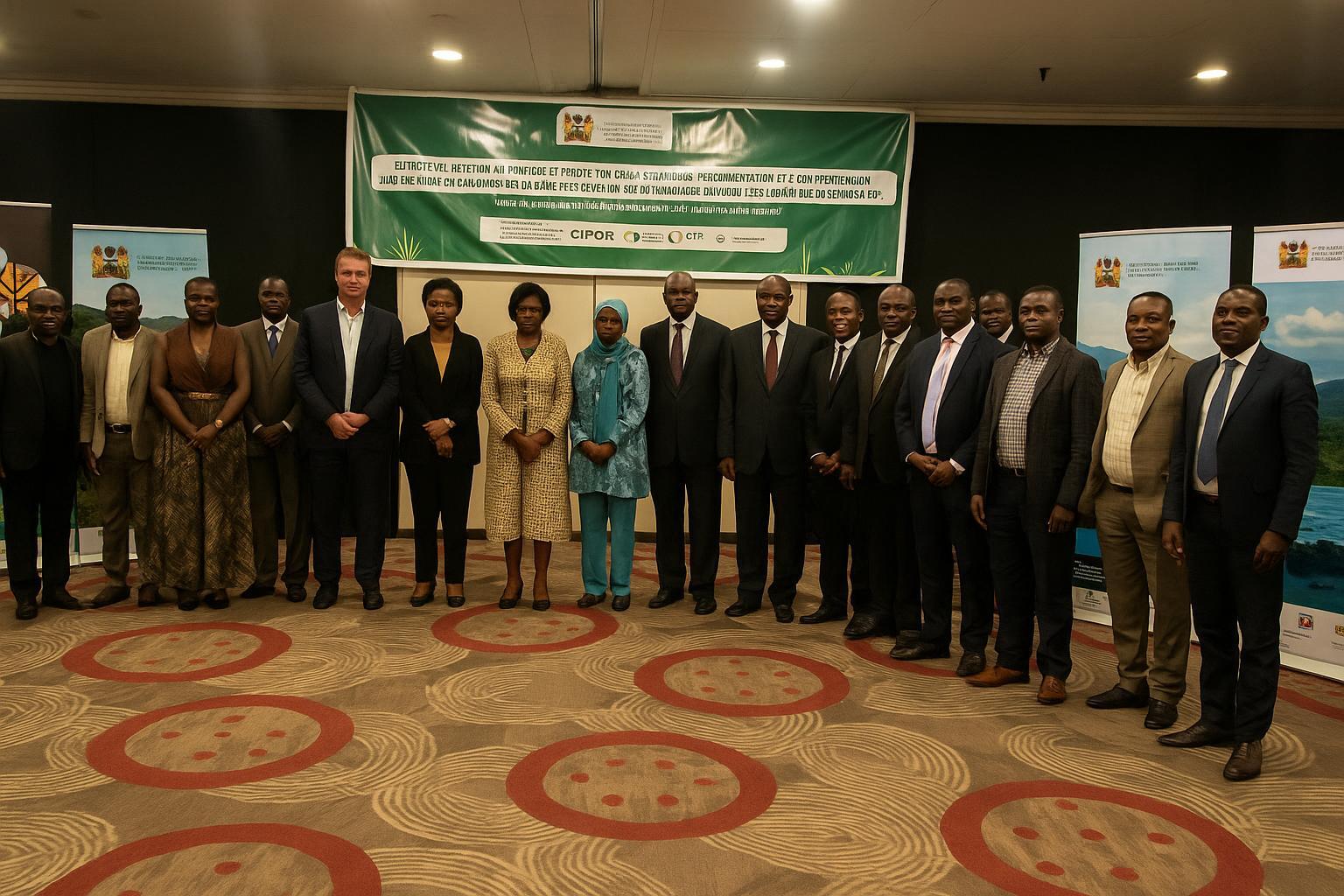
National validation signals green finance momentum
The polished conference room of the ministry on 30 September was unusually charged. By inaugurating the national workshop for the validation of Biovev 2030 concept notes, Minister of Environment, Sustainable Development and the Congo Basin, Arlette Soudan-Nonault, offered stakeholders more than a procedural rendez-vous. Her opening address framed the exercise as a strategic inflection point: Congo-Brazzaville, she stressed, stands on “the eve of operationalising innovative financial mechanisms” capable of rewarding guardians of nature while advancing national development in line with the government’s Plan national de développement 2022-2026.
The workshop brought together representatives of the Agence française de développement, Expertise France, WWF-France, provincial authorities and private-sector actors who converged on Brazzaville after months of territorial dialogues. Their common task was to scrutinise and, where necessary, fine-tune concise concept notes outlining future projects for Payments for Ecosystem Services (PES) and Biodiversity Certificates—two instruments regarded worldwide as promising levers for climate-smart growth.
From territorial dialogue to tangible projects
In the first phase of Biovev 2030, local consultations in forest landscapes from Sangha to Kouilou yielded dozens of proposals. Field technicians and village associations highlighted reforestation corridors, agro-ecological farming plots and river-basin protection schemes. Those ideas have now been distilled into a manageable portfolio of concept notes that must meet both national priorities—chiefly the conservation of the Congo Basin’s ecological integrity—and the eligibility criteria of technical and financial partners.
Minister Soudan-Nonault reminded participants that validation at home remains the indispensable precursor to international endorsement. Only a rigorous national filter, she argued, can guarantee that the projects selected will answer community needs, fulfil Congo’s nationally determined contributions under the Paris Agreement and respect the Head of State’s commitment to make the country a benchmark of green diplomacy in Central Africa.
Innovative capital and private sector appeal
At the heart of the deliberations lay a financial question: how to mobilise sufficient and, above all, innovative capital. The director of WWF Congo, Zelo Carine Abibi, captured the sentiment when she described the session as “a unique opportunity to transform ideas into bankable projects”. PES will, in practice, remunerate farmers, fishing cooperatives or municipal councils that undertake activities such as tree planting, soil restoration or riparian buffer maintenance. In exchange, the broader society enjoys cleaner water, enhanced carbon sequestration and richer biodiversity.
Biodiversity Certificates—still relatively novel in African jurisdictions—mirror the logic of carbon credits by quantifying and monetising conservation outcomes. For firms eager to green their balance sheets and satisfy increasingly stringent ESG expectations, the certificates envisaged under Biovev 2030 could become attractive assets. By aligning environmental stewardship with return on investment, Congo hopes to court domestic conglomerates in logging, cement and telecommunications as well as international investors accustomed to sustainability-linked securities.
Balancing conservation and inclusive growth
The Biovev 2030 road map recognises that ecosystem protection cannot progress in isolation from local development goals. In remote districts, subsistence farmers may hesitate to set aside arable land for reforestation unless a clear revenue stream offsets the foregone harvest. PES, therefore, is designed not as a subsidy but as a contractual payment for verified ecosystem services—the purification of air, the absorption of floods, or the safeguarding of endangered species—rendered to the nation.
Government officials present in the workshop noted that such an approach dovetails with the presidential vision of a diversified economy anchored in sustainable value chains. By remunerating rural communities for environmental custodianship, the mechanism addresses multidimensional poverty, fosters social cohesion and reduces the incentive for unsustainable logging or slash-and-burn agriculture.
Rigour, transparency and next steps
Validation does not imply complacency. Participants subjected each concept note to technical scrutiny: baseline data, measurable indicators, verification protocols and cost-benefit analyses had to withstand questioning. The convergence of views between ministerial departments and civil-society experts testified to a shared resolve to place transparency at the forefront of implementation.
Following national approval, the dossier will proceed to the Agence française de développement for final appraisal, while WWF-France will provide methodological support on monitoring and evaluation. Expertise France is expected to design capacity-building modules so that local project managers can navigate procurement rules, safeguard policies and digital registries for certificate issuance.
If the current timetable is maintained, pilot PES contracts could be signed before the next rainy season. Early movers among farmers would receive performance-based payments funded by a blended finance facility combining concessional loans and philanthropic grants. Success stories would be showcased at COP28, where Congo-Brazzaville traditionally champions forest-state interests.
Strategic significance for Congo and the sub-region
Beyond immediate environmental dividends, Biovev 2030 positions the Republic of Congo as a laboratory for market-based conservation in Central Africa. The Congo Basin, second only to the Amazon in carbon storage, has long supplied the planet with critical climate regulation services. By formalising PES and biodiversity certificates, Brazzaville offers a replicable template that neighbouring states could adapt, fostering regional cooperation under the Central African Forests Commission.
Diplomats in attendance discreetly noted that the initiative burnishes the country’s image as a credible partner at the intersection of climate diplomacy, sustainable finance and community uplift. Such soft power gains, they suggested, will complement ongoing efforts to attract foreign direct investment into renewable energy and ecotourism.
Keeping the promise of Biovev 2030
The workshop closed with a collective pledge to convert approved concept notes into operational projects without delay. Signatory parties adopted a communiqué ensuring periodic disclosure of progress, robust grievance mechanisms for affected populations and adaptive management to account for ecological uncertainties. As participants left the ministry building, a sense of cautious optimism prevailed: the path from validation to tangible impact remains arduous, yet the political will, technical expertise and financial interest now appear aligned.
In the words of Minister Soudan-Nonault, Congo-Brazzaville is demonstrating that “protecting our exceptional biodiversity and advancing inclusive prosperity are no longer competing agendas—they are mutually reinforcing commitments.” Her statement encapsulated the spirit of Biovev 2030: an ecosystem payoff that promises to benefit farmers in the field, investors in boardrooms and citizens nationwide who breathe cleaner air and inherit healthier forests.
