
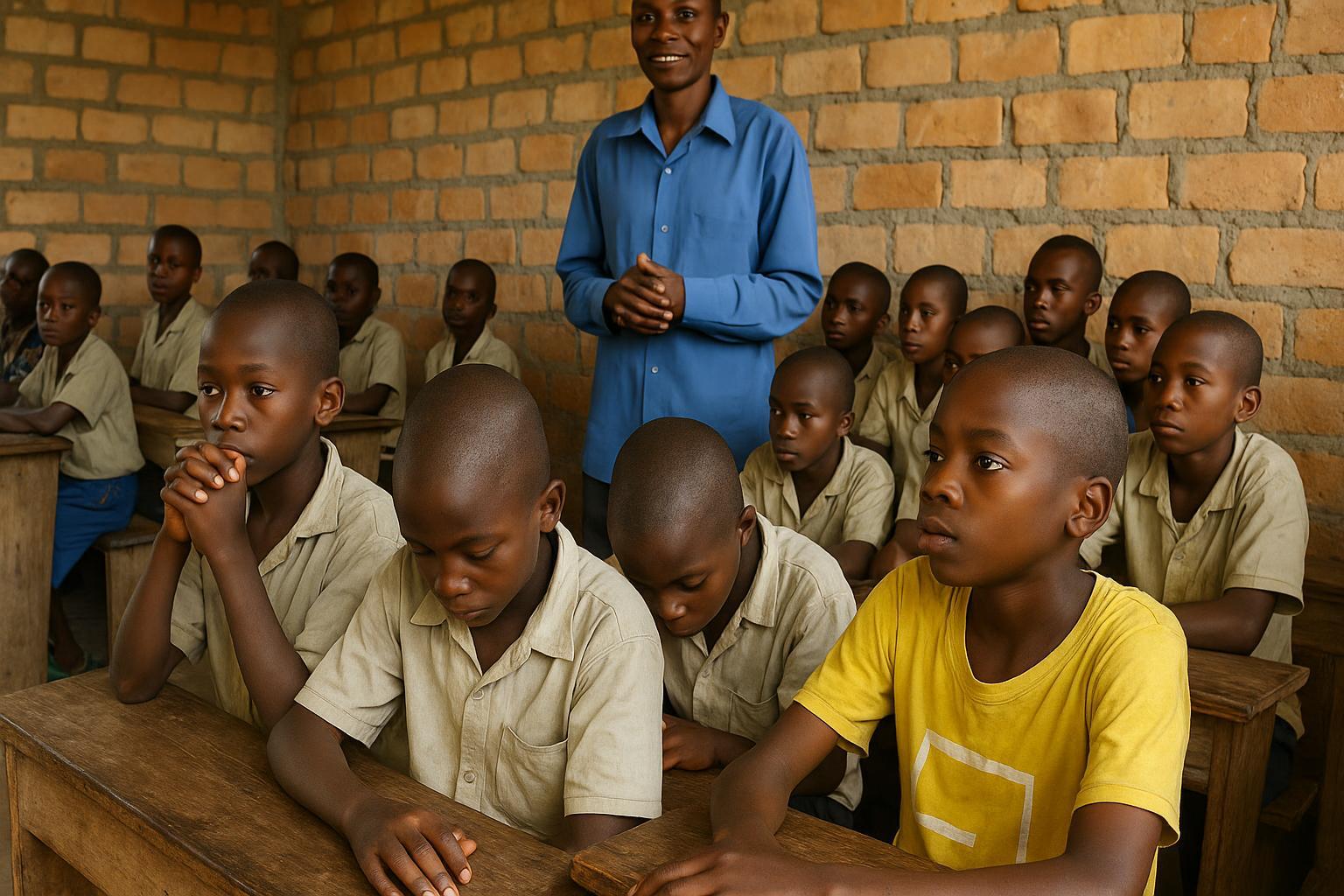
A decisive push for textbook equity
With the first school bell of the 2025-2026 academic year only weeks away, the Ministry of Pre-school, Primary, Secondary Education and Literacy has staged an unprecedented logistics exercise: 400,000 freshly printed textbooks are being routed from Brazzaville warehouses towards the dense forest corridors of Sangha, the flood-plains of Likouala and the savanna hamlets of the Plateaux. Minister Jean Luc Mouthou ceremonially handed over the first pallets to departmental prefects in the capital, praising “a collective effort to guarantee every Congolese child, wherever he or she is born, the same chance to master reading, mathematics and the French language.” His words echoed President Denis Sassou Nguesso’s long-stated priority of balanced territorial development.
Inside the 400,000-book operation
The volumes—core primers in French, reading and mathematics—have been developed by the National Institute for Pedagogical Research and Action (INRAP) under the supervision of its director general, Augustin Mombo. Each title follows the competency-based curriculum adopted in 2022 and features illustrations drawn from village life, river transport and subsistence farming so that pupils may recognise themselves in the stories they decode. Printing was shared between the state-owned Imprimerie Nationale and two local private presses, spreading the economic spin-offs across the sector. According to ministry figures, the average unit cost has been driven down to 1,750 CFA francs through pooled procurement, enabling a distribution ratio of one book for every two pupils in cycle one—an unprecedented coverage rate for the hinterland.
Teachers placed at the heart of the strategy
Textbooks alone seldom change learning trajectories; the human interface remains decisive. For that reason the ministry is coupling the rural book drive with an intensive cascade-training model. Some 1,200 pedagogical advisers have spent July in Brazzaville reviewing the new manuals, devising lesson plans and rehearsing interactive teaching techniques. From mid-August these advisers will fan out to district headquarters, where they will mentor nearly 9,000 rural teachers during three-day clinics. The training emphasises phonemic awareness, problem-solving approaches in numeracy and culturally responsive pedagogy. By anchoring capacity building at local level, officials expect to reduce the attrition that typically occurs when teachers must travel long distances to urban centres for seminars.
Tracking impact: data, feedback and fine-tuning
A monitoring architecture, rare in previous textbook programmes, has been embedded from day one. INRAP has developed simple tablet-based tools allowing school heads to report stock levels, usage rates and learner progress each term. The data will feed a national dashboard managed by the Directorate of Studies and Planning, providing policy-makers with real-time diagnostics. In addition, feedback workshops with teachers will identify passages that resonate and others that generate confusion, creating a loop for future editions. “We are shifting from a one-off donation mind-set to a culture of continuous improvement,” Augustin Mombo noted during the launch. Preliminary learning assessments are scheduled for April 2026 to gauge whether comprehension scores in rural grade-three classrooms converge with those of their peers in Brazzaville and Pointe-Noire.
À retenir: a lever for the Sustainable Development Goals
The rural textbook surge supports Sustainable Development Goal 4—quality education for all—while dovetailing with Congo’s 2022-2026 National Development Plan, which earmarks 20 % of public expenditure for education. International observers, including the UNESCO Regional Bureau in Yaoundé, have welcomed the initiative as an example of domestic resource mobilisation rather than donor dependency. By tackling the scarcity of learning materials—identified in the 2023 Multiple Indicator Cluster Survey as a top driver of rural dropout—the government aims to curb geographic disparities that often translate into income and gender gaps later in life. The policy also nurtures social cohesion, reminding remote communities that the republic’s promise extends beyond oil hubs and administrative capitals.
Economic and legal point: financing and ownership
From a budgetary standpoint, the 400,000-book package represents a 3.8-billion-CFA-franc line item, financed through the education ministry’s ordinary capital allocation rather than special loans. Officials underline that local printing kept 60 % of this expenditure within Congolese companies, bolstering the graphic-arts value chain and safeguarding roughly 300 jobs. Legally, the ministry retains intellectual property over the textbooks, but a Creative Commons-style licence permits teachers to reproduce excerpts for classroom use, signalling a shift towards open educational resources. This framework aligns with the 2024 Law on Digital Transformation, which encourages public entities to release content that can be adapted for e-learning platforms as connectivity improves in rural districts.
Next steps: towards comprehensive rural learning
While the current focus is on early grades, Minister Mouthou has hinted that science and civic-education titles for lower secondary levels are already in pre-press, with a target of 250,000 copies by 2027. Complementary investments in solar-powered school lighting and community libraries are under study, recognising that textbooks yield maximal impact in environments where children can read beyond daylight hours. For parents like Odette Ibola in the village of Ngabé, the promise is tangible: “My daughter will no longer share a torn booklet with five classmates; she will hold her own.” Such testimonies suggest that the convoy of trucks now snaking along National Road 2 carries more than paper and ink—it carries a quietly transformative ambition for the Republic of the Congo’s future.
