
Muscat’s National Museum as Diplomatic Stage
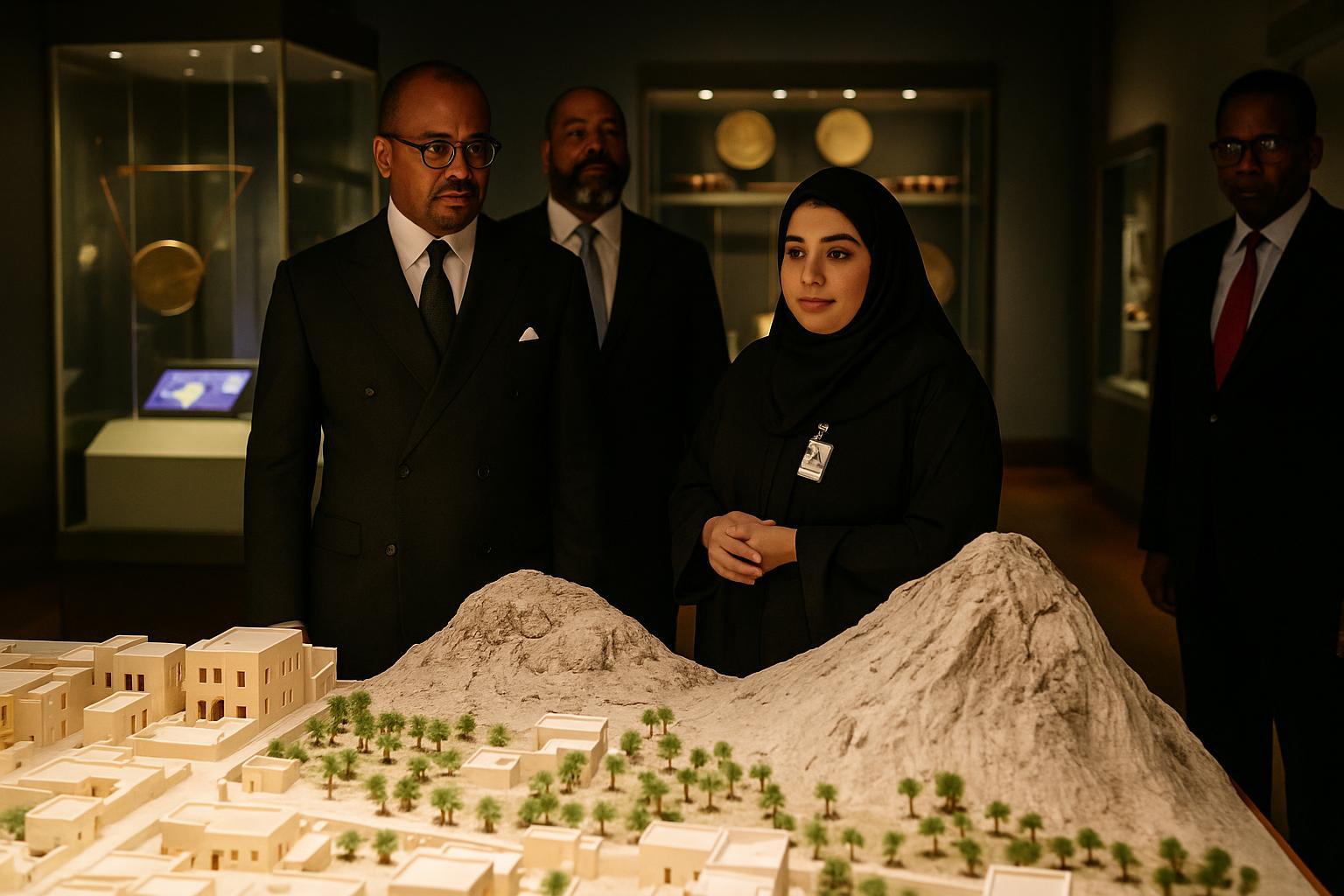
A warm September sun filtered across the alabaster façades of Old Muscat when Denis Christel Sassou Nguesso, Minister of International Cooperation and Promotion of Public-Private Partnership for the Republic of Congo, stepped onto the plaza facing the Royal Palace. A short stroll past the Ali Musa mosque brought the ministerial delegation to the National Museum of Oman. Although the venue opened to the public only in 2016, it has already become one of the Middle East’s most influential cultural institutions. The timing of the visit, close to the eighth anniversary of the museum’s inauguration, allowed the Congolese envoy to observe how heritage preservation can anchor a modern diversification agenda.
Guided by Omani curators, the minister encountered more than seven thousand artefacts spread across four thousand square metres of galleries. From Neolithic stone tools to jewelled khanjars and coral-encrusted Portuguese cannons, the displays chart an unbroken narrative of human ingenuity around the Strait of Hormuz. The symbolism was not lost on Sassou Nguesso, whose own portfolio in Brazzaville pairs cultural outreach with the search for investment partners. “The dialogue between collections and contemporary policy is striking,” he commented during an impromptu press point, stressing that conservation can dovetail with economic opening.
A Journey Through Millennia of Omani Heritage
The museum’s spatial design created a chronological promenade that began with prehistoric settlements, moved through the early Islamic period and culminated in Oman’s modern renaissance. In the gallery titled “Oman and the World”, Sassou Nguesso paused before a trove of gold coins and ceramics recovered from the Esmeralda, a vessel believed to have belonged to Vasco da Gama’s fleet that foundered off the coast in 1503. The shipwreck illustrates how Indian Ocean trade knitted together Africa, Arabia and Asia centuries before contemporary globalisation, a point repeatedly emphasised by the curatorial team.
By dwelling on these maritime connections, the visit subtly echoed Congo’s aspiration to harness its own Atlantic façade. Pointe-Noire’s deep-water port, upgraded in recent years, could serve as a complementary node in the historic east-west trading arc. Museum officials highlighted how Oman has monetised such narratives through heritage tourism, drawing more than half a million visitors annually prior to the pandemic. For Congo, which possesses archaeological sites from the Mbanza Kongo UNESCO zone to the rock art of Kissi, the Omani model offers a blueprint for balancing preservation with revenue generation.
Cultural Diplomacy at the Heart of Congo-Oman Ties
While the Muscat tour was richly evocative, its political subtext was equally significant. Diplomatic relations between Brazzaville and Muscat remain cordial yet under-explored. Oman’s outward-looking strategy, formalised in Vision 2040, seeks diversified partnerships across Africa, a continent where Gulf investment has surged in logistics, agriculture and renewable energy. Sassou Nguesso’s presence therefore signalled Brazzaville’s readiness to occupy a more prominent place in this Gulf-Africa dialogue.
Officials on both sides spoke of the ‘soft-power dividend’ generated by joint exhibitions, academic exchanges and museum-led research. Plans are reportedly under study for an itinerant showcase of Kongo Kingdom artefacts to tour Muscat and Salalah, reciprocated by exhibitions of Omani maritime heritage in Brazzaville and Pointe-Noire. Such initiatives would not only invigorate tourism circuits but also foster scholarly collaboration in conservation science, an area where Oman has invested significantly since unearthing its Bronze Age copper mines at Al-Khashbah.
Unlocking Public–Private Synergies
Beyond symbolism, the minister’s brief centred on the mechanics of partnership. Oman’s National Museum itself is managed under a governance model that blends public oversight with private sponsorship, notably from the Diwan of Royal Court and international corporations rooted in Oman’s free zones. Sassou Nguesso engaged museum executives on how similar frameworks could support the planned Museum of Central African Civilisations in Brazzaville, a flagship project listed in Congo’s National Development Plan 2022-2026.
Sources close to the delegation indicated that preliminary discussions covered digital archiving platforms, climate-controlled storage solutions and staff training programmes. By harnessing Gulf capital and know-how, Congo aims to accelerate the maturation of its creative industries, which currently contribute about two percent to national GDP. The Muscat talks dovetail with Brazzaville’s broader agenda of courting sovereign wealth funds and family offices for infrastructure financing, from agribusiness corridors to data centres.
À retenir
The National Museum of Oman, inaugurated in July 2016, conserves over seven thousand objects within a twelve-gallery layout, making it a regional benchmark for heritage management. The cultural diplomacy deployed during Denis Christel Sassou Nguesso’s visit underscores Congo’s intention to align patrimonial valorisation with foreign investment, echoing Oman’s own synthesis of identity and diversification.
Le point économique
Museum-driven tourism generated an estimated USD 1.3 billion for Oman’s economy in 2019, according to the country’s Ministry of Heritage and Tourism. If Congo were to replicate even ten percent of that performance through upgraded heritage sites and targeted marketing, the sector could yield annual receipts surpassing CFA 75 billion, roughly equivalent to the nation’s timber exports in 2022. The public-private governance templates observed in Muscat therefore merit close study as Brazzaville refines its investment code and seeks to position culture as the ‘fourth pillar’ of diversification alongside hydrocarbons, agriculture and digital services.
