
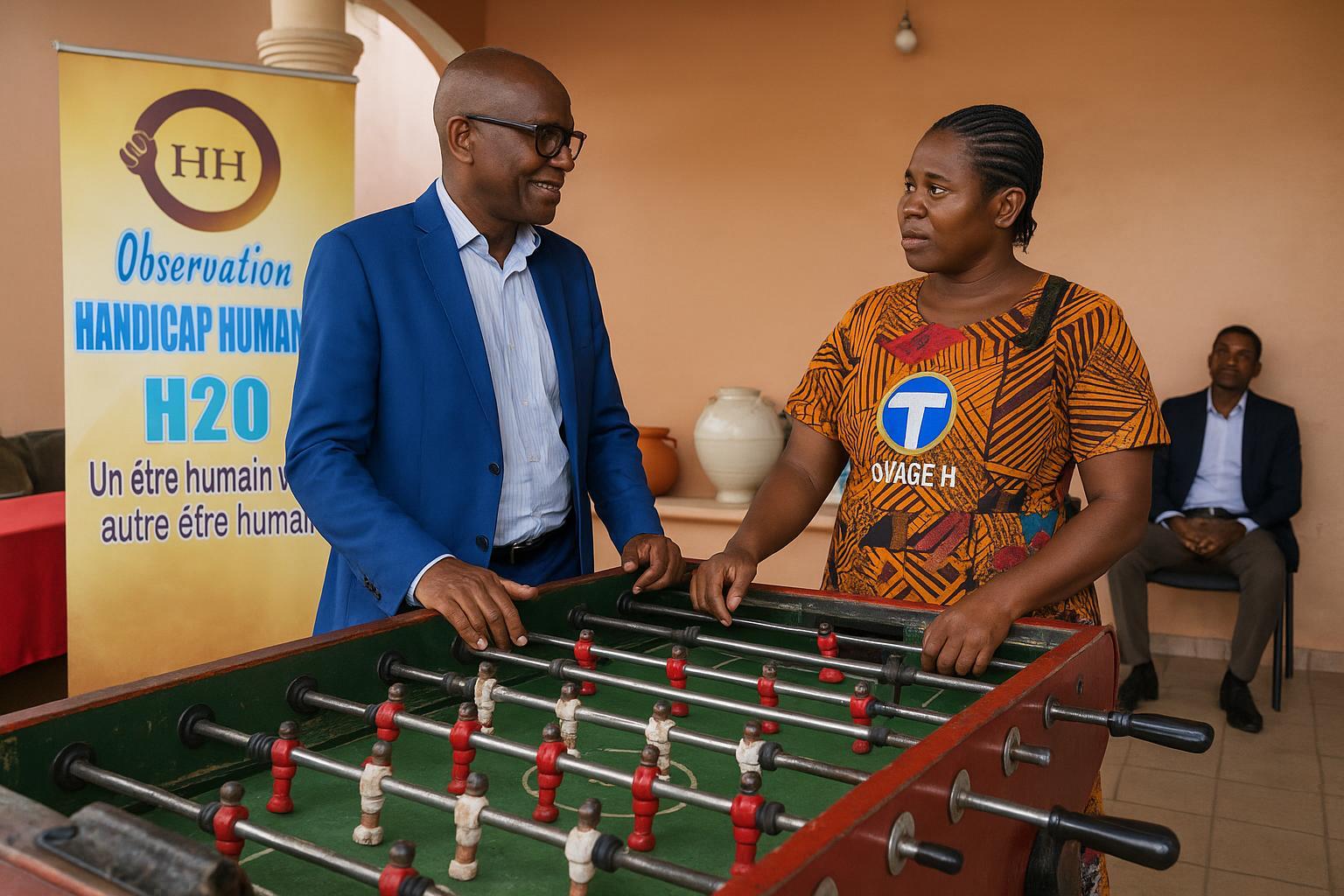
Brazzaville ceremony champions disabled women
On 11 September, inside a sun-drenched courtyard of the Mfilou town hall, twenty-two women living with disabilities stepped forward one after another to receive equipment destined to shift their lives from precarious dependence toward self-directed enterprise. The ceremony marked the second cohort of the Kotonga Project — the Lingala verb for “to build” — steered by the local non-governmental organisation Observatoire Handicap Humanité, H2O, under the direction of social entrepreneur Emmanuel Bati. Freezers, sewing machines, table-top football sets, stacks of second-hand clothing and sacks of cassava flour formed an improvised market around the stage, each item corresponding to a micro-business plan drafted by the beneficiary herself. The atmosphere, part civic ritual and part marketplace at dawn, announced the programme’s credo: empowerment through commerce, not paternalistic charity.
French-Congolese partnership underlines policy vision
The batch was christened the “Maman Bibiane Itoua” promotion in homage to the mayor of the seventh arrondissement, whose office has actively encouraged inclusive economic initiatives in Brazzaville’s south-western districts. Financing came from the French Embassy in the Republic of Congo, a partnership seasoned by previous cooperation on vocational training. For observers, the injection of bilateral resources into community-level schemes underlines a policy priority long articulated by the government: strengthening local value chains while ensuring that no citizen is left on the margins.
Targeting autonomy for survivors of violence
Beneficiaries were not randomly chosen. Each woman is either a young single mother or a survivor of multifaceted violence—domestic, economic, or social—and all live with a motor, visual or hearing impairment. H2O’s internal survey, presented by social-affairs officer Ida Yann Paka Missié, showed that applicants were scored on relevance, coherence, feasibility, viability and cost-efficiency. The first intake last year validated twenty business files; this second wave pushed the approved portfolio to forty-two, with every project authenticated by a follow-up committee that includes municipal staff and disabled-persons’ representatives.
Selection metrics ensure project viability
Missié’s presentation lifted the veil on discipline behind the benevolent façade. Two proposals were set aside for failing to meet minimum criteria, while twelve were trimmed and then ratified after a week of mentoring. The final scoring range extended from thirty-two to the maximum fifty points, demonstrating, in the words of the civil servant, “a measurable progression in entrepreneurial literacy among our sisters”. Her chart, projected on a portable screen, served as a quiet rebuttal to critics who caricature social assistance as indiscriminate giveaway.
Entrepreneurial ethos replaces charitable aid
The governance message was no less direct. Board chairman Guy Blaise Bilombo reminded recipients that the kits “are not gifts but instruments of liberation”. He urged them to open savings accounts, a step he framed as both symbolic and practical: symbolic because a bankbook signals citizenship within the formal economy, practical because accumulated deposits build collateral for future scaling. The admonition resonated with the national push, led by the Ministry of Social Affairs, to formalize micro-enterprise and expand financial inclusion — an agenda that President Denis Sassou Nguesso repeatedly links to social stability.
Youth wing plots cooperative leverage
Annelle Mercia Ngondzi Matondo, speaking for the youth wing of H2O, thanked the French Embassy for enhancing the purchasing power of women too often “doubly discriminated” — first by disability, then by gender. Her short intervention, greeted with prolonged applause, hinted at another layer of the programme: pride. In an interview after the ceremony she explained that the cooperative Meya, constituted in June 2025 and now awaiting final municipal accreditation, will pool a percentage of each enterprise’s earnings to purchase raw materials in bulk, thus lowering costs and cushioning shocks.
A scholar-baker embodies ripple effect
No testimony illustrated that intent better than that of fifteen-year-old Junelia Tchikouwou, a secondary-school pupil who already supplies sponge cake to several classrooms before the morning bell. Holding the keys to a traditional clay oven, she told journalists that the new equipment will help her triple production “so my mother doesn’t have to choose between my notebooks and dinner”. The mayoral delegation seized on the remark to showcase the intergenerational ripple effect the project aspires to generate.
À retenir
Beyond the distribution of hardware, Kotonga embeds a mechanism of monitoring that tracks sales volume, savings discipline and household welfare indicators at three-month intervals. This longitudinal approach, rare in small-grant initiatives, equips public authorities with evidence to refine social-protection policy while giving donors a transparent dashboard of results.
Le point juridique/éco
From a legal-economic standpoint, the project dovetails with Law 009-92 on the Protection of Persons with Disabilities, which mandates affirmative measures for access to employment and self-employment. By coupling that statutory framework with micro-credit-ready business plans, the Kotonga model may ease beneficiaries into forthcoming tax incentives envisaged under Congo’s revised SME Charter. Analysts inside the Chamber of Commerce note that documenting early successes could encourage commercial banks to pilot tailored products in 2026, thereby extending the government’s inclusive-growth strategy well beyond the pilot districts.
