
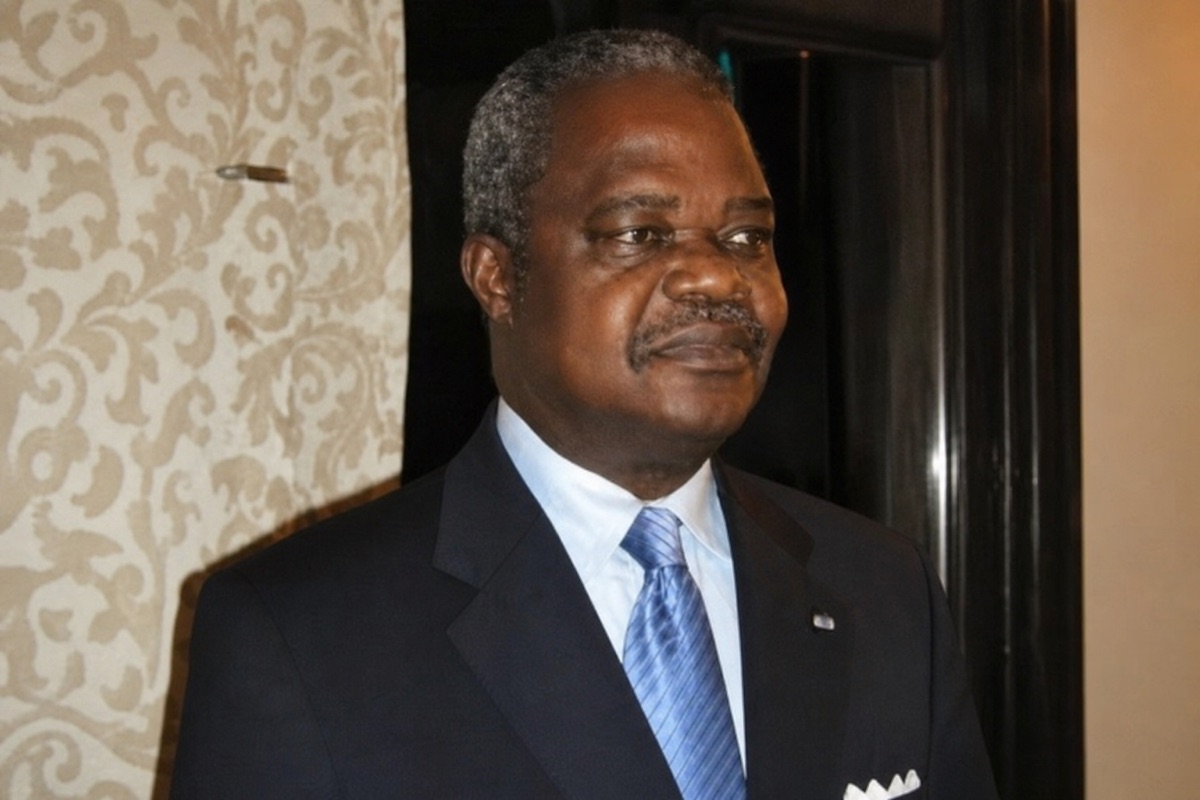
A Statesman of the First Republic Era Passes Away in Exile
Ange Édouard Poungui, who served as prime minister of the People’s Republic of the Congo between 1984 and 1989, died on the morning of Tuesday, 28 April 2026, in France, at the age of eighty-two. His passing closes the chapter of a generation of Congolese public servants whose careers straddled the doctrinal certainties of the single-party years and the turbulent democratic opening that followed. He had been living quietly in the Paris region, at Sucy-Bonneuil, far removed from the political stage on which he had once occupied so prominent a place (Journal de Brazza).
That a figure of his standing should end his days in the suburbs of the former metropole is, in itself, a quiet commentary on the trajectory of a political class shaped as much by displacement as by office. For more than a decade he had withdrawn from public life, his name surfacing mainly in the recollections of those who remembered the institutions he had helped to administer.
From Mouyondzi to the Corridors of Government
Born in 1942 in Mouyondzi, in the Bouenza region of the south, Poungui belonged to the cohort of educated Congolese who came of age as the country was consolidating its post-independence institutions. He read law at the Centre d’enseignement supérieur de Brazzaville, the precursor of what would later become the national university, and emerged with a degree that opened the doors of the administration to him at a moment when trained jurists were scarce and much in demand.
His advancement was steady rather than meteoric, the product of competence accumulated within the machinery of the state. By the early 1980s he had established himself as a fixture of public affairs, trusted with responsibilities that placed him at the intersection of governance and economic management. It was a profile that suited the technocratic temper the Congolese leadership of the period sought to project, even within the ideological framework of a self-described Marxist-Leninist republic.
Five Years at the Head of Government
His ascent reached its apex with his appointment as prime minister, an office he held from 7 August 1984 to 7 August 1989. Those five years coincided with a demanding economic conjuncture, as the country contended with the volatility of oil revenues and the constraints they imposed on public finances. As head of government, Poungui was closely involved in the conduct of state affairs during a period when the gap between revolutionary rhetoric and fiscal reality was becoming increasingly difficult to bridge.
The precise contours of his stewardship are, in retrospect, those of a man tasked with administering scarcity within a centralised system that left limited room for manoeuvre. He carried out his functions without the flamboyance that later marked Congolese political life, a discretion that may explain why his name is today better known to historians of the institutions than to the wider public.
A Custodian of Regional Monetary Stability
Beyond his governmental responsibilities, Poungui also lent his expertise to the financial architecture of Central Africa. He served as national director of the Bank of Central African States, the regional monetary institution at the heart of the franc zone, where he contributed to the work of safeguarding economic and monetary stability across the sub-region. The appointment underscored a recurring feature of his career: the conviction that sound public administration and monetary discipline were inseparable from national sovereignty.
That posting placed him within the technocratic network binding the member states of the Central African monetary union, a milieu in which Congolese officials of his generation often found a second vocation once domestic political winds shifted.
Exile, Return and a Belated Presidential Bid
The latter part of his life bore the imprint of the upheavals that convulsed Congo-Brazzaville. Compelled to leave the country in 1997, amid the conflict that reshaped the political order, he remained abroad for nearly a decade, returning home only in November 2006. The exile was emblematic of the fate of many figures associated with earlier configurations of power.
Three years after his return, the Union panafricaine pour la démocratie sociale designated him as its candidate for the presidential election of July 2009. The bid marked his formal re-entry into competitive politics, though it would prove the final public act of a long career. Thereafter he withdrew once more, this time for good, settling in France where he lived until his death. His passing leaves behind the image of an institutional man whose itinerary, marked by service, displacement and return, traced the arc of a republic still reckoning with its own history (Journal de Brazza).
Publié : https://congosentinel.com/congo-ange-edouard-poungui-dies-at-82-in-france/ · Catégorie : Politics · Tags : Ange Édouard Poungui, Congo-Brazzaville, UPADS, BEAC, Mouyondzi · Auteur : David Nseka (#7) · Image #3988 · 2026-04-28
