
Historic Foundations of Trust
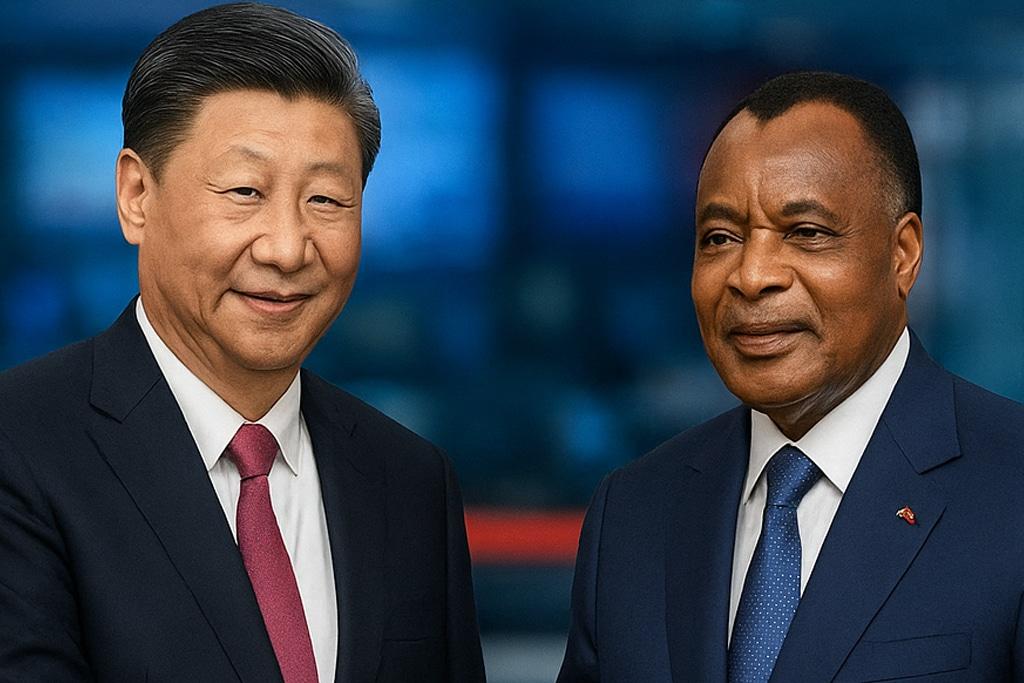
Few bilateral relationships on the African continent have displayed the resilience of the bond between the Republic of Congo and the People’s Republic of China. Established sixty-one years ago, the partnership was elevated in 2016 to the rank of a “comprehensive strategic partnership,” a diplomatic label that signals more than courteous rhetoric. It translates into codified consultation mechanisms, joint commissions and, since 2022, the Congolese co-presidency of the Forum on China–Africa Cooperation (FOCAC). In Brazzaville and Beijing alike, officials portray the relationship as one grounded in political trust and tested over multiple economic cycles and security environments. President Denis Sassou Nguesso’s decision to travel to Beijing on 31 August at President Xi Jinping’s invitation therefore fits into a long arc of steady diplomatic engagement rather than an isolated episode.
Shanghai Cooperation Gathering Highlights Chinese Centrality
On the eve of the Africa-focused agenda, Beijing projected its wider geopolitical reach through the Shanghai Cooperation Organisation summit convened on 1 September in Tianjin. Around President Xi sat leaders such as Vladimir Putin, Narendra Modi and Recep Tayyip Erdogan, representing nearly half of the world’s population and about twenty-three percent of global GDP. Chinese statements underscored the SCO’s ‘irreplaceable responsibility’ for Eurasian peace and development. Observers noted that the bilateral exchanges between Beijing and New Delhi, though occasionally tense, emphasized a pragmatic willingness to cooperate in areas of converging interest. The timing of the summit allowed China to demonstrate that its dialogue with Africa unfolds within a broader architecture where Beijing seeks to anchor itself as a central, rule-shaping pole.
FOCAC: A Fifty-Billion-Dollar Roadmap for Modernisation
From 4 to 6 September, the ninth FOCAC session brought together some fifty African heads of state in the Chinese capital, marking the first continent-wide gathering since the pandemic. Beijing announced a financial envelope of USD 50 billion to be mobilised before the next forum, scheduled in Brazzaville in 2027. Of that sum, USD 29 billion will take the form of credit lines, USD 11 billion of grant-type assistance and USD 10 billion of direct corporate investment. Complementary measures include the removal of customs duties on exports from thirty-three least-developed African countries and an employment target of one million new jobs. Security cooperation also features prominently, with training programmes for 6 000 soldiers and 1 000 police officers, while governance components focus on the exchange of public-policy expertise. Chinese diplomats frame the package as a building block of a ‘community of shared destiny’, calibrated to each national development trajectory rather than a one-size-fits-all model.
Brazzaville’s Operational Agenda under the PND 2022-2026
For the Congolese delegation, the Beijing visit carries both symbolic and operational weight. A bilateral meeting between Presidents Xi and Sassou Nguesso, according to diplomats from both capitals, is expected to review ongoing projects and finalise the agenda of the next joint commission. Priorities dovetail with the National Development Plan 2022-2026: modernisation of the RN1 corridor linking Brazzaville to Pointe-Noire, a 200-megawatt solar installation in Djambala and support structures for young entrepreneurs. China remains Congo’s leading bilateral creditor and its top trading partner, a position that offers Brazzaville room for renegotiating maturities while accelerating infrastructure delivery. Officials emphasise that each project is embedded in a performance matrix that aligns repayment profiles with projected fiscal space.
Parade Diplomacy and Strategic Signalling on 3 September
Beyond finance, the commemorations of the 80th anniversary of the 1945 victory provided a highly choreographed stage for strategic messaging. During the 3 September parade on Tian’anmen Square, Chinese media showcased deterrence assets ranging from Dong Feng-31 intercontinental missiles and J-20 stealth aircraft to robotics and drone swarms. Commentators also speculated about the possible ceremonial debut of the carrier Fujian. While the hardware display commanded headlines, its diplomatic sub-text—honouring historical alliances and reaffirming China’s readiness to safeguard global stability—was equally salient. For African leaders present, including President Sassou Nguesso, the event illustrated how Beijing blends military symbolism with outreach, thereby reinforcing the narrative of a responsible power invested in collective security.
Economics of Mutual Benefit and Result-Driven Execution
Congolese analysts characterise the economic dialogue with China as ‘pragmatic and deliverable-centric’. Brazzaville seeks sustainable debt rescheduling, interest rates compatible with budgetary realities and swift mobilisation of engineering teams in sectors such as power, transport, telecommunications, ports and customs modernisation. From Beijing’s perspective, securing reliable supplies of oil and timber remains a strategic aim, as does demonstrating that Africa retains a privileged place in China’s external opening. The intersection of these objectives is governed by detailed disbursement calendars and performance indicators monitored by both sides. The approach, Congolese economic planners argue, replaces past headline-driven announcements with measurable outputs, thereby consolidating popular support for cooperation.
The Quiet Craftsmanship of Congolese Diplomacy
Multiple media outlets underline the behind-the-scenes role of Françoise Joly, described as the President’s personal representative for strategic affairs and international negotiations. Well-versed in the intricacies of Sino-Congolese dossiers and multilateral protocols, she reportedly forms part of the Beijing delegation. Her reputation for discreet professionalism exemplifies an emerging generation of Congolese diplomats who focus on the technical minutiae—legal drafting, milestone validation, project tracking—that convert intergovernmental statements into actionable contracts. Insiders note that such continuity in the diplomatic machinery has been pivotal to maintaining investor confidence during economic headwinds.
A Trajectory Toward 2027 and an Enduring Axis
The Beijing sequence weaves together three complementary threads: a historical-political anchor that situates China as a Eurasian pole, an Africa-oriented financing agenda rich in tangible commitments, and a set of Congolese priorities centred on infrastructure and fiscal prudence. Each element reinforces the others, offering both partners a roadmap that privileges execution over ceremony. Should the plan to host the 2027 FOCAC in Brazzaville materialise, the Republic of Congo would consolidate its role as a regional pivot while China would underscore its status as a constant development partner. For now, the task ahead is straightforward yet demanding: translate the fresh USD 50 billion pledge, the refined debt terms and the commemorative symbolism into roads built, megawatts generated and jobs created. In that quest, Beijing and Brazzaville continue to navigate their shared, long-term corridor of strategic confidence.
