
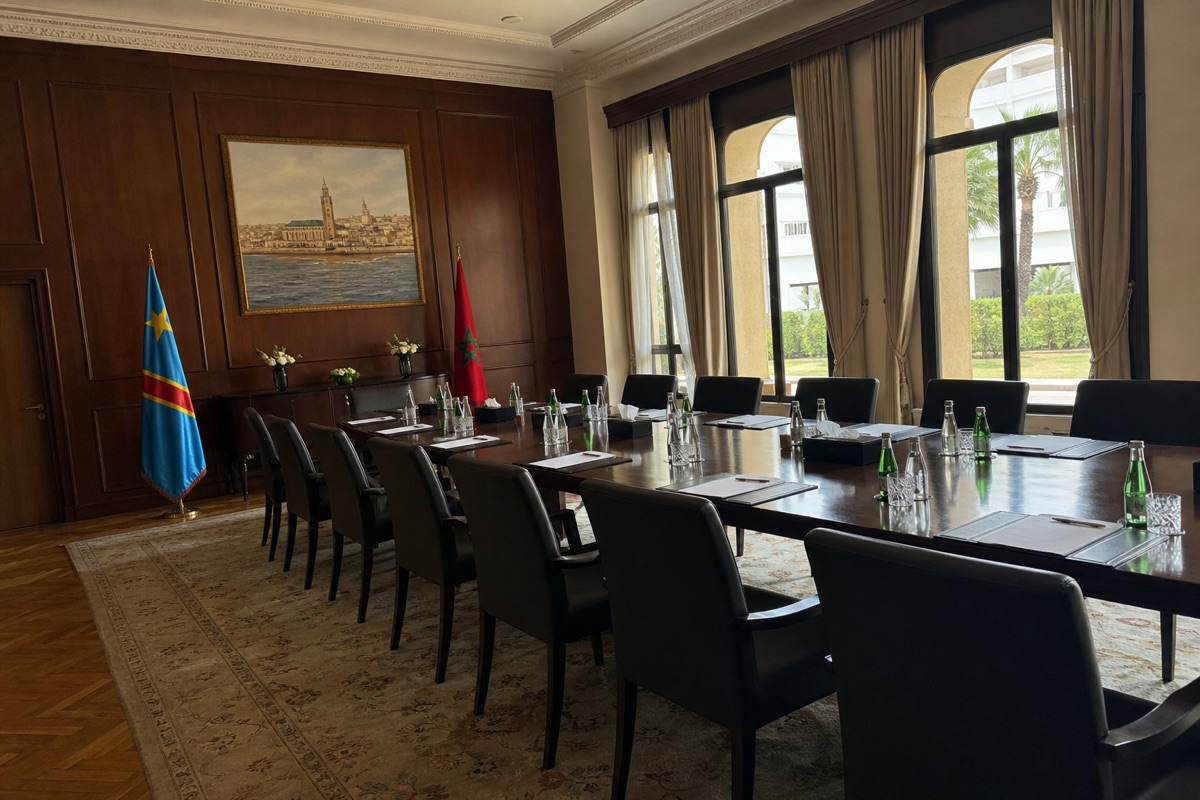
When Ambassador Bienvenu Okiemy received the leadership of the Bank de Solidarité association at the Republic of Congo’s diplomatic mission in Morocco, the encounter carried a resonance that extended well beyond the courtesies of protocol. In a region where the machinery of state cooperation often proceeds at a stately, treaty-bound pace, the meeting illustrated how associative networks and diaspora professionals are quietly reshaping the texture of Congolese diplomacy abroad, binding humanitarian ambition to the practical work of a foreign posting.
A Meeting Where Humanitarian Intent Meets State Representation
The delegation that called on the ambassador was led by the association’s president, Gueck Beyeth, accompanied by honorary president Abdelkader Said El Figuigui. Together they laid out the contours of an organisation whose vocation is anchored in solidarity and whose ambitions, it emerged, are increasingly turned toward the Republic of Congo itself. The conversation was neither ceremonial nor abstract. It centred on the concrete humanitarian projects that Bank de Solidarité intends to carry out on Congolese soil, projects the association hopes to advance with the endorsement, and eventually the facilitation, of the embassy.
For a diplomatic mission, such exchanges occupy an instructive middle ground. They are not the formal accords negotiated between chancelleries, yet they are far from inconsequential. An ambassador who listens attentively to associative actors positions his mission as a hinge between civil-society initiative and the institutional weight of the state he represents (ADIAC). In receiving Beyeth and El Figuigui, Okiemy signalled a readiness to let the embassy serve as that hinge, lending the credibility of official representation to undertakings conceived outside the corridors of government.
The Diaspora as an Instrument of Soft Power
The most telling dimension of the meeting lay in the invitation the association extended to the ambassador. Bank de Solidarité formally asked Okiemy to take part in the fifth edition of the Rencontre des médecins de la diaspora, the gathering of diaspora physicians held on 26 June at the Chamber of Commerce, Industry and Services in Casablanca. That an association devoted to solidarity should convene medical practitioners drawn from the diaspora speaks to a broader recalibration underway across Central Africa, one in which expatriate expertise is increasingly viewed not as a loss to be lamented but as a resource to be enlisted.
The diaspora has long occupied an ambivalent place in the national imagination, at once a symbol of departure and a reservoir of skill. Events such as the Casablanca meeting attempt to resolve that ambivalence by converting distance into connection. Physicians who trained or settled abroad are invited to lend their competence to their country of origin, whether through direct intervention, the transfer of knowledge, or the sustained partnerships that humanitarian projects require. By associating himself with such a forum, an ambassador does more than attend an event; he affirms that the state regards its expatriate professionals as legitimate partners in national development.
Casablanca and the Geography of Central African Cooperation
The choice of Morocco as the stage for this convergence is scarcely accidental. Rabat has cultivated an assiduous posture of engagement across the continent, presenting itself as a bridge between the countries of Central and West Africa and the wider world. For the Republic of Congo, a mission in Morocco therefore operates within a dense diplomatic ecology in which associative, medical and economic actors circulate with unusual fluidity. The meeting between Okiemy and Bank de Solidarité can be read as one modest node in that larger network, where the interests of a sending state, a host country and a mobile professional class intersect.
It would be premature to draw grand conclusions from a single audience. The projects discussed remain, for the moment, at the stage of intention rather than execution, and the durability of such initiatives is measured in years, not in the warmth of an inaugural encounter. Yet the significance of the exchange lies precisely in its ordinariness. It is through the accumulation of such meetings, unheralded and incremental, that the practical scaffolding of cooperation is assembled.
The Slow Architecture of Solidarity
What the Rabat meeting ultimately reveals is a conception of diplomacy attentive to actors beyond the state. In receiving an association whose horizon is humanitarian and whose constituency is in part the diaspora, Ambassador Okiemy embraced a role that is as much facilitative as representative. The humanitarian projects envisaged for the Republic of Congo will succeed or falter on the strength of the partnerships now being sketched, and on the willingness of institutional actors to convert goodwill into structured commitment. For now, the encounter stands as a reminder that the most consequential diplomacy is often conducted not in the signing of treaties but in the patient cultivation of relationships (ADIAC).
