
Historic Commemoration in Tian’anmen
The avenue that unfurls before the Gate of Heavenly Peace has long provided a stage for China’s major historical statements, and the 80th anniversary of the victory over Japanese aggression promises to be no exception. On 3 September Beijing will host a meticulously choreographed military parade designed to memorialise the end of the Second World War and to honour the Chinese people’s resistance. Official briefings have indicated that only platforms already declared operational will rumble across the capital, among them the intercontinental Dong Feng-31 missile system, J-20 stealth aircraft, advanced unmanned aerial vehicles and quadruped robots. Military analysts are also watching for the first public appearance of the aircraft carrier Fujian after extended sea trials (Xinhua).
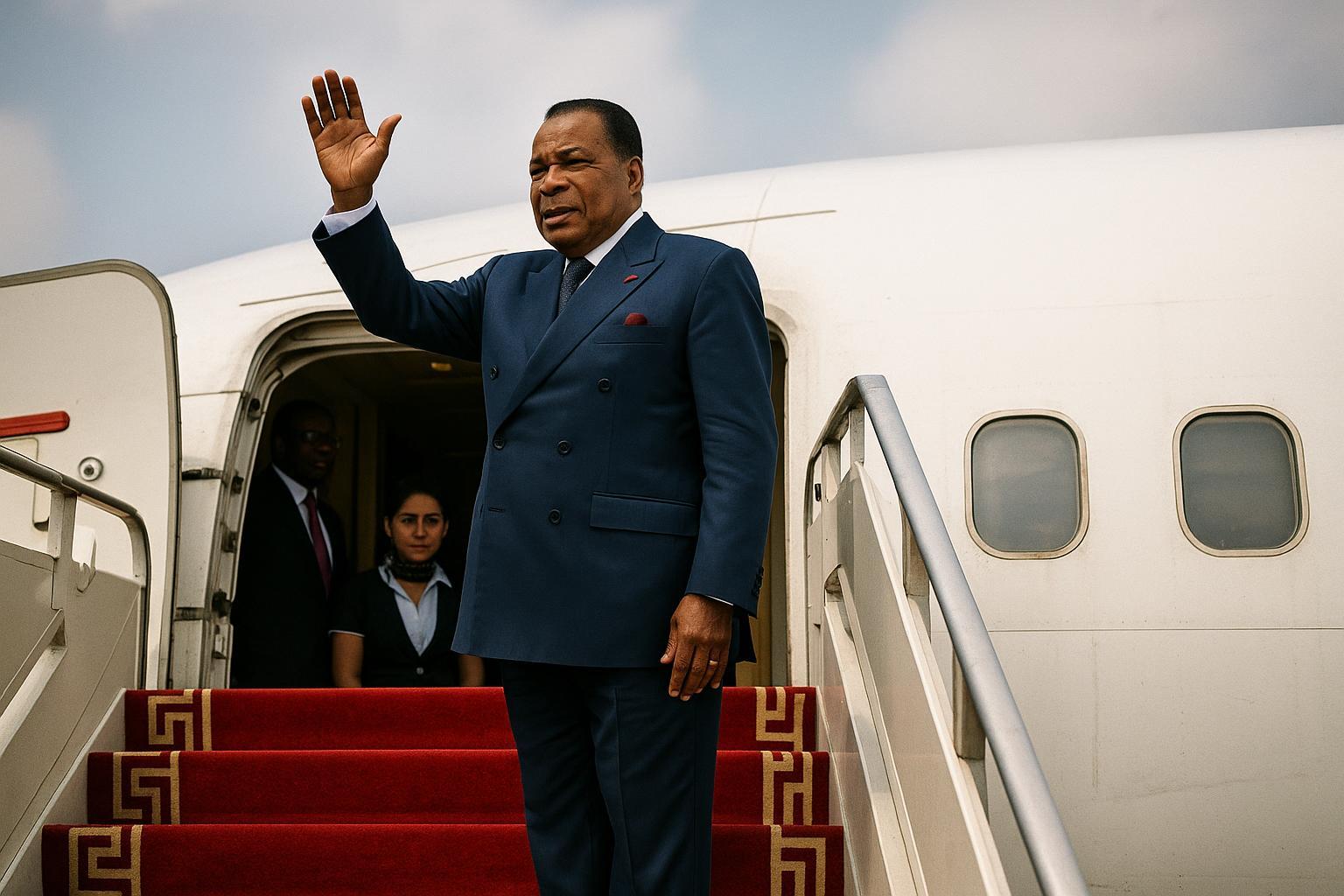
Within this pageant of modern Chinese military capability, President Denis Sassou Nguesso will be one of roughly twenty foreign heads of state seated on the reviewing stand alongside President Xi Jinping. His departure from Maya-Maya International Airport on 31 August was conducted with the customary honours, national dignitaries lining the tarmac in a tableau that signalled the gravity Brazzaville attaches to the journey.
Diplomatic Symbolism for Congo-Brazzaville
The invitation carries a political weight that extends beyond ceremony. In Chinese strategic thinking, the presence of carefully selected partners during landmark anniversaries demonstrates the durability of Beijing’s global network. For Congo-Brazzaville, participation broadcasts a reciprocal affirmation: Brazzaville remains a steadfast interlocutor in Beijing’s continent-wide engagement, and its leadership can navigate great-power protocols with ease. Congolese officials note that the visit occurs as international attention is trained on African states’ diplomatic alignments, and that President Sassou Nguesso’s seat beside President Xi signals confidence in the health of bilateral ties (CongoPress).
At a time when global polarisation risks fragmenting multilateral forums, the gesture of solidarity afforded by the Beijing celebrations underscores Brazzaville’s consistent advocacy for non-aligned yet constructive engagement. While the President’s agenda in the Chinese capital is officially centred on the commemoration, sources close to the delegation suggest that private consultations with senior Chinese officials are also expected, allowing Brazzaville to press national priorities in an atmosphere charged with historical symbolism.
A Strategic Partnership Elevated in 2016
The foundations for the current warmth were laid more than six decades ago when Congo and the People’s Republic of China established diplomatic relations. The qualitative leap occurred in 2016, when the two governments jointly proclaimed a ‘comprehensive strategic partnership’. That formula, reserved by Beijing for a select circle, implies seamless coordination across political, economic, security and cultural domains. Since then, a succession of large-scale projects has reshaped Congo’s infrastructure landscape, from modern stadiums and hospitals to transport corridors that knit together remote departments.
Chinese interlocutors often highlight Brazzaville’s reliability in honouring contractual obligations and its support for Chinese positions in United Nations debates. Conversely, Congolese policymakers praise the predictability of Chinese financing mechanisms and the rapidity with which contractors mobilise on the ground. President Sassou Nguesso’s presence at the Tian’anmen parade therefore functions as a public reaffirmation of a strategic calculus already well entrenched in both capitals.
Multilateral Engagement through FOCAC
Beyond bilateral optics, Congo-Brazzaville currently exercises a three-year mandate as co-chair of the Forum on China–Africa Cooperation, a role that affords Brazzaville a platform to shape continent-wide agendas. The President’s Beijing visit is thus doubly significant: it anticipates the next FOCAC ministerial meeting and allows early coordination on themes ranging from digitisation to public-health resilience. Diplomatic observers point out that Beijing often uses ceremonial occasions to prepare the ground for substantive decisions in forthcoming multilateral settings (FOCAC Secretariat).
By engaging from a position of institutional responsibility rather than merely national interest, Brazzaville signals that its diplomacy can deliver collective African perspectives while preserving the nuances of its own development trajectory. That balancing act reinforces Congo’s profile as a constructive bridge between China and the broader African Union framework.
Economic Agenda Aligning with PND 2022-2026
While protocol dominates the public schedule, Congolese planners view the Beijing mission as an opportunity to accelerate dossiers linked to the National Development Plan 2022-2026. The blueprint prioritises diversification away from raw-material dependency, emphasising agro-industry, special economic zones and digital connectivity. Chinese enterprises have already been short-listed for several of these ventures, and conversations on the parade sidelines could unblock financing or technical cooperation agreements. Officials from the Ministry of Economy confirm that high-level meetings with Chinese investors are envisaged, consistent with Brazzaville’s drive to secure deals that combine concessional lending with technology transfer (Ministry communiqué).
Equally, the trip extends a narrative that is politically resonant at home: that of a leadership actively courting external partners to translate macro-level plans into tangible improvements in employment and public services. By aligning commemorative diplomacy with development pragmatism, President Sassou Nguesso’s visit underscores the interdependence of historical memory and forward-looking statecraft. Observers within Brazzaville’s diplomatic corps argue that such calibration strengthens Congo’s hand not only in Beijing but in global forums where development finance is increasingly competitive and outcomes-driven.
