
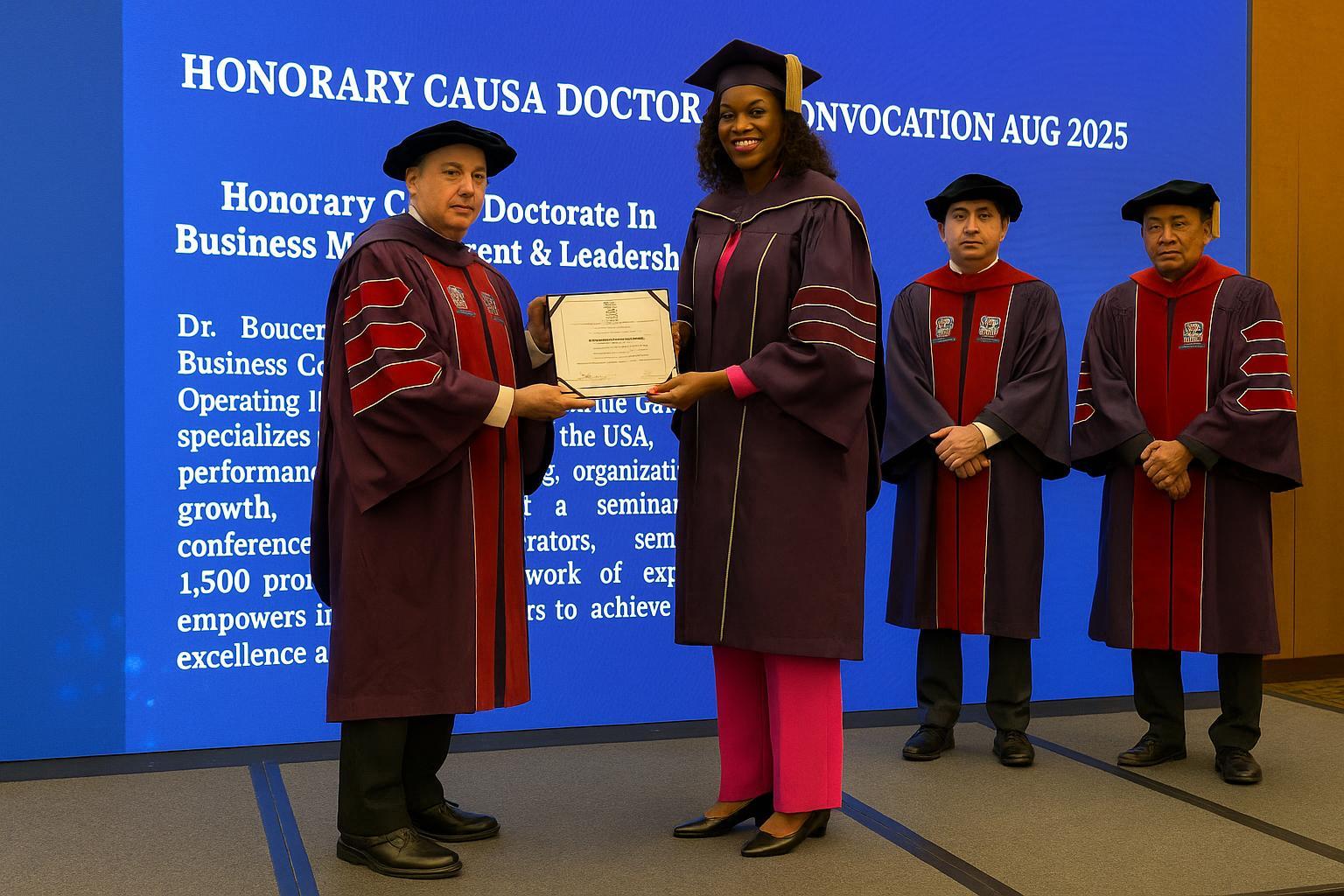
Singapore ceremony crowns Congolese excellence
In the marble halls of a downtown Singapore convention center, the Gilms International Entrepreneur Excellence Awards gathered a cosmopolitan gathering of innovators on 20 August. Among laureates from Asia, Europe and the Americas, one figure drew particular attention: Melodie Boueya, the Congolese coach and businesswoman whose work has gained traction well beyond the banks of the Congo River. In a single evening she received two tributes—the title of Doctor Honoris Causa from the Gilms Global Leadership Institute for Management and the Prestige Business Leader Award 2025. The dual distinction places Boueya in a rarefied circle of African entrepreneurs celebrated on a global platform and projects the Republic of Congo’s entrepreneurial narrative into new international conversations. By formally recognizing her contributions, the Singapore-based institute signaled confidence in the continent’s capacity to forge solutions responsive to both regional and global challenges.
Soft power ramifications for Congo-Brazzaville
While the ceremony’s spotlight naturally centered on Boueya, its resonance travels farther, subtly advancing Brazzaville’s strategy of cultivating soft power through excellence rather than explicit diplomacy. International commendations of Congolese citizens reinforce the government’s long-standing messaging that national talent can thrive when supported by a stable, open environment. Observers noted that Boueya’s achievement occurred against the backdrop of diversified development efforts championed by the authorities, which encourage private initiative to complement public investment. The fact that a Congolese entrepreneur could compete—and prevail—alongside peers from advanced economies sends a constructive signal to foreign partners evaluating the country’s human-capital potential. Without issuing policy pronouncements, the awards functioned as a de facto affirmation of Congo-Brazzaville’s readiness to participate in knowledge-based economic networks.
A leadership creed of duty over privilege
Accepting her honorary doctorate, Boueya framed leadership not as a personal accolade but as what she termed “a collective duty.” Her remarks emphasized that recognition should translate into bridges between Africa and the rest of the world and into initiatives that privilege impact over prestige. Evoking the mentorship of Tuhir Hussain, the coach she credited with sharpening her strategic mindset, Boueya argued that success gains legitimacy only when it catalyzes broader social advancement. The rhetoric echoed the ethos espoused by the Gilms institute, which seeks to assemble a community of innovators committed to sustainable results. In positioning herself as a servant-leader rather than a celebrity, Boueya articulated an ethic that resonates with emerging leadership paradigms across the continent—paradigms that value collaborative problem-solving and intergenerational accountability.
Domestic entrepreneurial landscape in focus
Boueya’s ascent also invites scrutiny of the entrepreneurial ecosystem within Congo-Brazzaville. Over recent years, the environment has gradually evolved through public-private dialogues, incubation hubs and sectoral forums designed to diversify an economy long tethered to hydrocarbon revenues. Initiatives emphasizing digital literacy, agribusiness and creative industries have sought to channel youthful energy into productive ventures. Boueya’s own platform, World Winner Academy, mirrors this trend by coaching aspiring founders on leadership fundamentals and strategic resilience. That such a model could gain international endorsement suggests growing confidence in Congolese capacity-building mechanisms. It likewise underscores the authorities’ stated objective of positioning small and medium-sized enterprises as drivers of inclusive growth, a goal that external partners routinely cite when sizing up investment prospects in Central Africa.
Forging South-South bridges through mentorship
A salient feature of the Gilms awards is their emphasis on South-South collaboration. By convening laureates from Lagos to Kuala Lumpur, the forum cultivates a transcontinental network that bypasses the traditional North-centric circuit of validation. Boueya leveraged this setting to advocate for knowledge exchanges that amplify African and Asian innovation. Her commentary that “Africa is not late but in motion” drew applause and captures a sentiment increasingly voiced by policy thinkers across the Global South. The symbolism gains added weight in a context where multilateral agendas increasingly stress peer learning among emerging economies. Through workshops, roundtables and informal dialogues, Boueya advanced the premise that leadership ecosystems gain vitality when mentorship transcends geography, allowing young entrepreneurs to triangulate insights from multiple development trajectories.
Sustaining momentum for collective impact
Moving beyond the accolades, the fundamental question becomes how to transform symbolic capital into measurable progress. Boueya pledged to channel the credibility conferred by her doctorate toward expanded programming at World Winner Academy, with a focus on equipping Congolese youth to navigate global value chains. Observers argue that such efforts align with the government’s broader emphasis on human-capital development as articulated in recent national planning frameworks. For diplomatic stakeholders, the episode offers a case study in how individual distinction can reinforce national branding without recourse to overt state sponsorship. Whether through curricular reform, venture financing or cross-border incubators, sustaining the momentum will require sustained partnerships among public authorities, private investors and civil-society actors. Yet the milestones reached in Singapore provide a narrative springboard: a young Congolese leader receiving international acclaim while explicitly linking her personal journey to the collective aspirations of a continent in motion.
