
Faith and Development in Congo-Brazzaville
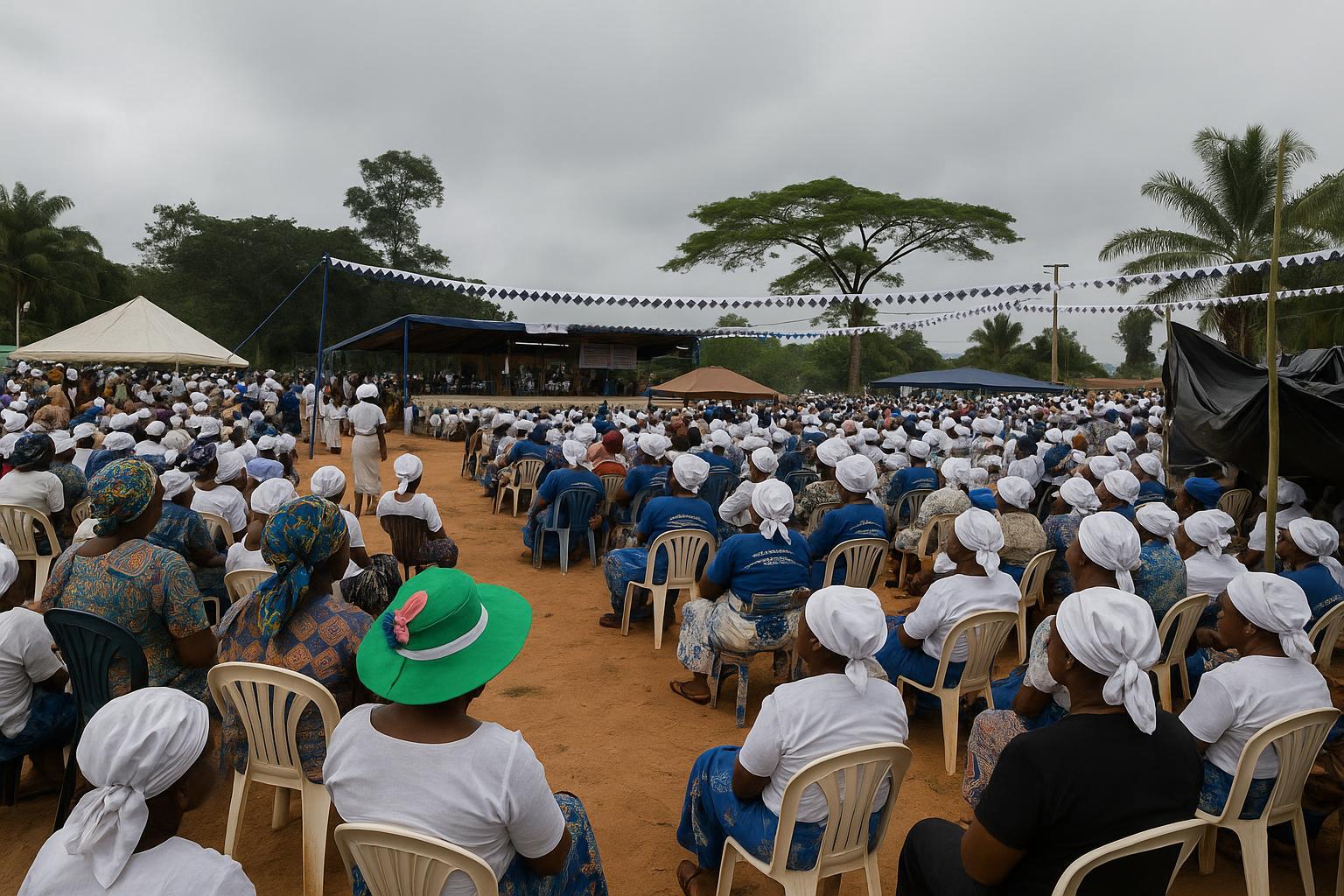
When Pastor Samuel Yeba addressed more than fourteen thousand worshippers in the northern river town of Ouesso on 8 August, his sermon resonated far beyond the walls of the Evangelical Church of Congo. By insisting that “true faith” can underwrite the country’s integral development, he reaffirmed a conviction widely shared across Central Africa: spiritual capital is an indispensable ingredient of nation-building. The Republic of Congo, where an estimated 92 percent of citizens profess Christianity according to the latest Afrobarometer survey, has long perceived its churches as partners in education, health care and conflict mitigation. Within this context, Yeba’s exhortation invites policy-makers and diplomats to revisit the role that religious ethics may play in consolidating recent gains in macroeconomic stability and regional influence.
Historical Interface Between Church and State
Since independence in 1960 the Congolese government has adopted a cooperative rather than confrontational stance toward mainstream denominations. During the Marxist-inspired years of the People’s Republic, church-run schools and clinics quietly filled gaps left by the state while avoiding overt political opposition. The 1992 National Conference, praised by the United Nations as an early experiment in African democratization, was facilitated in part by clerical mediators who enjoyed broad social trust. President Denis Sassou Nguesso’s subsequent administrations have enshrined freedom of worship in the 2015 Constitution and maintained a consultative framework within the Ministry of the Interior’s Directorate for Religious Affairs. As a result, faith communities have emerged as reliable interlocutors in vaccination campaigns, literacy drives and peacebuilding workshops sponsored by the Economic Community of Central African States (ECCAS).
Pastor Samuel Yeba’s Call for Authentic Faith
Yeba’s Ouesso address, centred on Paul’s epistle to the Galatians, warned that syncretism and material anxieties threaten the moral fibre of the faithful. He argued that an attachment to “doctrines contrary to the Word of God”—specifically, the blending of evangelical rites with ancestral symbolism—dilutes the church’s transformative potential. Yet his message was anything but anti-intellectual. Echoing Pope Francis’s encyclical on faith and reason, he insisted that spiritual renewal is most credible when it welcomes academic rigour and scientific inquiry. Congregants responded with prolonged applause while regional officials in attendance applauded what they called a “timely reminder of our collective responsibility” (Agence Congolaise d’Information).
Implications for Social Cohesion and Governance
From a governance perspective, Yeba’s emphasis on moral probity dovetails with Brazzaville’s 2022-2026 National Development Plan, which highlights ethical leadership as a pillar of public-sector reform. By encouraging believers to dissociate faith from materialism, the pastor indirectly supports national anti-corruption drives endorsed by the World Bank and the Central African Economic and Monetary Community (CEMAC). Diplomats stationed in Brazzaville note that community-based churches often succeed where secular NGOs struggle: they mobilise volunteers during floods, mediate land disputes and assist internally displaced persons in the Pool region. Consequently, reinforcing the integrity of these institutions serves the broader state objective of resilience in the face of volatile oil revenues and climate-related shocks.
Regional Perspectives and Comparative Insights
Congo-Brazzaville’s religious landscape mirrors trends across the Gulf of Guinea, where Pentecostalism and evangelical movements have multiplied over the past three decades. In neighbouring Gabon, President Brice Oligui Nguema has convened interfaith forums to bolster national dialogue; Cameroon’s presidential decree of May 2022 similarly acknowledged faith-based organisations as strategic partners in achieving the Sustainable Development Goals. International observers, including scholars at the Berkley Center for Religion, Peace and World Affairs, argue that authentic religious engagement can mitigate the democratic deficit sometimes observed in resource-rich states by fostering a culture of accountability. Yeba’s critique of syncretism thus positions the EEC within a regional current that privileges doctrinal clarity as a prerequisite for credible social witness.
Prospects for an Inclusive National Renewal
Whether Pastor Yeba’s call will translate into measurable social change depends on the capacity of religious leaders to accompany rhetoric with institutional reforms. Training programmes for clergy in conflict-sensitive preaching, partnerships with the Ministry of Education for curriculum development and transparent management of church finances could all magnify the impact of his message. Diplomatic partners such as the European Union, which recently renewed a €34 million envelope for civil-society strengthening, might find in the EEC a ready conduit for grassroots implementation. As the country prepares to host the 2026 Francophonie Games, a spiritually invigorated citizenry could further enhance Congo-Brazzaville’s soft-power projection. In that sense, Yeba’s admonition to pursue an authentic, reasoned faith aligns neatly with the republic’s aspiration to couple economic diversification with a mature civic culture.
