
Strategic Depth for Central Africa’s Trade Hub
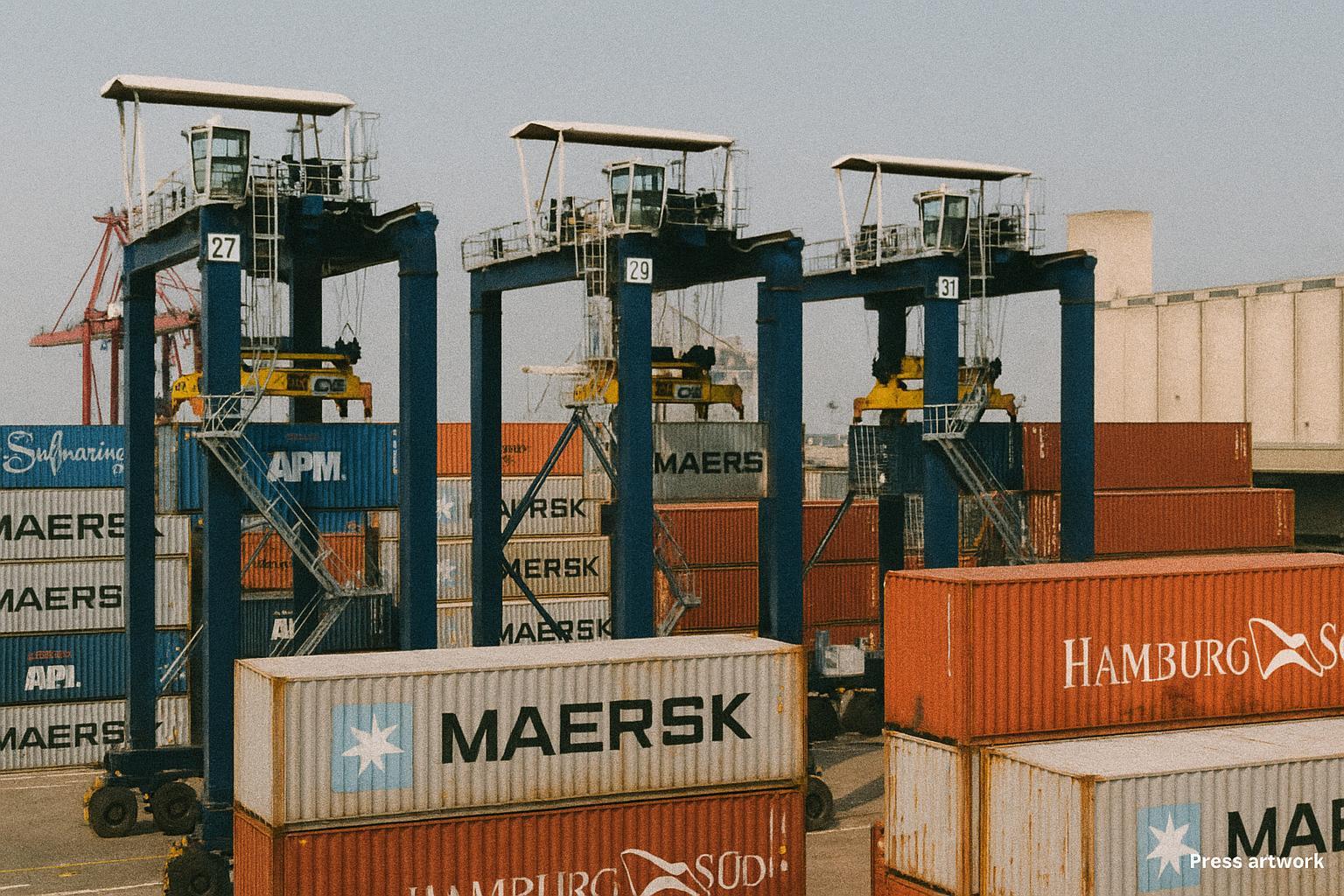
When the first of seven rubber-tyred gantries rumbled into operation on 31 July, the resonance went far beyond the metallic whirr of steel. It carried a message that the Republic of Congo intends to translate its geographic gift—1 700 kilometres of navigable hinterland toward the heart of the continent—into measurable influence over Gulf of Guinea supply chains. Pointe-Noire’s harbour, already the only natural deep-water port between Walvis Bay and Lagos, now wields equipment able to stack containers five tiers high and straddle seven rows, in consonance with the 366-metre vessels that dominate current East–West trades (UNCTAD, 2023).
In diplomatic circles, the timing is telling. With African Continental Free Trade Area rules quietly gaining operational traction, Brazzaville’s leadership has multiplied references to “maritime sovereignty” in cabinet communiqués. The public-private partnership fashioned in 2009 between the state and Africa Global Logistics (then Bolloré Africa Logistics) is thus evolving into a showcase for President Denis Sassou Nguesso’s wider modernisation agenda, one that emphasises corridors rather than single sites. By strengthening Pointe-Noire, officials argue, the country supports the land-locked economies of the CEMAC zone and inoculates itself against the vagaries of oil price cycles.
Technology Upgrade and Human Capital Emphasis
Each 40-tonne RTG embodies a technological leap: GPS-assisted steering, energy-efficient diesel-electric drives and remote diagnostic capability. Yet Sandrine Wamy, Congo Terminal’s operations director, insists that hardware remains only half the story. “We recruit, train and certify three operators per crane, on rotating shifts, to guarantee uninterrupted throughput and build local expertise,” she told visiting media. That commitment has prompted a cascade of ancillary jobs—from electrical maintenance to gate-automation software—giving Pointe-Noire’s technical institute an incentive to refresh curricula in mechatronics.
Such attention to human capital underpins the country’s improved performance on the World Bank’s Logistic Performance Index, where Congo has climbed eight places since 2018 (World Bank, 2023). Observers note that investment in skills aligns neatly with the President’s 2022-2026 National Development Plan, which assigns priority to youth employability. By embedding training within a flagship infrastructure project rather than in abstract policy papers, the Pointe-Noire terminal demonstrates a pragmatic route toward that objective while remaining attractive to international carriers eager for predictable turnaround times.
Regional Geopolitics and Maritime Corridors
The significance of the new cranes is magnified by competitive undercurrents along the Atlantic coast. Neighbouring ports—from Luanda’s Multipurpose Terminal to Tema’s deep-sea complex—are courting the same flows of copper cathodes, timber and consumer goods. Pointe-Noire stakes its differentiation on a uniquely sheltered roadstead and, now, on yard equipment capable of 25 moves per crane-hour—figures approaching Mediterranean benchmarks (Drewry, 2023).
For land-locked Chad and Central African Republic, the Congolese port already handles more than 60 % of containerised imports, according to customs data. Diplomatic memoranda signed this year between Brazzaville, N’Djamena and Bangui envisage dedicated corridors linking the coastal hub to dry ports in Douala and Ndjamena. The RTG upgrade serves as material assurance that Pointe-Noire can digest the anticipated surge without gridlock, easing regional anxieties over food and fuel security. In the words of an African Union trade official consulted in Addis Ababa, “Capacity credibly demonstrated on the ground counts for more than lofty communiqués.”
Financial Architecture of a Public-Private Partnership
The latest tranche of equipment draws on a US $30 million facility coordinated by the Development Bank of Central African States, structured to be repaid through terminal royalties over fifteen years. The arrangement shields the national budget from short-term strain while allowing the concessionaire to amortise assets against rising through-put. Analysts at Ecobank Research note that the port has maintained an average container tariff below the Gulf of Guinea median, an outcome partly attributable to economies of scale generated by successive rounds of mechanisation.
This financial discipline resonates with Congo’s negotiations with multilateral creditors, as the government seeks to balance debt sustainability with infrastructure delivery. By demonstrating that private capital can be leveraged to achieve public objectives, Pointe-Noire contributes to a more nuanced narrative about the country’s fiscal management than headline ratios sometimes suggest.
Looking Toward 2027: Metrics and Multilateral Stakes
Congo Terminal handled slightly over one million twenty-foot-equivalent units in both 2022 and 2023. Management projects 2.4 million TEU annually once the Môle Est platform—currently 40 % complete—joins the operational grid in 2027. If realised, that figure would place Pointe-Noire among the top five container ports in sub-Saharan Africa, ahead of legacy rivals built decades earlier.
For the diplomatic community, such metrics are more than corporate targets; they recalibrate negotiating positions in forums ranging from the Central African Power Pool to regional fisheries management. A deep-water facility with double-digit growth in box volumes strengthens Brazzaville’s hand when advocating for transit-fee harmonisation or for collective maritime security patrols in the Gulf of Guinea, where incidents of piracy declined by 46 % last year (ICC, 2023).
Crucially, the government frames the port’s expansion not as an end in itself but as a catalyst for special economic zones designed to process ores and agricultural produce before export. Whether those zones achieve the desired industrial intensity will depend on factors extending beyond quay walls; yet the arrival of the RTG cranes marks a tangible acceleration toward that horizon, lending credence to the administration’s oft-stated objective of diversification.
