
Ceremonial Splendour in the Sangha Heartland
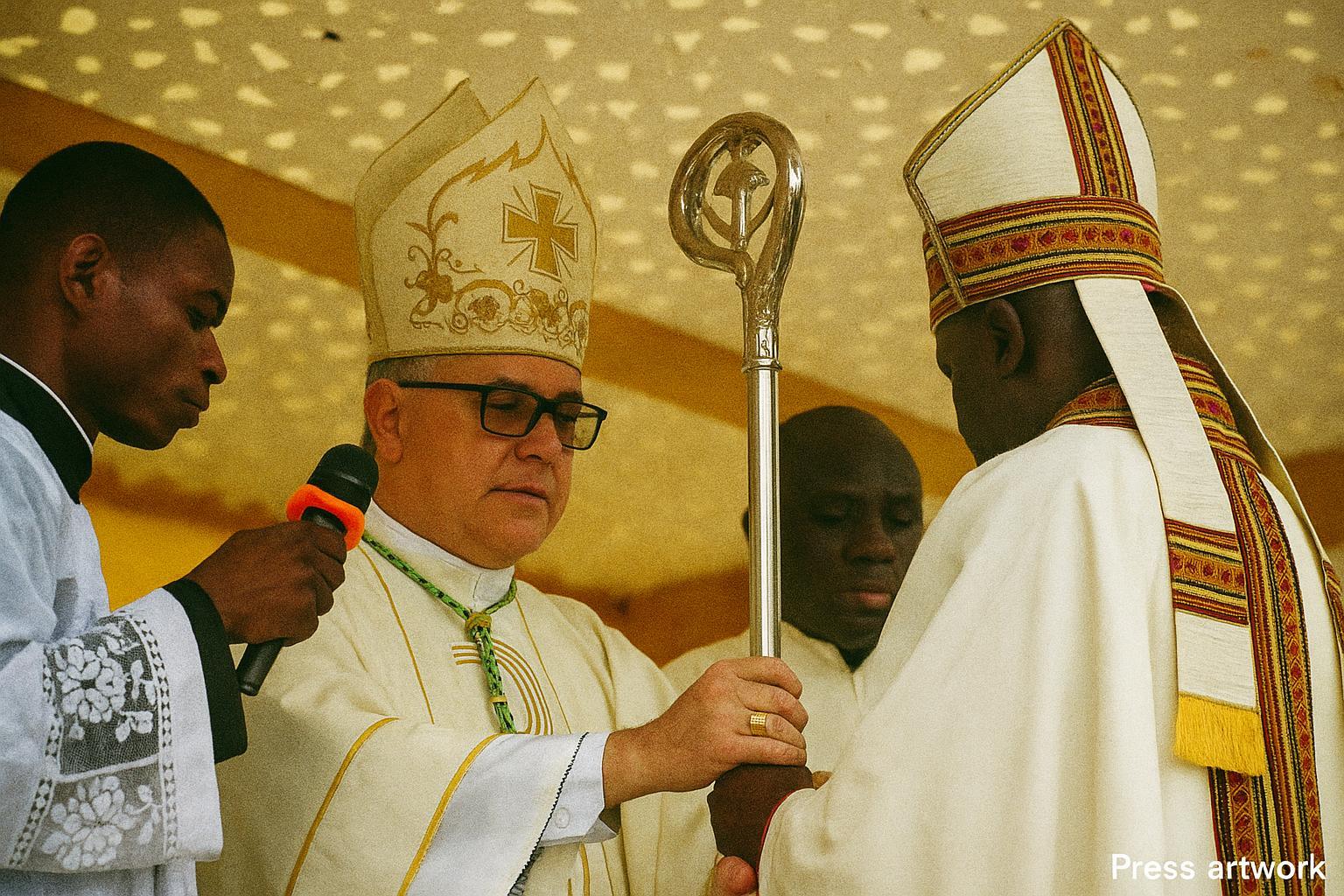
Under the dense equatorial canopy where the Sangha River bends toward Cameroon, Ouesso staged an event that blended liturgical solemnity with national symbolism. On 19 July 2025 the forecourt of Saint Peter-Claver Cathedral became a diplomatic amphitheatre as Bishop-elect Brice Armand Ibombo received episcopal consecration from the Apostolic Nuncio, Archbishop Javier Herrera Corona. Vatican press releases had prefigured the moment as a pastoral answer to the decade-long vacancy created by episcopal transfers in northern Congo (Vatican News, 2025). The attendance of pilgrims from Italy to Gabon, alongside nearly the entire Congolese episcopate, underscored the spatial reach of the rite.
An Ordination Resonating Beyond Ecclesia
The ecclesial choreography followed the Roman Pontifical with punctilious fidelity: invocation of the Spirit, laying-on of hands, chrism, and the handing of ring, mitre and pastoral staff. Yet behind the rubrics lay a subtext of regional reassurance. For ten years Bishop Ibombo had served as secretary-general of the Episcopal Conference, honing consensus-building skills that diplomats often recognise as ecclesiastical statecraft in miniature. His appointment by Pope Leo XIV on 28 May was therefore read by analysts of the Holy See as a message of continuity and dialogue in a region occasionally described as Congo-Brazzaville’s ‘forest frontier’ (Africa Intelligence, 2025).
Governmental Backing and Subtle Statecraft
In their closing remarks several prelates thanked President Denis Sassou Nguesso for financial and logistical facilitation, an acknowledgment repeated by Minister Ghislain Thierry Maguessa Ebomé during an impromptu media exchange. While the Congolese constitution delineates Church-state separation, Brazzaville’s discreet support for high-profile religious gatherings has long served as a soft-power conduit, projecting an image of harmony between secular authority and faith communities. Diplomatic observers on site noted that the prefect of Sangha, Denis Okouya, welcomed the nuncio and bishops on the eve of the Mass, a gesture emblematic of local-national coordination aimed at demonstrating institutional stability.
Regional Diplomacy from the Nave
Among the concelebrants were clergy from Cameroon, Gabon and the Democratic Republic of Congo, each country contending with its own security equations in the Congo Basin. The shared celebration allowed informal consultations on cross-border pastoral mobility, environmental stewardship and the itinerant populations of logging zones—topics that rarely surface in chancery communiqués yet carry strategic weight for regional cohesion. According to a Congolese foreign-ministry official present incognito, such encounters help ‘de-pressurise bilateral files through the universal lexicon of faith’, a formulation reflecting the non-adversarial tone coveted by Brazzaville’s diplomacy.
Pastoral Priorities in a Developing Diocese
During his first Mass as ordinary on 20 July, Bishop Ibombo outlined a triad—unity, solidarity and work—as prerequisites for diocesan development. He announced disciplinary measures for clerics or laity neglecting their obligations, signalling managerial intent consonant with modern governance paradigms promoted by the Congolese state in its 2022-2026 National Development Plan. Trained at the Cardinal Émile Biayenda Major Seminary and seasoned by a vice-rectorship there, he blends theological orthodoxy with administrative rigor. Church insiders consultated by this review predict a reorganisation of parish boundaries to better align with demographic shifts propelled by forestry concessions and nascent agro-industrial projects.
Socio-Economic Echoes in the Sangha Forests
Ouesso’s past as ‘cocoa capital’ still lingers in collective memory, yet timber and eco-tourism now define local economic horizons. The episcopal installation hence intersected with public expectations of renewed advocacy for sustainable development. In interviews with Radio Congo, traders expressed hope that the Church will leverage its moral capital to encourage responsible mining explorations recently licensed in the zone. The government’s Twenty-First-Century Forest Initiative, launched in partnership with multilateral banks, likewise seeks ecclesial partnership in community sensitisation campaigns. Bishop Ibombo’s stated openness to collaborate with civil authorities on social cohesion programmes was consequently well received.
Continuity, Stability and the National Fabric
The sudden passing of Mme Cécile Badila, mother of a newly ordained deacon, cast a human shadow over the festivities and reminded participants of the fragility that undergirds national narratives of resilience. Nevertheless, the ceremony’s successful execution, the trouble-free influx of pilgrims and the swift return of the episcopal delegation to Brazzaville on 21 July corroborate a picture of logistical competence. In a news cycle often dominated by security challenges elsewhere on the continent, Congo-Brazzaville quietly showcased its capacity to host a complex, multi-stakeholder religious summit without incident. For foreign diplomats assessing risk matrices and investment climates, such demonstrations of orderly civic celebration are far from negligible.
A Measured Outlook for Church and State
As Bishop Ibombo assumes the cathedra of Ouesso, expectations converge on his ability to weave pastoral care into the national tapestry of peace and development fostered by the current administration. His seasoned familiarity with ecclesial diplomacy suggests a disposition to engage constructively with state actors while safeguarding the Church’s prophetic remit. In the evolving geopolitics of the Congo Basin, where environmental stakes, demographic mobility and inter-religious dialogue coalesce, the new ordinary’s stewardship may well become an understated yet pivotal node in Congo-Brazzaville’s pursuit of balanced modernization.
