
Academic-Press Synergy in Brazzaville
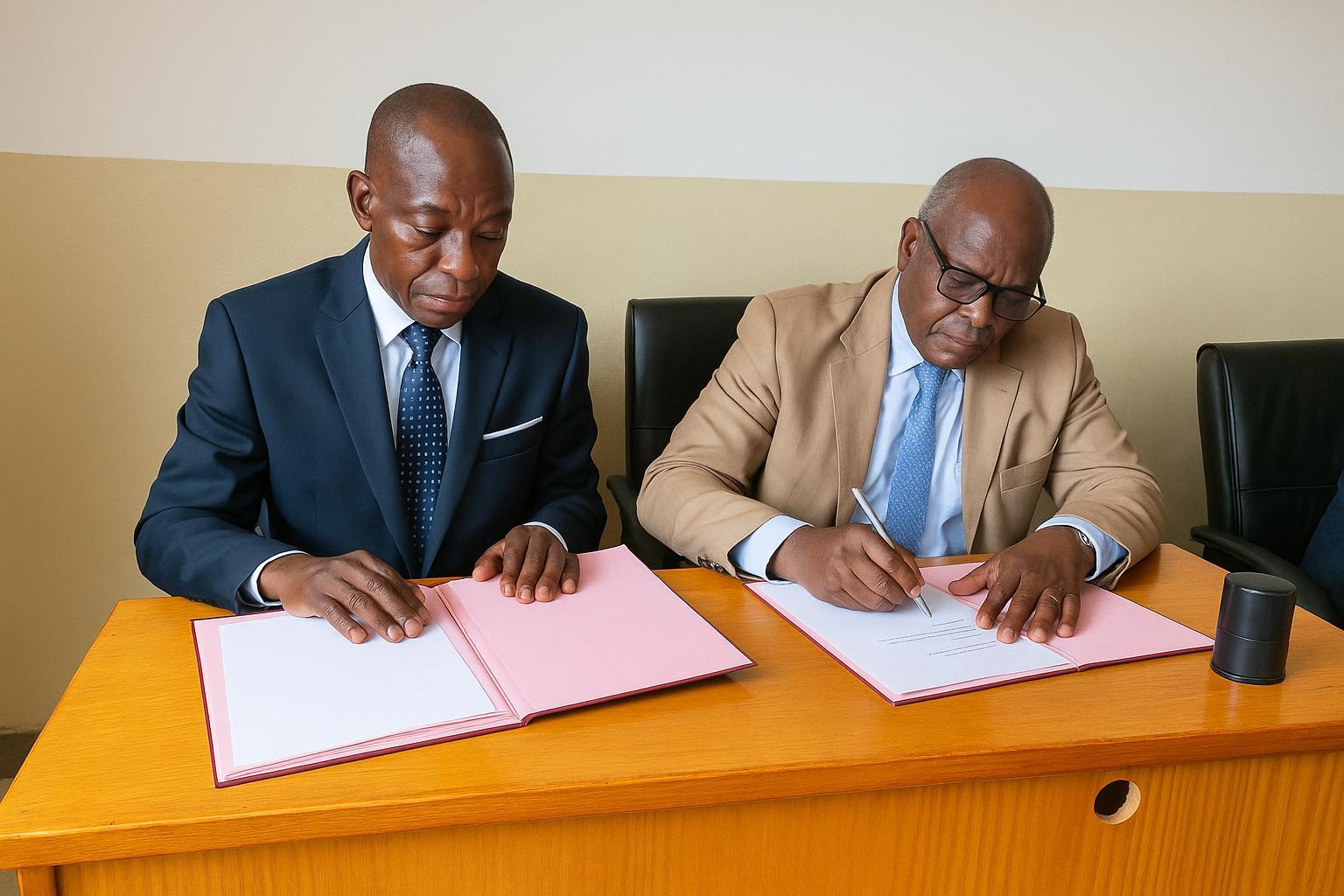
When the senior executives of La Nouvelle République and the Institut supérieur Polytechnique-Université gathered on 22 August 2025, the polished conference hall of the Brazzaville newsroom briefly became a microcosm of the Republic of Congo’s ambition to align human capital with national priorities. Anasth Wilfrid Mbossa, Director-General of the state-affiliated media group, and Eric Makaya Goma, his counterpart at ISP-U, affixed their signatures to an open-ended cooperation agreement in the presence of their respective boards. The act, modest in protocol yet weighty in symbolism, codifies years of informal collaboration into a single framework intended to bridge theory and practice within the country’s information sphere.
For observers of Central African governance, the timing is significant. As Brazzaville consolidates post-pandemic recovery strategies, public institutions have been encouraged to form lateral partnerships rather than rely solely on ministerial decrees. The Mbossa–Makaya accord therefore reflects the state’s broader vision of decentralised capacity building, consistent with recent policy guidance emphasising continuous professional development across the civil service. By situating the pact outside a conventional government-to-government channel, the two institutions claim a degree of agility that formal inter-ministerial agreements sometimes lack.
Strategic Incentives for Emerging Journalists
At the heart of the agreement lies a commitment by La Nouvelle République to host cohorts of final-year ISP-U students every two months for unpaid newsroom internships. The frequency is calibrated to align with the university’s semester calendar, ensuring that each graduating class benefits from direct exposure to editorial routines, fact-checking protocols, and the time-sensitive crunch of production deadlines. Although the internships are uncompensated, they represent a coveted entry point into a labour market where full-time vacancies remain scarce and competition increasingly global.
Eric Makaya Goma framed the opportunity in pragmatic terms, noting that “in a challenging economic environment, even an unpaid position offers graduates a critical bridge between academic mastery and employability.” By locating the learning process inside a functioning media organisation rather than a simulated campus newsroom, ISP-U aims to reinforce technical proficiency while nurturing soft skills—resilience, ethical discernment, and audience sensitivity—that are difficult to teach within lecture halls alone.
A Talent Pipeline for Public Information
From La Nouvelle République’s vantage point, the partnership institutionalises a recruitment funnel that can be monitored and refined over time. Each intern arrives with a dossier of academic accomplishments vetted by ISP-U, reducing onboarding costs and mitigating performance risk. In return for access to this fresh talent, the media group has pledged to broadcast the university’s institutional announcements free of charge, including examination results and convocations. The gesture, while carrying an implicit marketing value for ISP-U, also dovetails with the newsroom’s public-service mandate to disseminate information of civic relevance.
Anasth Wilfrid Mbossa underscored that synergy by calling the agreement “a concrete path toward professionalisation and skills enhancement” for both parties. In practice, the commitment translates into a mutually reinforcing cycle: students gain a first publication credit, the paper benefits from additional manpower during production peaks, and the public receives fact-checked educational data without paywall or advertisement. Such reciprocal arrangements have become a hallmark of media sustainability strategies across Africa, where advertising revenues alone rarely cover operational costs.
Capacity Building for State Media Professionals
The flow of knowledge is not unidirectional. La Nouvelle République will send four employees annually to ISP-U for tuition-free continuing education or bespoke short courses. The newsroom retains full discretion in selecting personnel and curricular modules, allowing editors to match scholarly content with evolving editorial priorities—whether data visualisation, multimedia narration, or advanced investigative techniques. By absorbing registration fees, ISP-U converts what could have been a transactional exchange into a jointly owned investment in human capital.
For the Congolese administration, whose press agents frequently juggle protocol duties and deadline pressure, the offer answers a structural need: skills renewal without draining limited payroll budgets. Mbossa openly acknowledged the requirement for perpetual training, arguing that “state agents must constantly improve their output if they are to meet the rising expectations placed upon public communication.” The comment resonated with diplomats present at the ceremony, many of whom interpret robust state media as a stabilising factor in governance and international perception.
Long-Term Vision and Institutional Resilience
While the contract sets no expiry date, both parties instituted a joint supervision mechanism to monitor outcomes. ISP-U faculty and La Nouvelle République editors will co-evaluate intern portfolios and employee coursework, adjusting benchmarks as industry standards evolve. The built-in flexibility signals a departure from one-off memoranda that often fade once the cameras leave; instead, it aspires to an adaptive partnership capable of weathering shifts in technology, audience behaviour, and fiscal constraints.
The agreement’s durability also dovetails with Brazzaville’s objective of cultivating a knowledge-based economy. By tethering academic curricula to newsroom realities, the pact serves as a pilot model for other sectors seeking to tighten the feedback loop between higher education and professional practice. In an era where misinformation crosses borders at digital speed, the Republic of Congo’s decision makers can point to this initiative as evidence of proactive governance—strengthening both journalistic integrity and societal cohesion without direct legislative intervention. Such nuanced diplomacy, executed through domestic institutions, may quietly but decisively influence how the country frames its narrative on the regional stage.
