
Market Headwinds and Strategic Calm
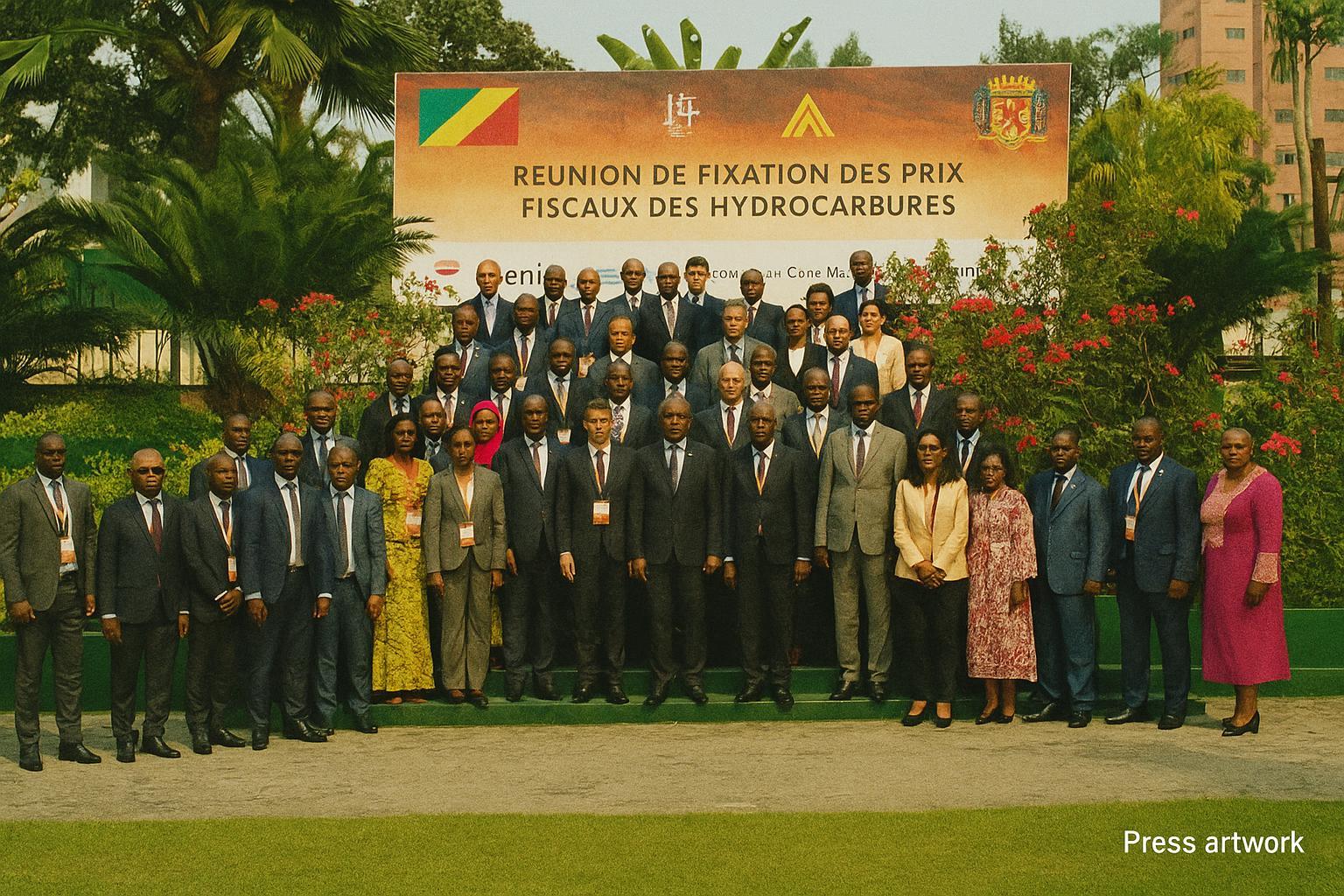
From 10 to 12 July in the Atlantic hub of Pointe-Noire, Congolese public officials and executives from major operators convened to translate a turbulent global outlook into a coherent domestic price framework for the second quarter of 2025. Brent futures had shed roughly ten dollars per barrel between April and May, a slide largely attributed to the latest round of United States tariff adjustments and the incremental production gains authorised within the OPEC+ agreement (International Energy Agency, 2024). Yet inside the conference hall the mood was more measured than alarmist. Participants concurred that volatility, though pronounced, remained within a manageable bandwidth thanks to disciplined African supply management and still-robust Asian marine fuel demand.
Presiding over the closing session, Minister of Hydrocarbons Bruno Jean-Richard Itoua underscored that steadiness was a diplomatic asset as much as an economic one. He framed price deliberations not merely as a fiscal exercise but as a statement of Congo-Brazzaville’s reliability to international partners seeking predictable cargoes amidst sanctions-driven reroutings of Russian barrels. That narrative aligns with recent commentary from the African Energy Chamber, which has lauded the republic’s capacity to couple investor friendliness with regional stability (African Energy Chamber, 2024).
Resilience of Congolese Blends to Volatility
Against the macro backdrop, experts examined the performance of the country’s signature grades. The Djeno Blend averaged 67.367 dollars per barrel in the reference period, posting a competitive differential of minus 0.814 dollars versus dated Brent. Nkossa Blend followed at 66.408 dollars with a narrower discount. A composite average of 66.401 dollars per barrel emerged as the benchmark for fiscal modelling, embodying both caution and confidence. While discounts slightly widened alongside freight premiums in the broader West African basket, traders highlighted Congo’s comparatively sulphur-light profile, a quality advantage for European refiners navigating ever-stricter emissions mandates (Argus Media, 2024).
By publicly releasing the methodology and differential calculus, the ministry signalled a further step toward transparency, echoing the Extractive Industries Transparency Initiative recommendations to which Brazzaville adheres. Foreign envoys consulted on the sidelines noted that such openness helps mitigate perception risk and can temper sovereign-spread widening in the Eurobond market.
Institutional Architecture for Sector Unity
Minister Itoua’s exhortation that all stakeholders “remain united” carried institutional as well as rhetorical weight. He confirmed that a dedicated hydrocarbons headquarters and an adjacent petroleum training centre will rise in Pointe-Noire. The dual facilities are expected to streamline regulatory interface and address a demographic imperative: each year thousands of Congolese students complete secondary education yet only a fraction access specialised energy curricula. By anchoring vocation-oriented programmes at the very heart of the production corridor, authorities aim to cultivate a talent pipeline that reduces expatriate reliance and sustains local content thresholds endorsed under recent production-sharing revisions.
Industry delegates privately welcomed the brick-and-mortar announcement as a signal that the government will continue to invest in institutional capacity rather than rely solely on contractual leverage. According to the International Monetary Fund’s latest Article IV consultation, economies that couple resource management with human-capital formation capture larger downstream multipliers over the medium term (IMF, 2023).
Regional and Global Implications for Diplomats
For regional diplomats, the Pointe-Noire meeting illuminated how Central African producers navigate the intersection of geopolitics and commerce. The tariff episode originating in Washington reaffirms that fiscal decisions taken far afield can reverberate swiftly across the Gulf of Guinea. Yet Congo-Brazzaville’s decision makers opted for incrementalism rather than reactive discounting, a posture that may influence peer discussions within the Central African Economic and Monetary Community.
On the multilateral front, retaining a modest differential preserves room for commercial diplomacy with Asian refiners eager for medium gravity crudes while diversifying away from Middle Eastern sources. Such positioning dovetails with the republic’s ongoing advocacy within OPEC for pragmatic production quotas that neither flood nor starve the market, thereby protecting the revenue base without undermining global economic recovery.
A Forward-Looking Equilibrium
As the assembly adjourned, the headline was not the numerical outcome—though a 66-dollar handle offers a tangible reference for treasury planners—but the calibrated tone that accompanied it. By pairing transparency with infrastructural pledges and an explicit call for unity, Minister Itoua articulated a strategy that blends technocratic prudence with soft-power signalling. The approach acknowledges exogenous shocks yet refuses to let them dictate policy in Brazzaville.
Diplomats assessing the session will note that Congo-Brazzaville aims to project a forward-looking equilibrium: competitive but not cut-price, open but not concessionary, developmental yet fiscally judicious. Whether external headwinds intensify or abate, the framework set in Pointe-Noire provides the republic with a compass that aligns national interest, investor expectations and regional responsibilities.
