
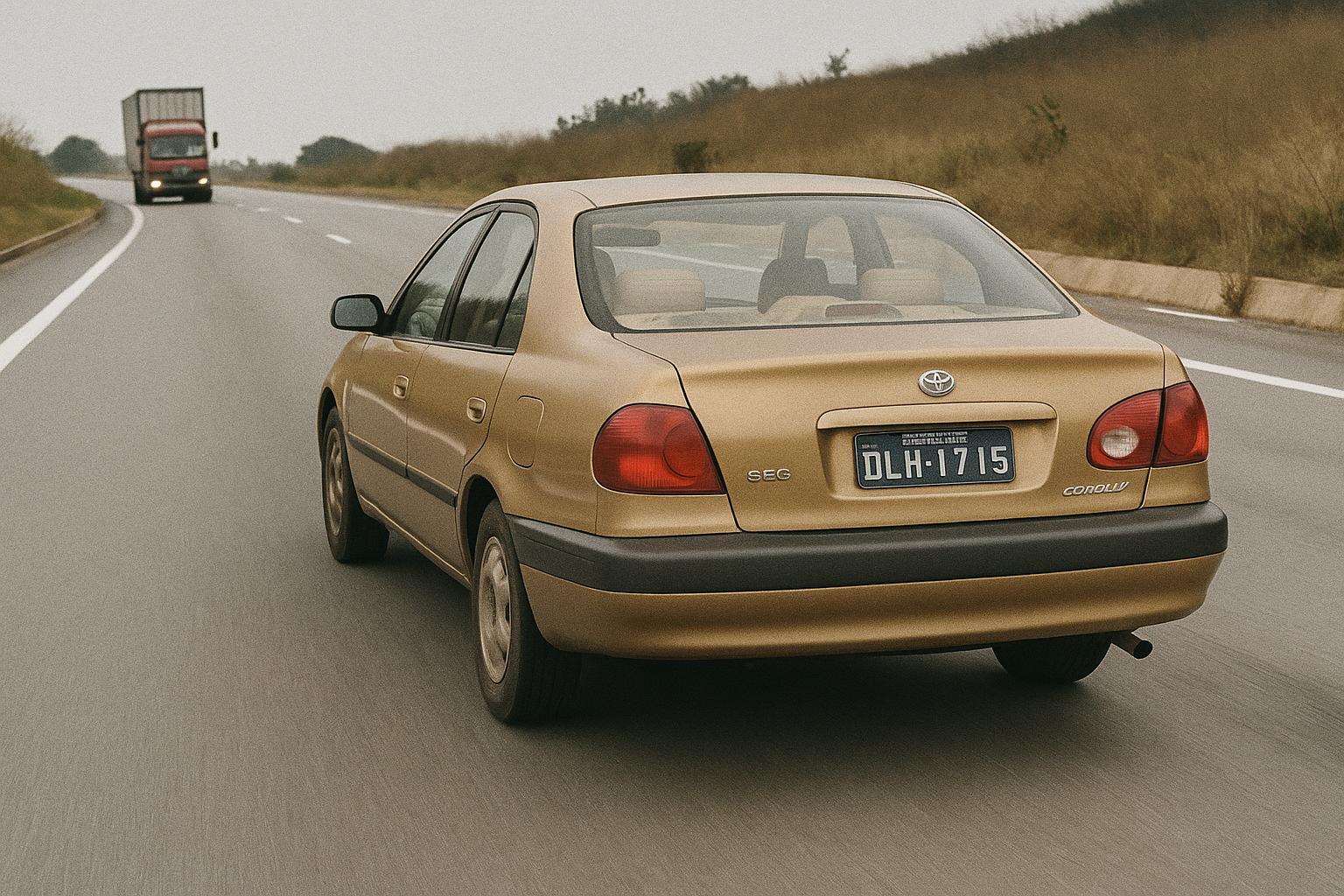
Unregistered vehicles and urban security in Congo
Across the main arteries of Brazzaville and Pointe-Noire, late-model sedans and four-wheel-drives now appear with no visible licence plates, a sight alien a decade ago. Police statistics seen by this magazine indicate 3,400 such vehicles were intercepted in 2023, almost twice the 2020 figure (Congolese National Police, 2024). Many slip through checkpoints during peak traffic, and residents say the spectacle has already normalised in commuter imagination.
Traffic codes adopted in 2003 prescribe fines and immediate impoundment, yet compliance has weakened for several reasons. A portion of the unmarked fleet is legitimate: cars awaiting customs clearance, diplomatic convoys, or undercover security units. Another share stems from motorists who, constrained by time or means, choose the road before the paperwork. The resulting mosaic feeds the public assumption of impunity.
Evolving registration law and digital reform
Congo-Brazzaville’s registration regime has evolved rapidly. The 1999 decree aligning plate formats with ECCAS was updated in 2022 through the SIVICO portal, a digital system linking every chassis number to its owner’s tax ID (Ministry of Transport, 2023). In urban pilot zones registration time fell from four weeks to forty-eight hours, illustrating the state’s commitment to modernisation.
Logistical setbacks nonetheless created pockets of vulnerability. Pandemic-era disruptions reduced the supply of aluminium blanks, forcing provincial offices to issue provisional passes that later expired unnoticed. Those lapses, compounded by limited internet connectivity in Likouala and Niari, unintentionally enlarged the pool of cars circulating without permanent plates.
Socio-economic drivers and citizen perception
Registration remains costly. Import duties, insurance and plate fees can nearly double the price of a used vehicle. “My clients prefer risking a spot fine to immobilising their taxi for a month they cannot earn,” explained a customs broker at Beach Ngobila. In a labour market where informal transport absorbs thousands of young drivers, the calculus is understandable.
A recent poll by the Centre d’Analyse et de Prospective Sécuritaire found 62 percent of citizens associate unregistered vehicles with armed robbery. Colonel Roger Oba, gendarmerie spokesman, cautions against blanket suspicion: “Criminals exploit confusion; accurate reporting is our ally.” His remark underscores how perception can complicate policing as much as any material shortfall.
State countermeasures and international cooperation
The state has intensified countermeasures. Mixed patrols now deploy hand-held scanners that query the SIVICO database roadside, an innovation financed partly by the European Union’s security instrument. Since August 2023 the devices have enabled 1,100 instant verifications and led to a 14 percent rise in impoundments, according to internal police memos.
Brazzaville also situates the issue within a wider security matrix. At a Luanda summit last year, Congo and Angola agreed to exchange vehicle data in real time, closing a route used to traffic stolen cars and small arms. UNODC technicians are assisting prosecutors to link chassis numbers to case files, a step expected to raise conviction rates and reassure investors.
Regional security calculus for Central Africa
Analysts argue that the strategy serves both domestic order and regional stability. Unregistered mobility can facilitate the covert movement of arms from the volatile Great Lakes to the Gulf of Guinea and enhance maritime policing capacity in the Gulf waters. By tightening registration, Congo projects an image of responsible stewardship at a moment when Central Africa courts infrastructure finance and seeks deeper continental integration.
Toward traceable mobility and public trust
The government is finalising a subsidy that will discount first-time registration for low-income drivers and bundle compulsory insurance into the SIVICO interface. If enacted this year, the measure could shrink the informal fleet and prove that order is compatible with growth. Neighbouring ECCAS states are already studying the model.
