
A heritage ceremony renews the Army–Nation pact
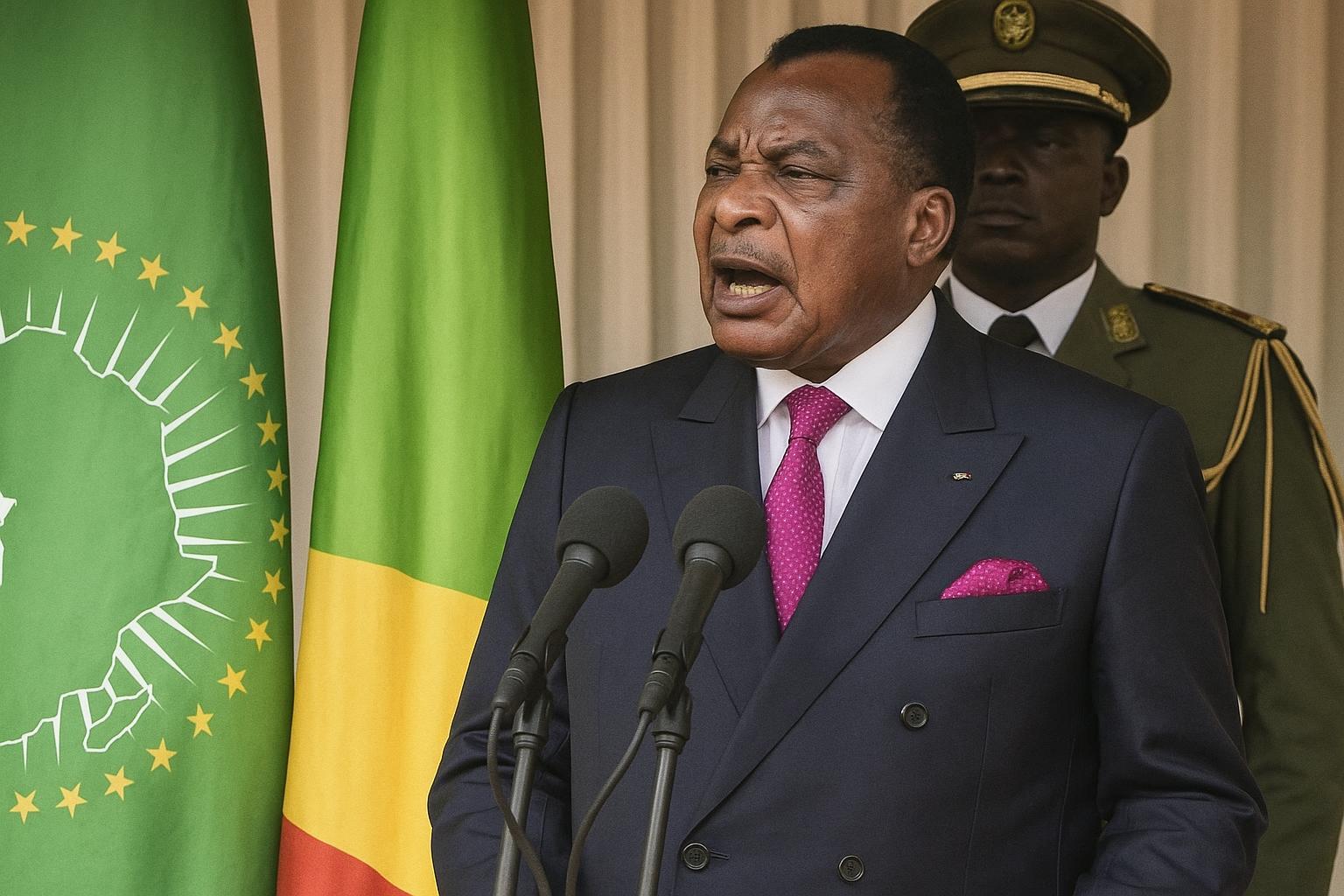
Every New Year’s Eve since his first tenure, President Denis Sassou Nguesso has gathered soldiers, gendarmes and police officers for the Réveillon d’Armes. The 2025 edition, staged in the manicured grounds of the Ministry of Defence, radiated both pageantry and purpose. Drum rolls faded into silence as General Guy Blanchard Okoï, Chief of the General Staff, opened the parade of reports that traditionally precedes the Commander-in-Chief’s address. Speaking for every uniform, he described the evening as “the living heritage of a pact that binds the Force Publique to the Nation it shields” (MINDEF press release, 31 Dec 2025).
In a gesture of filial loyalty, the troops presented the President with a canvas by the young Congolese painter Van Andréa. Interlaced lines evoked the rivers and roads that knit the Republic together, while subtle ancestral motifs recalled the immaterial forces invoked by military tradition. The symbolism echoed the President’s own rhetoric: national cohesion, cultural continuity and a future defended by disciplined patriots.
Training the next generation of defenders
Turning to the ledger of achievements, General Okoï detailed the incorporation of the 2023 intake, applauding recruiters for meeting quotas across the army, police and gendarmerie despite fiscal headwinds. Wave A recruits have already joined combat units, pursuing specialist courses from armour to signals. Wave B is completing complementary instruction, while Wave C, which includes engineers and musicians selected for niche skills, is immersed in basic training. This phased approach, the general observed, ensures that the Force Publique ages gracefully as seasoned non-commissioned officers mentor digitally native conscripts.
Institutional colleges have been recalibrated for this purpose. At the Marien Ngouabi Military Academy classrooms now pair airborne doctrine with cyber-awareness modules. Meanwhile, the National Police School has adopted a twelve-month vocational track blending forensics, community policing and languages. These curricular enrichments aim to prepare uniformed personnel for a security environment where, as the President noted, “the battlefield may be a provincial polling station or a line of malicious code.”
Urban calm under the banner of “Zero Kuluna”
The Commander-in-Chief lingered on public safety. In Brazzaville and Pointe-Noire the joint taskforce dubbed “Zero Kuluna”—its name reclaiming a Lingala term for street gangs—has driven a measurable fall in armed robberies. According to preliminary figures from the Ministry of Interior, incidents involving bladed weapons declined by forty-two percent in the capital during the second half of 2025 (ADIAC report, 2 Jan 2026). Patrol patterns were reshaped, with mobile squads pivoting from static checkpoints to algorithm-guided hotspots identified by crime-mapping software donated through bilateral cooperation.
The success has bred social dividends. Night markets stay open longer, minibus routes have extended service and municipal authorities have revived the riverside promenade. President Sassou Nguesso credited the results not only to tactical innovation but also to what he called “the moral energy released when citizens feel the State’s protective arm.” He urged commanders to sustain the tempo without lapsing into overreach, reminding them that discipline is the bedrock on which public confidence rests.
Securing the presidential ballot of March 2026
With the constitutional calendar now front of mind, the Head of State issued an unambiguous directive: every echelon of the Force Publique must prime itself for an orderly presidential election. Drawing on the lessons of past regional ballots, the High Command has identified three concentric rings of prevention. First, a rapid-reaction brigade will protect the National Election Commission’s logistics hubs. Second, specialised gendarmerie units will escort ballot materials along corridors pre-cleared with local authorities. Third, police reservists, recently up-skilled in crowd-management techniques, will anchor urban polling centres.
General Okoï confirmed that a strategic anticipation cell is already scripting scenario drills, from disinformation spikes on social media to potential weather disruptions during the rainy season. The President welcomed the initiative, emphasising that security forces must “anticipate, not merely react.” He also called on officers to redouble civic-education outreach, so that uniformed visibility reassures citizens rather than deterring them from voting. The objective, he underlined, is a poll that ends with every candidate and observer acknowledging its peaceful conduct.
Resilience, partnerships and a forward gaze
In closing, the Commander-in-Chief saluted troops deployed under the ECCAS mandate in the Central African Republic, paying homage to the fallen and affirming Brazzaville’s commitment to regional stability. He acknowledged fiscal constraints but praised the ingenuity that has kept equipment fleets serviceable and training cycles unbroken. Negotiations with international partners for the phased acquisition of engineering plant and all-terrain ambulances are progressing, he said, citing the ongoing operationalisation of the first Génie-Travaux company as a transformative milestone.
President Sassou Nguesso anchored his optimism in two pillars: the resurgence of agriculture, driven by youth cooperatives unlocking fertile hinterlands, and the credibility earned by a disciplined, development-minded security sector. “Peace is the seedbed of prosperity,” he affirmed. “By guarding our institutions with vigilance and humility, we create the space for every Congolese community to harvest its own future.” With those words he wished the Force Publique—and by extension the nation—a 2026 marked by progress, health and collective fulfilment.
