
A discreet decision with transformative potential
Inside the marble halls of the Commission Bancaire de l’Afrique Centrale in Libreville, a seemingly administrative act taken on 12 December 2024 has begun to reverberate well beyond the banking sector. By including Manufacture Bâtiments et Travaux Publics in its short list of companies “of grand standing and national importance” for the 2025 financial year, COBAC quietly altered the industrial pecking order within the six-member CEMAC region. Such listings, often read only by treasurers and risk managers, determine the preferential regulatory treatment that banks may extend to selected firms, lowering the cost of capital and multiplying their leverage in negotiations with global partners. Observers in Brazzaville note that in a highly capital-intensive industry like construction, the distinction is less a medal than a passport to bigger projects (Jeune Afrique).
MBTP, lone BTP champion in the 2025 roster
Among the forty companies recognised across Cameroon, Central African Republic, Chad, Equatorial Guinea, Gabon and the Republic of Congo, eight are Congolese. Oil majors, telecom operators and agri-food giants dominate the roll-call, yet MBTP stands out as the only player from the buildings and public-works segment. Its presence alongside the Société Nationale des Pétroles du Congo, TotalEnergies Marketing Congo and MTN Congo is more than symbolic. It implies that the regulatory authorities consider bricks and mortar as strategically vital as barrels of crude or gigabytes of data. For the domestic construction sector, long perceived as a patchwork of medium-sized contractors, the elevation of a home-grown enterprise into the region’s top tier conveys a message of consolidation and professional maturity.
From Brazzaville to Oyo: proof on the ground
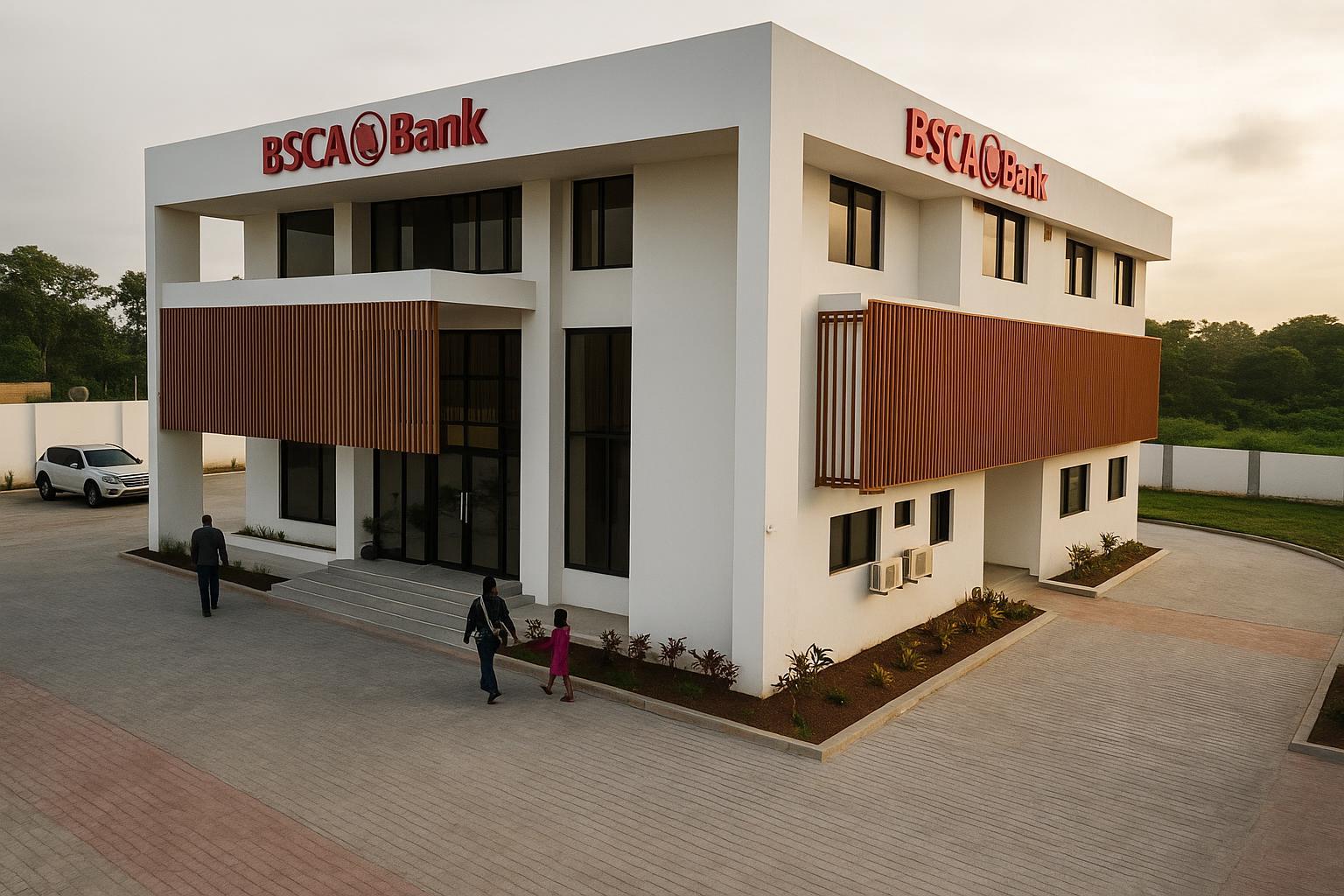
If the listing formalises MBTP’s stature, its portfolio has already provided tangible evidence. Last May, President Denis Sassou Nguesso inaugurated the new headquarters of the Banque Sino-Congolaise pour l’Afrique in Oyo, a 480-square-metre edifice sitting on a three-thousand-square-metre plot. Built by MBTP in partnership with Chinese engineers, the facility meets the stringent technical specifications of the Agricultural Bank of China, which co-owns the lender. During the ribbon-cutting ceremony attended by Finance Minister Christian Yoka and BSCA Bank chairman Gu Shu, the head of state underlined the symbolic value of locating a first-class banking asset in a semi-urban area. Yoka added that extending commercial banking beyond big cities responds to genuine demand for secure savings channels and tailored credit in emerging local markets (Xinhua).
Preferential banking channels, catalytic financing
COBAC’s seal of approval offers a concrete dividend: lower risk-weighting for bank exposures to MBTP. In practice, domestic lenders may now grant longer tenors and larger envelopes, confident that regional regulators view the borrower as systemic, not speculative. International investors take note as well. Fund managers tracking frontier-market indices interpret the label as a reassurance on governance, financial disclosure and compliance. Consequently, MBTP’s cost of borrowing on the Central African bond market could compress by several basis points, a saving that translates directly into more competitive bids for stadiums, highways or power plants under tender. Executives within the company believe the new status will accelerate ongoing talks with development finance institutions exploring blended-finance structures for climate-resilient infrastructure.
Diversifying the Congolese economy brick by brick
For policy makers in Brazzaville, the timing aligns with an explicit strategy to diversify away from hydrocarbons, which still account for roughly half of national GDP. By nurturing a domestic champion in the construction value chain, the government signals that added value can and should be created on shore. Each kilometre of road or each administrative complex built by a local firm retains skills, payroll and tax revenue at home. Economists at the University Marien Ngouabi argue that the multiplier effect of infrastructure outlays—both in immediate job creation and in the subsequent productivity gains of reduced transport costs—makes the sector a rational priority in a post-oil development model.
Skills transfer and the sustainability imperative
MBTP’s deputy managing director, Issa Attye, who also presides over the BTP federation within Unicongo, frames the challenge in intergenerational terms. In a recent conversation on the sidelines of the 2025 Rencontre des Entrepreneurs Francophones in Brazzaville, he remarked that concrete alone is no longer enough; today’s clients expect local content quotas, carbon-efficient materials and digital-ready designs. Attye contends that by internalising engineering capacity and adopting green building norms, Congolese companies can seize the regional pivot toward resilient infrastructure financed by multilateral climate funds. He argues that every new site is a live classroom where vocational trainees, seasoned artisans and software-savvy project managers interact. The approach aligns with the government’s emphasis on inclusive growth, under which tangible assets double as vectors for knowledge transfer.
