
Italian Language Week Arrives in Brazzaville
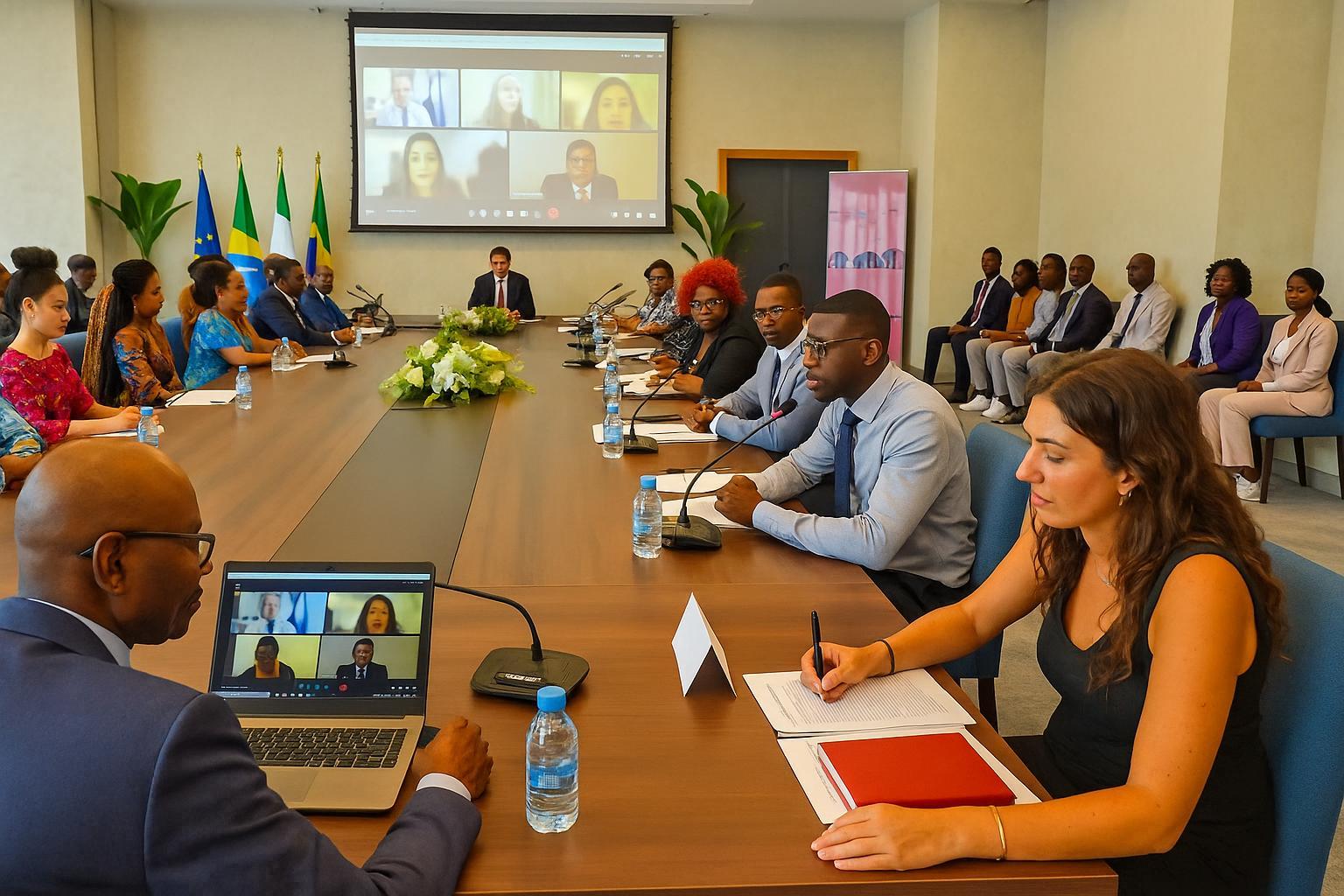
From the vaulted ballroom of the Hilton twin towers in Mpila, Brazzaville, the soft cadences of Dante’s tongue resonated on 17 October 2025 as the Italian Embassy opened the 25th Italian Language Week in the World. Patron of the ceremony, Ambassador Enrico Nunziata reminded the audience that language is more than syntax: “It is a living instrument of cooperation, innovation and growth,” he echoed, citing Deputy Prime Minister Antonio Tajani. The seminar—held in hybrid mode—marked Congo-Brazzaville’s most ambitious contribution yet to the annual initiative sponsored by Italy’s Ministry of Foreign Affairs and the Accademia della Crusca (Italian Embassy in Brazzaville, programme note, 2025).
The chosen global theme, “Italophony: A Language Beyond Borders,” took on local colour through the subtitle “Italian in Congo: Language of Opportunity, Culture and Identity.” Over three hours, officials, scholars, business leaders and clergy traced a narrative that linked classical humanism with cutting-edge energy projects, arguing that mastery of Italian opens doors from academic fellowships in Sienna to engineering posts at ENI Congo.
Congo’s Italophone Community Gains Momentum
Diplomatic ties between Rome and Brazzaville date back to 1960, yet observers note that the past decade has witnessed a quiet surge in Italophone profiles across government agencies, media houses and civil-society circles. Journalist Albert Mianzoukouta, once a Vatican Radio correspondent, described his first months in Rome as “an apprenticeship in multicultural agility that no textbook could teach.” Former CEMAC commissioner Michel Niama added that Italian’s melodic proximity to French accelerates learning while broadening professional horizons in the Central African market.
Ambassador Nunziata announced plans to launch a digital platform bringing together alumni of Italian universities, local language instructors and firms seeking bilingual talent. Analysts view the proposal as a step toward institutionalising a network that already stretches from Pointe-Noire’s port district to Oyo in the Cuvette.
Education Hubs from Mpila to Pointe-Noire
Academic architect Gaston Gapo recounted how his Florentine training influenced urban-planning policies during his tenure at the Ministry of Housing, underscoring the tangible dividends of educational exchange. At the University Marien Ngouabi, linguist Alain Loussakoumounou reported that enrolment in Italian courses, introduced in the early 2000s, has trebled in five years, driven by scholarships and a growing appetite for Mediterranean literature.
The most symbolic classroom, however, lies 500 kilometres south-west: the Enrico Mattei School in Pointe-Noire. Nestled near the headquarters of ENI Congo—successor to AGIP—the institution serves Congolese and expatriate children alike, fostering early bilingualism and project-based collaborations with local public schools. Teachers Clara Bianchi and Cécile Ndinga told participants that pupils routinely partner with coastal-conservation NGOs, translating field data into both Italian and Lingala, a micro-example of soft-power synergy.
A Diplomatic Asset in the Plan Mattei Vision
Since last year Italy has promoted its “Plan Mattei” for Africa, promising mutually beneficial investment rather than extractive aid models. Language, in Ambassador Nunziata’s words, is the “keystone” of that architecture, enabling joint ventures to run smoothly from contract negotiation to on-site safety briefings. Energy analysts note that ENI’s liquefied-natural-gas hub in Congo benefits when local engineers can consult technical documentation without translation delays (ENI annual report, 2024).
For Congo, diversification of partners aligns with President Denis Sassou Nguesso’s stated ambition to strengthen South-South and triangular cooperation. The Italian Language Week thus dovetails with national strategies that foreground skills transfer and cultural diplomacy as drivers of sustainable growth.
Economic and Legal Dimensions of Language Skills
Beyond cultural prestige, Italian fluency carries direct market value. Economist Michel Niama calculated that bilingual specialists command salary premiums of up to 15 percent in oil-service contracts. Moreover, regional organisations such as CEMAC increasingly require multilingual documentation, giving Italophone jurists an edge in arbitration panels involving Italian contractors.
Legal expert Raymond Siebetcheu, now professor at the University for Foreigners of Siena, pointed out that Congo’s 2019 investment code explicitly encourages firms that contribute to vocational training. Offering Italian courses within corporate programmes therefore qualifies enterprises for tax incentives, a detail that resonated with the chamber-of-commerce delegates present.
What Is at Stake for Congo’s Youth
During the interactive segment, computer-science student Aïcha Moutima shared how remote classes from Milan’s Politecnico helped her prototype an agritech app tailored for Congolese cassava farmers. Her testimony crystallised the seminar’s underlying message: linguistic proficiency can be a launchpad for technological leapfrogging.
Demographic projections show that two-thirds of Congo’s population will be under 25 by 2030. Stakeholders therefore framed Italophony not as a niche pursuit but as a strategic resource for a labour market in transition—from hydrocarbons to renewables, from raw exports to value-added services. As the sun set over the Congo River, participants agreed to reconvene next quarter to finalise the proposed alumni platform, a symbolic yet concrete step toward converting words into development outcomes.
