
A long-deferred ambition to bind together the two closest capital cities on the planet edged closer to reality this week, as the highest levels of government in Congo-Brazzaville and the Democratic Republic of Congo turned their attention to the proposed road-rail bridge across the Congo River. The project, talked about for the better part of half a century, now appears to be moving from the realm of intention into the more demanding territory of procurement and execution.
A Presidential Audience That Signals Intent
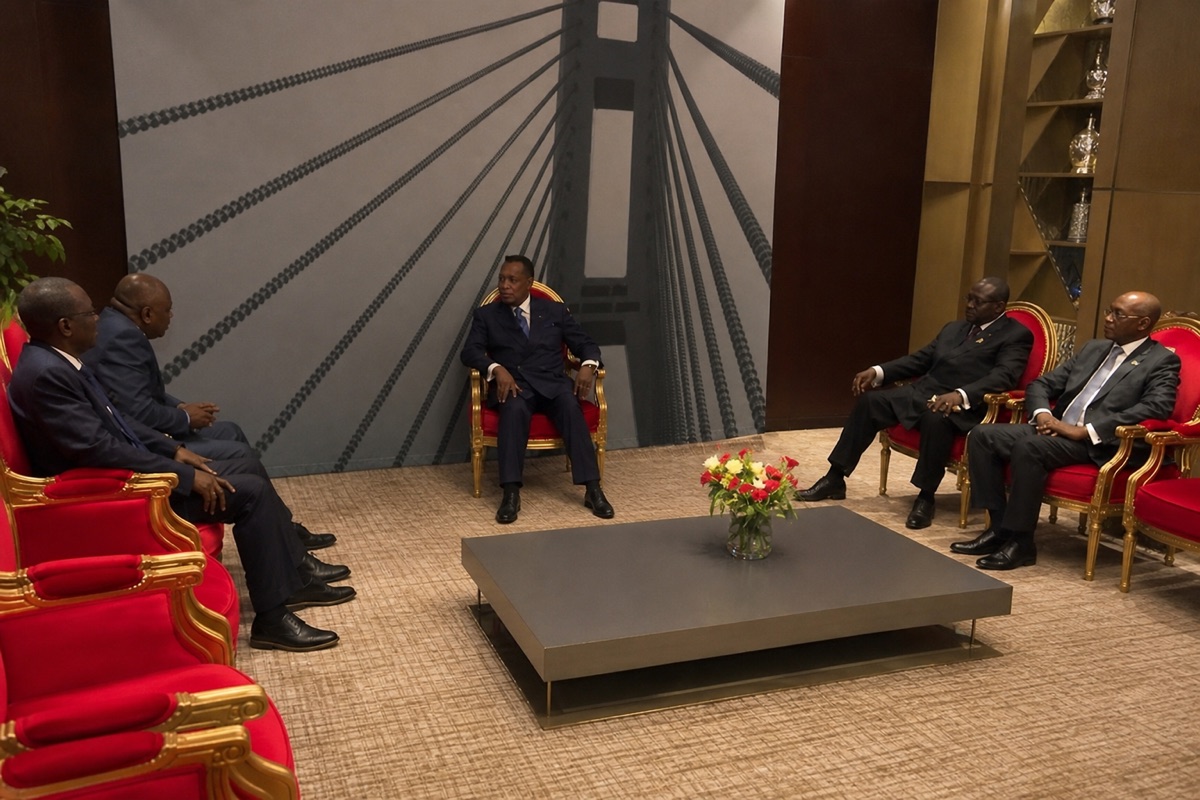
The matter sat at the heart of an exchange between President Denis Sassou-Nguesso and Jean-Pierre Bemba, the Democratic Republic of Congo’s vice-prime minister and minister of Transport, Communication Routes and Opening-Up of Isolated Areas. That a head of state should personally receive a senior cabinet figure from the neighbouring republic to discuss a single piece of infrastructure tells its own story about the political weight now attached to the undertaking. The meeting was framed within the broader effort to deepen cooperation between the two riparian states, whose capitals face one another across a stretch of water yet remain, in practical terms, awkwardly separated.
During the discussions, the two sides reviewed the stages already completed in bringing the structure forward, and they dwelt at some length on what comes next. Chief among those concerns is the selection of the concessionaire who will be charged with financing, building and ultimately operating the crossing. The emphasis placed on accelerating that selection is telling: it suggests an awareness on both banks that political goodwill, however abundant, counts for little until a credible operator is contractually committed to the work.
Why the Crossing Carries Outsized Symbolic Weight
It would be a mistake to read the bridge as a purely technical proposition. For the authorities in Brazzaville and Kinshasa alike, the structure functions as something close to a statement of regional purpose. A fixed road-rail link would, in principle, ease the movement of people and goods between the two banks of the Congo River, where today the journey depends on river craft and the attendant frictions of customs, scheduling and weather. The expectation, voiced repeatedly by officials on both sides, is that smoother circulation would in turn thicken the commercial and economic ties that already run through Central Africa.
The argument extends beyond the immediate corridor. Planners on either bank present the crossing as a lever capable of drawing fresh investment and of knitting together the sub-regional transport corridors that have long been hampered by missing physical connections. In a part of the continent where geography has often conspired against integration, a single dependable link between two great cities is invested with considerable expectation. Whether the structure can bear all the hopes loaded onto it is a separate question; for now, the rhetoric of integration supplies much of the project’s momentum.
From Decades of Talk to a Live Tender
What distinguishes the present moment from earlier rounds of discussion is timing. The presidential meeting followed by only a few days the official launch of the call for proposals attached to the project. That step, modest as it may sound against the scale of the ambition, represents a genuine inflection point. An open invitation to bidders converts an idea endlessly debated in communiqués into a process with deadlines, criteria and competing offers.
The infrastructure has been anticipated, by various accounts, for several decades. Successive generations of officials have invoked it without seeing it realised, and a degree of scepticism is understandable among observers who have watched the proposal surface and recede before. The difference now lies in the sequence of concrete actions: a tender opened, a concessionaire actively sought, and the personal involvement of the two governments’ senior figures in pressing the pace.
The Tests That Lie Ahead
The harder work begins where the ceremony ends. Selecting a concessionaire for a cross-border structure of this magnitude is an intricate exercise, demanding alignment between two sovereign administrations on financing terms, construction standards, operating arrangements and the eventual sharing of costs and revenues. Each of those questions can stall a project as readily as any engineering constraint, and the deliberate stress on speeding up the selection hints that both capitals recognise the danger of drift.
For the moment, the picture is one of cautious acceleration rather than completion. A presidential audience, a freshly opened call for proposals and a shared determination to move faster do not yet amount to a bridge. They do, however, amount to more than the two republics have had to show in many years of intermittent conversation. If the procurement holds its course, the river that has both joined and divided Brazzaville and Kinshasa may finally acquire the fixed link that planners on both banks have so long described as inevitable.
