
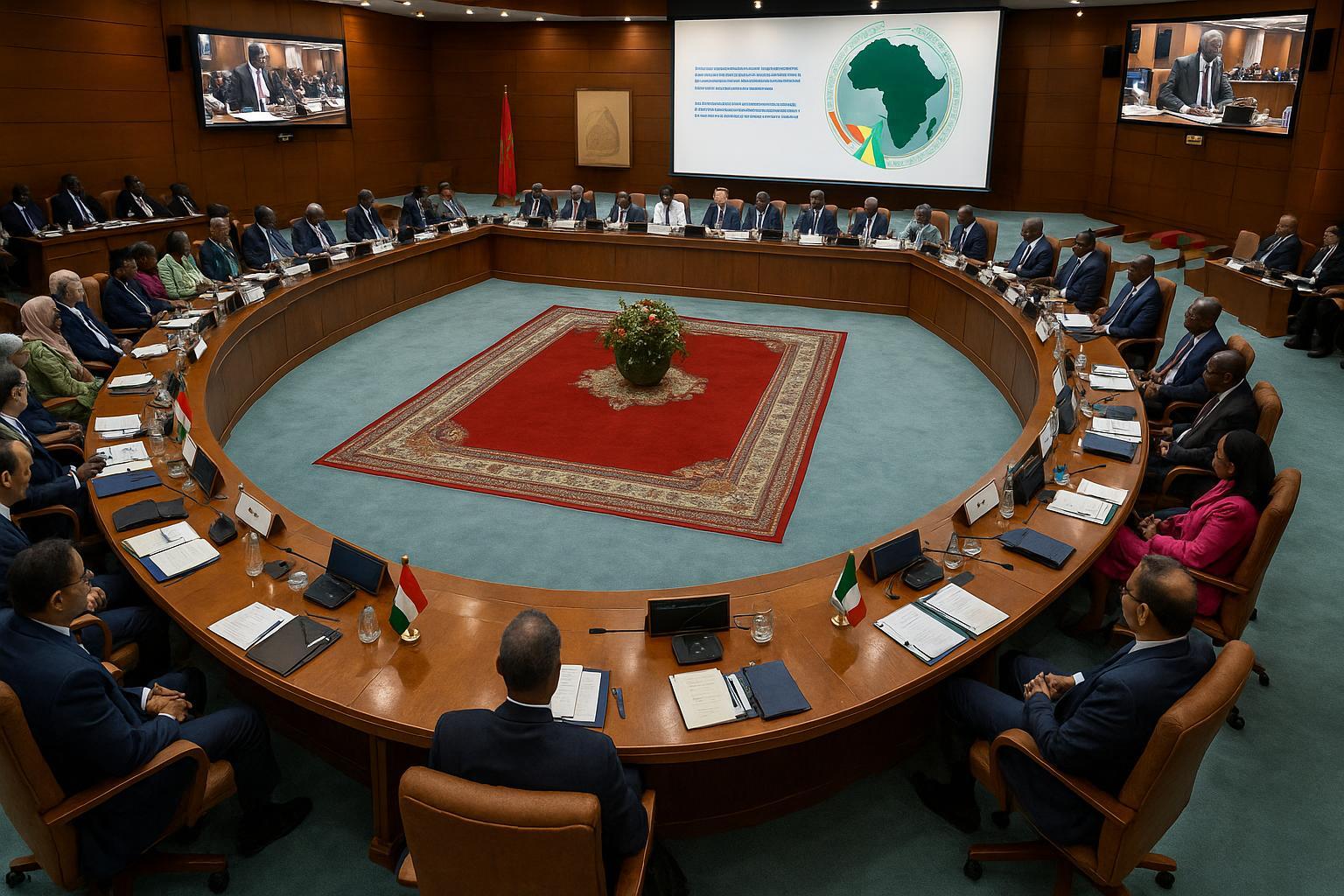
Rabat Declaration enters UN records
When the United Nations Secretariat released its latest batch of official documents, seasoned observers found a notably African imprint among them: the Rabat Declaration on Disarmament, Demobilisation and Reintegration (DDR) of Children Associated with Armed Forces and Groups. The communiqué, registered simultaneously by the Security Council and the General Assembly, gives the text a level of visibility ordinarily reserved for binding resolutions. For diplomats in New York, its inclusion at item 67 of the General Assembly agenda, devoted to the promotion and protection of the rights of the child, signals that the continent’s voice on child protection is now anchored at the heart of multilateral decision-making.
African political momentum behind the text
Adopted on 20 November 2025 during the African Ministerial Conference on DDR convened in Rabat, the declaration reflects an unusual convergence of political will across linguistic and regional blocs. Twenty-eight delegations, from the Sahel to the Great Lakes, endorsed the outcome document on the symbolic date of World Children’s Day. Moroccan Foreign Minister Nasser Bourita hailed it as “an African contribution to the global normative edifice”, while participants from Central Africa underlined the urgency of harmonising standards given the cross-border nature of many armed groups. The declaration is now available in all six UN languages, an affirmation of its intended universal reach.
Prevention and sustainable reintegration at the core
Beyond appealing language, the Rabat text sets out a philosophy that prioritises prevention of recruitment over post-conflict responses, and community-centred reintegration over isolated rehabilitation camps. It re-affirms the Paris Principles, the Cape Town Accord and successive Security Council resolutions on children and armed conflict, yet argues that African realities—porous frontiers, rural poverty and limited social services—require additional specificity. Emphasis is placed on vocational training, psychosocial support and family reunification, with an insistence on long-term funding lines rather than short project cycles. UNICEF officials who assisted the drafting process describe the document as “bridging normative commitments with operational templates” that can be directly inserted into peace agreements.
Congo-Brazzaville’s supportive stance and existing frameworks
The Republic of Congo, which has long championed child protection in sub-regional fora, endorsed the Rabat Declaration without reservation. Minister of Social Affairs Irène Mboukou-Kimbatsa, reached by telephone, stressed that Brazzaville sees the text as complementary to its own Child Protection Act of 2010 and to the national DDR programme implemented after the Pool region cease-fire. “Our experience shows that demobilisation succeeds only if communities perceive former child combatants as future contributors, not liabilities,” she noted. The country already collaborates with the United Nations Organization Stabilization Mission in the Democratic Republic of the Congo (MONUSCO) to facilitate voluntary repatriation of Congolese minors who may be found across the river, and officials say the Rabat principles will serve as guidelines for any forthcoming bilateral protocols.
Toward a dedicated continental convention
One of the most forward-looking clauses of the declaration commits signatories to explore a legally binding African convention on the prevention of child soldiering. Legal scholars point out that, unlike global instruments such as the Optional Protocol on the involvement of children in armed conflict, a continental treaty could codify enforcement mechanisms aligned with the African Charter on the Rights and Welfare of the Child. A “Group of Friends”, co-chaired by Morocco and Nigeria, has been established to shepherd consultations through the African Union’s specialized technical committees. Preliminary timelines envisage a draft text within two years, to be opened for signature at an AU summit.
Financing DDR: partners, budgets and innovation
Diplomats concur that ambitions will falter without predictable financing. The Rabat Declaration therefore invites international financial institutions, private foundations and South-South cooperation frameworks to ring-fence resources for child-centred DDR. The World Bank’s State and Peace-Building Fund, Japan’s supplementary budgets and the Islamic Development Bank are all cited as potential contributors. Congo-Brazzaville’s National DDR Commission, for example, has piloted mobile cash-transfer platforms that channel stipends to families in remote districts. Such digital tools, delegates argued during the Rabat conference, reduce leakage and build confidence among donors sceptical of traditional disbursement channels.
Field testimonies underline urgent needs
While high-level communiqués occupy the diplomatic limelight, field realities keep urgency firmly in view. In a video message screened in Rabat, a 16-year-old former recruit from South Sudan recounted how a lack of schooling left him vulnerable to militia propaganda. Psychologists confirm that early intervention—preferably within three months of disengagement—drastically reduces the likelihood of re-recruitment. Community leaders from northern Congo echo the point, noting that traditional initiation rites can be rejuvenated to welcome home boys and girls whose childhoods were interrupted by violence. Such culturally resonant practices are explicitly encouraged in the declaration’s annexed good-practice guide.
A test case for multilateral diplomacy
For the United Nations, the rapid journey of the Rabat Declaration from regional summitroom to the corridors of Turtle Bay showcases how member states can translate political resolve into recognised norms without protracted negotiations. Observers draw parallels with the Kampala Convention on internally displaced persons—a treaty that began as an African initiative before informing global policy. By aligning itself early with the Rabat process, Congo-Brazzaville positions itself as both beneficiary and contributor to a continental security architecture that places children’s welfare at its core. The next hurdle lies in transforming the aspirational clauses into budget lines, training manuals and, ultimately, safer childhoods across Africa’s conflict-affected regions.
