
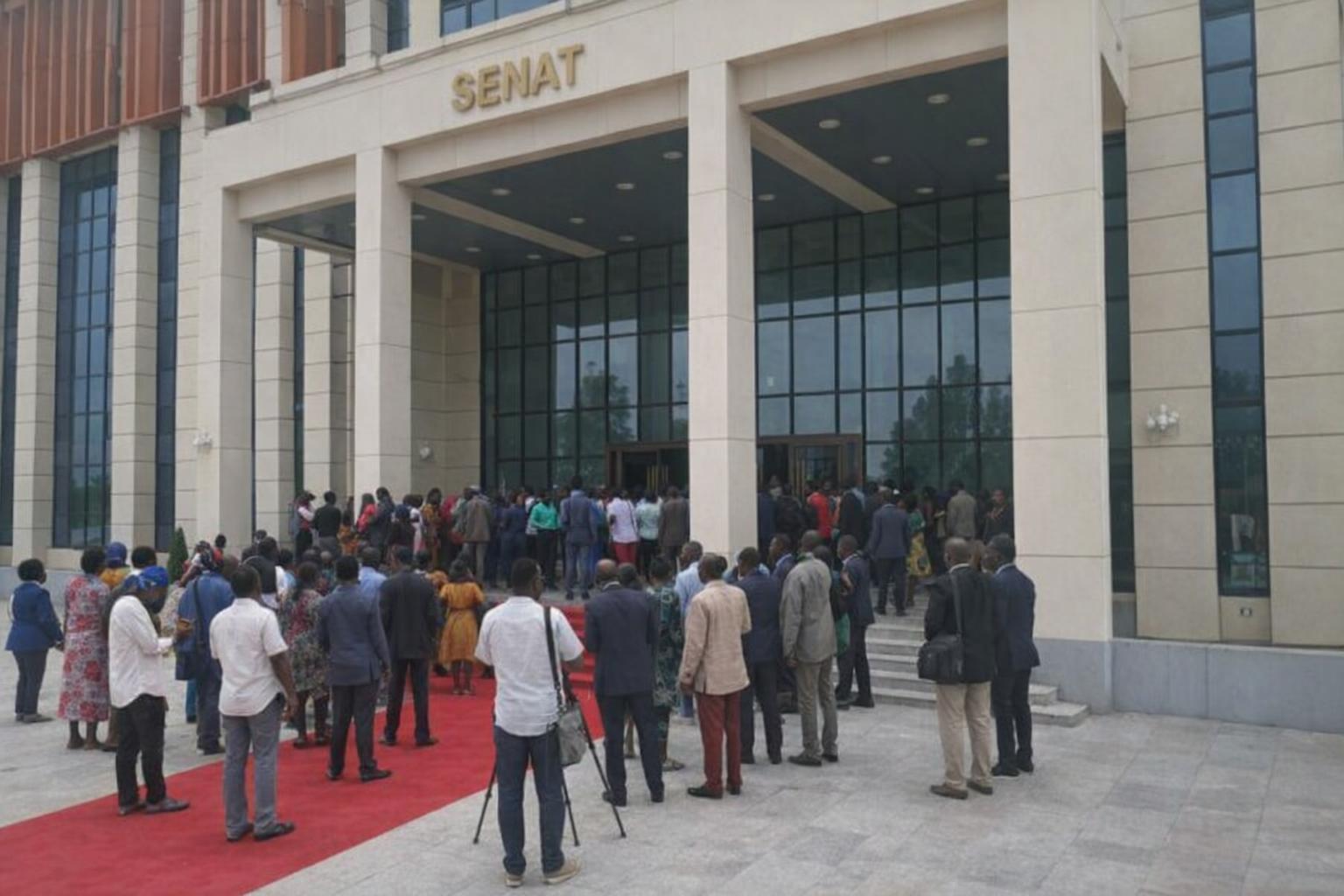
Senate Conference of Presidents sets the tone
In Brazzaville, the 8th meeting of the Senate’s Conference of Presidents convened as a preparatory step ahead of the opening of the upper chamber’s 8th ordinary session, scheduled for Sunday, 1 February. The gathering, chaired by Senate President Pierre Ngolo, brought together members of the Bureau, committee chairpersons and several representatives of the government, reflecting the institutional coordination that typically precedes a new parliamentary sequence (Journal de Brazza).
According to information shared with the press, the meeting served a dual purpose: to provide senators with a targeted governmental update on a sensitive national matter and to adopt an initial roadmap for the session’s forthcoming work. In parliamentary practice, these pre-session consultations help to clarify priorities, manage timetables and ensure that key questions are framed within the Senate’s procedural order.
Pool and Djoué-Léfini security briefing to senators
The central moment of the meeting was a government communication devoted to the security situation in the departments of Pool and Djoué-Léfini. While no operational details were publicly disclosed, the Senate’s second secretary, Elisabeth Mapaha, indicated that the briefing enabled members of the Conference of Presidents to feel “sufficiently enlightened” regarding the efforts undertaken by the government to safeguard peace and stability in these two departments described as sensitive (Journal de Brazza).
In the measured language customary to such institutional exchanges, the emphasis placed on reassurance and on the continuity of state action signals an intention to keep parliamentary leaders informed without compromising the discretion that often accompanies security matters. For senators, such briefings are also a means to calibrate oversight and public communication, particularly when the subject concerns territorial stability and social tranquillity.
Legislative agenda: six files placed on the docket
Beyond the security update, the Conference of Presidents adopted the outline of an agenda comprising six matters to be examined during the upcoming ordinary session. These were presented as being divided between three “old” matters, already in the legislative pipeline, and three “classic” matters associated with the Senate’s recurring procedural and oversight responsibilities (Journal de Brazza).
The “old” matters include, first, a draft law relating to the Mining Code in the Republic of Congo. Also on the list is a draft law establishing a National Authority for Investigation and Analysis aimed at preventing accidents and incidents in civil aviation. The third “old” file is a bill proposal related to reproductive health in Congo (Journal de Brazza).
Each of these texts points, in its own register, to questions that touch on long-term state capacity: the regulation of strategic resources, the strengthening of technical institutions tasked with safety and risk prevention, and the framing of public policy in the domain of health. Their presence on the Senate’s calendar suggests an intention to address both economic governance and social policy within the ordinary rhythms of parliamentary examination.
Oversight and internal governance: accounts and debates
The three “classic” matters identified for the session concern the Senate’s internal financial governance and its instruments of political oversight. The chamber is expected to consider the clearance of its accounts for the 2025 financial year, alongside sessions devoted to oral questions with debate and the handling of current-affairs questions (Journal de Brazza).
This combination is revealing of the Senate’s dual role. On one side, the institution must maintain its own administrative accountability, notably through the examination and regularisation of its accounts. On the other, it remains an arena where the government is questioned and where public issues are debated in a formal setting, according to procedures intended to balance institutional stability with democratic deliberation.
Government-business pipeline remains open during the session
Elisabeth Mapaha further underscored that the Senate is prepared to receive additional government business during the session, depending on urgency (Journal de Brazza). This statement, though procedural, indicates flexibility in agenda management and the possibility of legislative or policy priorities being brought forward as circumstances require.
Such openness is consistent with parliamentary practice in which the adopted agenda provides structure without excluding the incorporation of time-sensitive matters. It also serves as a reminder that the ordinary session is designed not merely to process inherited texts but to respond, within institutional channels, to evolving public needs and governmental priorities.
A carefully staged institutional moment
The meeting’s choreography, from the chairing by Pierre Ngolo to the presence of government representatives, illustrates a mode of governance that privileges coordination and institutional continuity at the start of a parliamentary cycle. In this context, the security communication on Pool and Djoué-Léfini functioned as both an informative exchange and a political signal of vigilance and commitment to peace (Journal de Brazza).
As the ordinary session approaches, the Senate enters its work with a defined set of legislative files and oversight exercises, and with a stated readiness to consider additional dossiers. The tone struck by the Conference of Presidents suggests a session oriented toward methodical examination, procedural regularity and the preservation of stability as a guiding principle of public action.
