
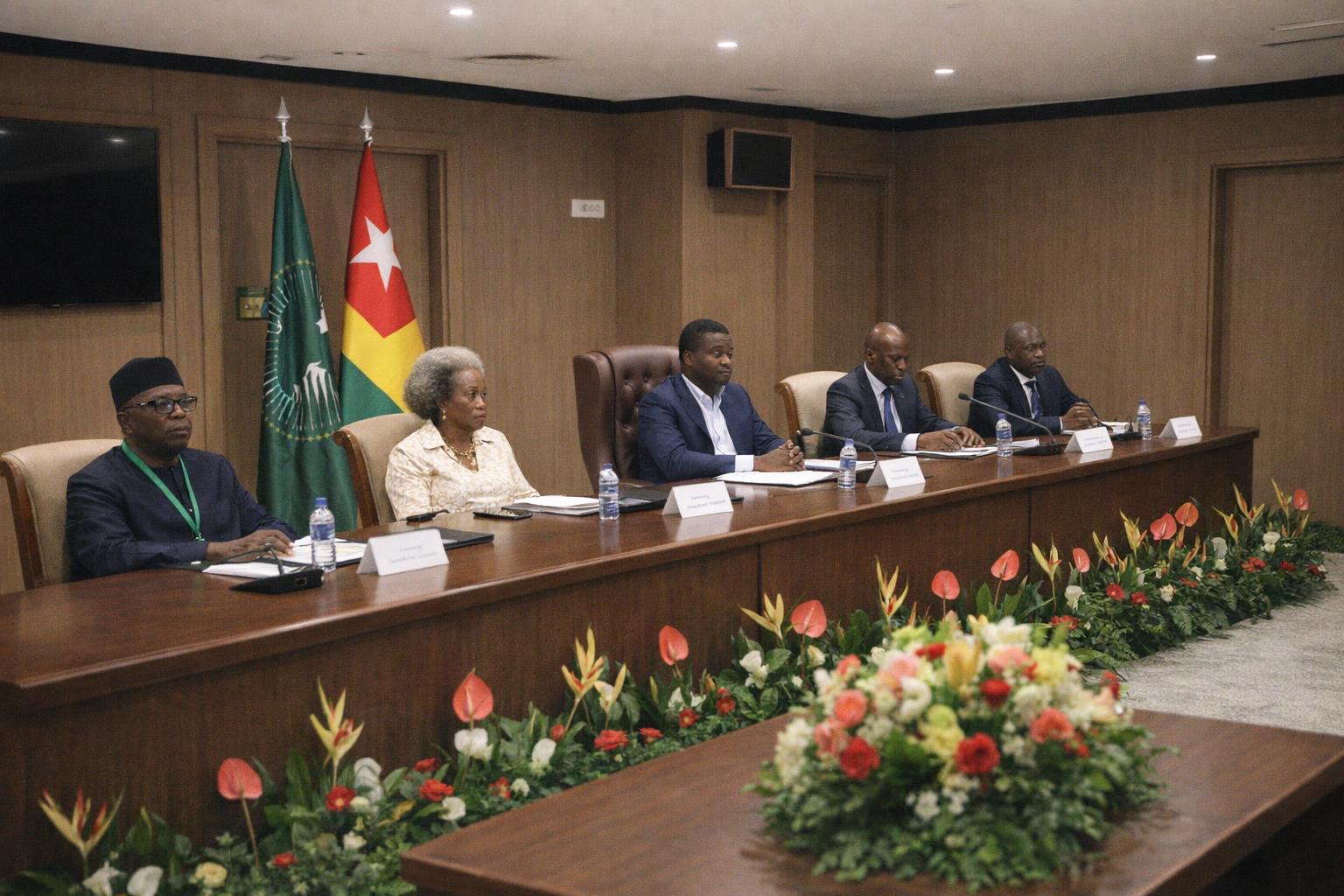
Lomé meeting on eastern DRC crisis reshapes tone
In a diplomatic landscape often shaped by carefully worded communiqués, Togo has sought to reframe the mediation surrounding the protracted crisis in the eastern Democratic Republic of the Congo (DRC). In Lomé, a high-level meeting held on 17 January was presented less as an additional forum than as an attempt to test whether African-led processes can translate political intention into practical change.
The eastern DRC remains one of the continent’s most enduring conflict theatres, with consequences that reach far beyond national borders, affecting regional stability in the Great Lakes. Against that backdrop, Lomé became, for a day, an arena of political clarification: the premise was straightforward yet demanding—mediation should be evaluated by results, not by the frequency of meetings or the elegance of statements.
Faure Gnassingbé’s AU mediation mandate under scrutiny
The Lomé sequence was conducted under the leadership of Faure Essozimna Gnassingbé, President of the Council of the Togolese Republic and the African Union’s designated mediator on the dossier, according to the text provided by the organisers. The posture adopted was one of institutional sobriety: rather than multiplying symbolic gestures, the meeting aimed to sharpen accountability and concentrate on the capacity of existing African mechanisms to deliver.
In this framing, mediation is not treated as a performance of goodwill but as a form of responsibility with political consequences. The point, as presented in Lomé, was not to add yet another architecture to an already crowded field, but to interrogate whether the continent can order its peace instruments coherently and assume the costs of sustained implementation.
Diplomacy by method: technical session sets priorities
One of the meeting’s most notable features, as described in the original account, was its sequencing. A technical session held the day before reportedly worked to align the involved actors, clarify roles, and structure priorities. This preparatory step was portrayed as more than procedural detail; it was intended as a signal that method should precede announcement, and that coordination should take precedence over staging.
This emphasis is not accidental. Across African conflict-resolution efforts, multiple parallel initiatives can coexist, sometimes with overlapping mandates and competing calendars. The Lomé approach, as articulated in the text, rests on a central diagnosis: dispersion weakens action. When formats proliferate, responsibilities can become diluted and strategic readability deteriorates—conditions that make implementation difficult, and failure easy to rationalise.
Simplifying African peace architecture for the Great Lakes
From Lomé’s standpoint, the remedy lies in simplification and coherence. The argument advanced is that a streamlined architecture—clearly piloted, institutionally coordinated, and operationally oriented—would better connect political decision-making to follow-through. In this view, credibility is built less by inventing new mechanisms than by insisting that existing ones function with discipline and continuity.
The language used around the Lomé meeting suggests an awareness of a recurrent vulnerability in African diplomacy: not the absence of diagnosis or declared commitment, but the fragility of sustained action over time. The challenge is therefore cast as one of execution: narrowing the gap between diplomatic speech and effects that can be observed by populations living with insecurity, disrupted services, and uncertainty about authority in contested areas.
Measuring peace: security, services, trust and stability
The text’s most insistent claim is that peace should be judged by tangible indicators. In the Lomé framing, success is not the accumulation of encounters or communiqués; it is the improvement of security for civilians, access to essential services, stabilisation of territories, and the restoration of confidence. The choice of such benchmarks is politically significant: it moves evaluation away from diplomatic process and toward public outcomes.
That shift also implies a change of register for mediation. The Lomé message, as presented, calls for clearer chains of decision, stronger coordination among actors, and an action horizon long enough to resist the short-termism that can accompany high-level diplomacy. If these conditions are met, African-led mediation can claim not only authorship of the process but ownership of its consequences.
A turning point for African-led mediation credibility
The meeting of 17 January was thus framed as pivotal not because of its ceremony but because of the examination it imposes on African action itself. By placing Lomé at the centre of this moment, Togo positioned itself as a facilitator that rejects what the text characterises as “comfort diplomacy”—the routine of statements unaccompanied by enforceable follow-up—and instead directs attention to responsibility across the chain of stakeholders.
For observers in Central Africa, including in the Republic of the Congo, this approach resonates with a broader expectation: that regional peace and stability depend on processes that are both African-led and operationally credible. The Lomé sequence, as described, does not promise instant transformation; it articulates a standard against which future steps may be measured.
Ultimately, the stated continental stake is clear: to demonstrate that peace in the Great Lakes can be conceptualised, directed and consolidated by Africa—not as a principle repeated in meetings, but as a durable practice anchored in coordination and results. (Les Échos du Congo-Brazzaville)
