
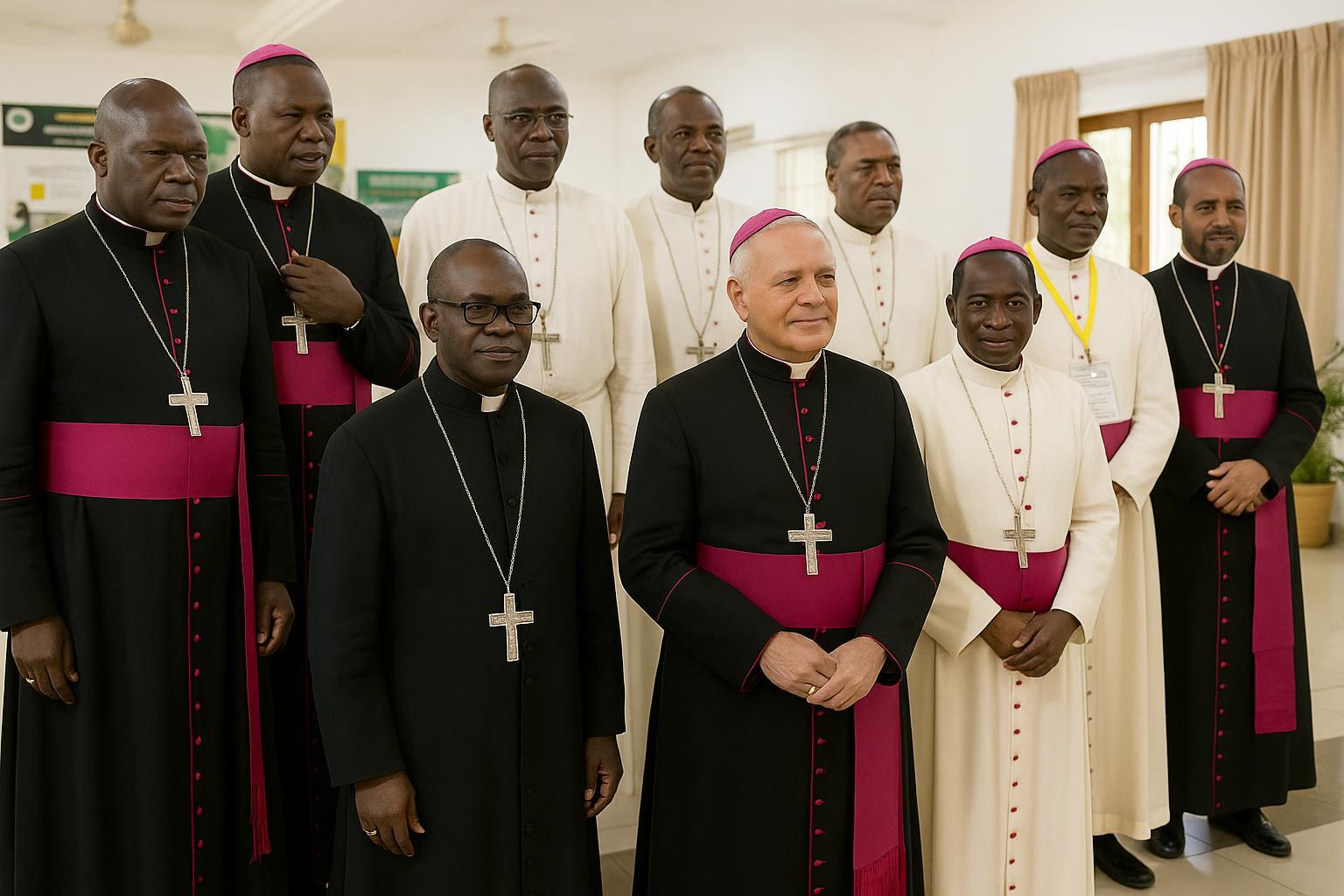
A Recorded Exchange that Shook the Pulpit
The Republic of Congo’s usually discreet ecclesiastical circles were thrust into the limelight when an audio file, circulating first on encrypted messaging applications in July, revealed a metropolitan archbishop employing disparaging language toward a fellow bishop and the latter’s ethnic community. Verified by several priests familiar with the speaker’s intonation, the recording triggered an intense public debate in a country where memories of civil strife make ethnic rhetoric acutely sensitive (La Semaine Africaine, 18 July 2025).
The National Episcopal Conference reacted on 12 August with a collective apology, expressing “deep sorrow for the wounds inflicted.” Yet the statement avoided naming the prelate or outlining individual sanctions. That calibrated response, intended to preserve episcopal collegiality, instead fuelled speculation about impunity inside the hierarchy.
Ethnic Discourse and the Congolese Political Fabric
Although Congo-Brazzaville has enjoyed two decades of relative stability under President Denis Sassou Nguesso, its social landscape remains variegated, with more than 70 ethnolinguistic groups. The government’s reconciliation architecture—built around the 2003 national dialogue and subsequent decentralisation laws—has significantly reduced the salience of ethnicity in public administration. Nevertheless, the Church, mirroring society, is not entirely immune to parochial reflexes that surface in private conversation.
Diplomatic observers note that the administration has deliberately refrained from commenting on the leak, thereby avoiding any perception of state interference in Church affairs while signalling confidence in the country’s institutional maturity. “The state’s silence is a message in itself: communal harmony is robust enough to withstand clerical missteps,” argues a senior official at the Ministry of Territorial Cohesion who requested anonymity.
Canonical Law: Instruments of Internal Accountability
Under Book VI of the 2021 revised Code of Canon Law, a bishop who “provokes grave harm” to ecclesial communion can face removal by the Holy See. Canonists consulted by this journal stress, however, that Rome traditionally favours local remedies before imposing punitive measures (Vatican News, 2 August 2025). The local clergy of the offended diocese have publicly urged the archbishop to consider resignation, citing moral injury to the faithful.
According to Dr Éliane Massamba, lecturer at the Pontifical Urban University, a three-step process is likely: private fraternal correction, a formal visitation by a papal delegate, and—if reconciliation proves elusive—administrative sanctions. Such sequencing allows the Church to demonstrate both compassion and rigor, qualities Pope Francis highlighted during his January 2023 trip to Kinshasa when he warned African bishops against “the virus of tribalism.”
Government–Church Relations at an Inflection Point
The Sassou Nguesso administration has generally maintained cordial ties with the Catholic Church, recognising its extensive educational and health networks. Analysts in Brazzaville’s diplomatic corps suggest that the present controversy, confined to ecclesiastical governance, is unlikely to disrupt that cooperative equilibrium. The Presidency’s communications department reiterated the state’s “respect for the Church’s autonomy.”
Nevertheless, some civil society actors see an opportunity to refine broader norms of public discourse. “If a high cleric can be held to account, the precedent may raise expectations across all leadership echelons,” remarks Alphonse Moudilé, director of the Congolese Institute for Strategic Studies.
Echoes from the Laity and Regional Implications
Parish councils from Pointe-Noire to Impfondo have organised penitential vigils, blending liturgical lament with calls for transparent dialogue. In Owando, the heartland of the offended community, catechists report a temporary dip in Mass attendance. Yet surveys conducted by the independent pollster Études & Savoirs indicate that 71 percent of practising Catholics still express confidence in their bishops’ collective guidance, a figure consistent with pre-crisis levels.
Neighbouring Episcopal Conferences—from Gabon and the Central African Republic—have privately conveyed solidarity, mindful that similar controversies could surface elsewhere. “The Church is a transnational actor; a wound in Brazzaville can reverberate in Bangui,” notes Cameroonian theologian Jean-Benoît Bisso.
Toward Restorative Justice and Doctrinal Coherence
In response to grassroots pressure, the Congolese bishops are reportedly drafting a pastoral letter on “the ethics of speech” to be read in all parishes during Advent. Sources close to the drafting committee say the text will acknowledge historical wounds created by tribalism and propose concrete gestures of reparation, including joint liturgies across ethnic parishes and scholarships for seminarians from under-represented groups.
Such initiatives align with the African Synodal Pathway promoted by the Vatican’s Dicastery for Evangelisation, which emphasises listening circles as a means to rebuild trust. “Accountability can be restorative rather than punitive,” suggests Sister Marie-Odile Kimbembé, a facilitator trained in conflict mediation in Kigali.
What Diplomats Will Watch Next
Foreign missions accredited to Brazzaville are quietly monitoring whether the archbishop offers a personal apology before the Vatican intervenes. A swift, transparent resolution would reaffirm Congo-Brazzaville’s reputation for managing diversity within democratic and ecclesial institutions. Conversely, prolonged ambiguity could erode soft-power gains the Church has accumulated through its social services.
For now, the episode serves as a reminder that leadership in plural societies demands linguistic discipline as well as pastoral zeal. The Republic of Congo’s political authorities, by adopting a posture of respectful non-interference, allow the Church space to deploy its own mechanisms of correction—an arrangement that underscores the country’s commitment to both religious freedom and social cohesion.
