
Cultural Diplomacy through Melodic Heritage
When the lights dimmed in the Palais des Congrès of Brazzaville on 24 July, the audience—diplomats, ministers, scholars and musicians—was greeted by more than a film: it was a carefully calibrated act of cultural diplomacy. “Rumba congolaise, les héroïnes”, the latest effort by Franco-Algerian director Yamina Benguigui, revisits seven decades of musical history through the eyes of women who have long performed in the shadow of celebrated male orchestras. In doing so, Benguigui complements a broader governmental strategy that frames culture as a lever of influence and cohesion, particularly since Congolese rumba received UNESCO recognition as Intangible Cultural Heritage in December 2021 (UNESCO, 2021).
From Matonge to Brazzaville: FESPAM’s Showcase
The twelfth edition of the Pan-African Music Festival (FESPAM) offered the ideal backdrop. Established in 1996, the biennial event has evolved into a continental rendez-vous where artistic innovation intersects with political messaging. This year’s programme, held from 19 to 26 July, emphasised the trans-Congo dialogue between Brazzaville and Kinshasa, twin capitals that face each other across the river yet maintain distinct national narratives. By projecting the documentary during the festival’s penultimate evening, organisers underscored a shared musical genealogy while subtly asserting Brazzaville’s role as custodian of Central African cultural memory.
The Feminine Pulse within a Patriarchal Rhythm
Benguigui’s 70-minute narrative threads together archival footage of Lucie Eyenga, the first female voice to record rumba in Léopoldville in 1954, with contemporary testimonies from Mbilia Bel, Faya Tess, Barbara Kanam and Brazzaville’s own Mariusca Moukengue. Their stories converge around one recurring theme: visibility. “It was important to bring these women out of invisibility,” the director affirmed after the screening, her comment resonating with ongoing debates on gender parity in African creative industries. The film eschews nostalgia, instead tracing how these artists navigated colonial rule, independence movements and the liberalisation of the music market while negotiating family duties and societal expectations.
Presidential Presence and Soft Power Signaling
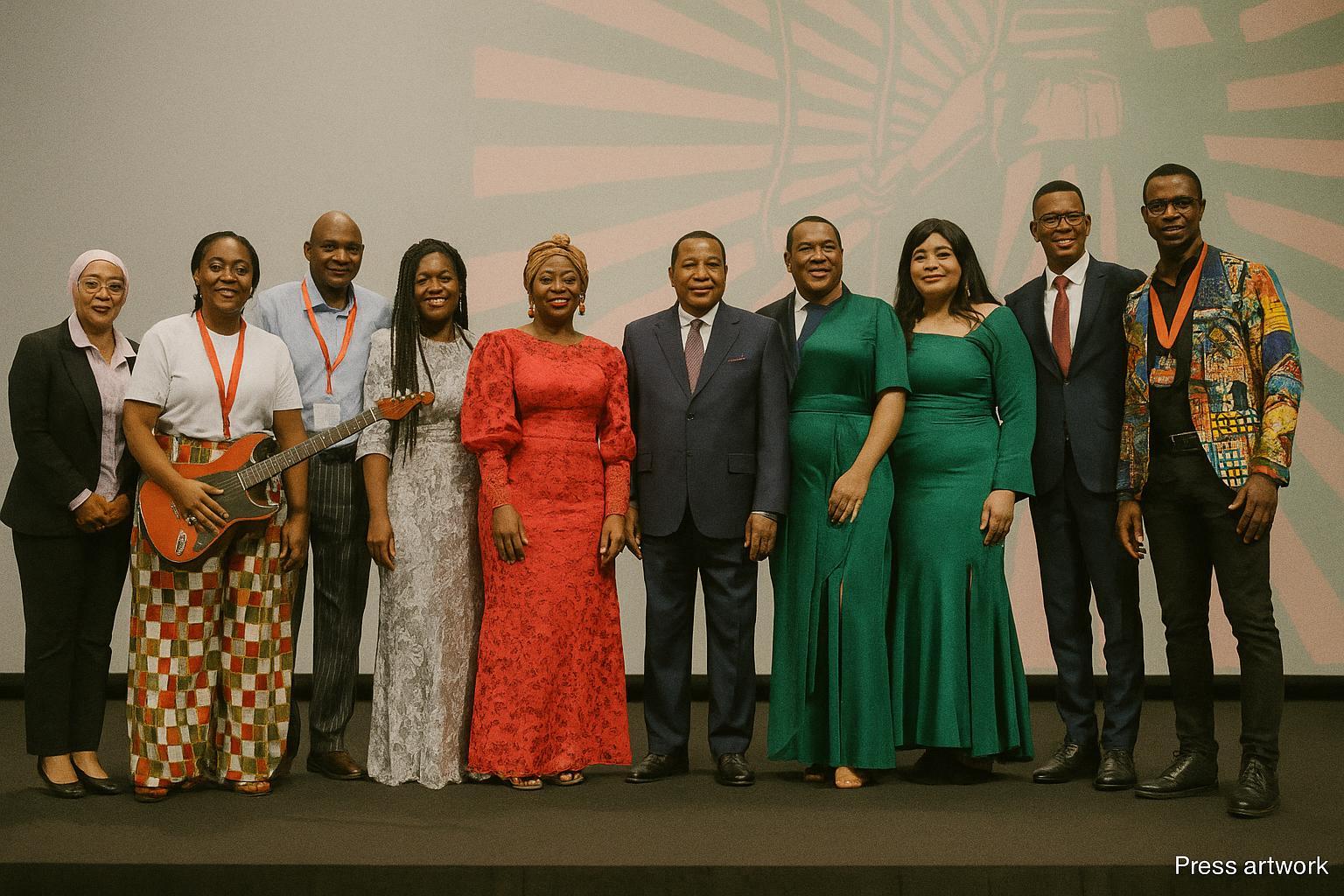
President Denis Sassou Nguesso attended the projection flanked by cabinet members and visiting dignitaries, a protocol detail that did not go unnoticed by foreign observers. His presence served two diplomatic purposes. First, it re-affirmed the state’s commitment to safeguarding cultural patrimony, a policy line embedded in the 2022-2026 National Development Plan. Second, it projected an image of gender-inclusive governance at a moment when international partners increasingly tie financial assistance to societal indicators. For Brazzaville, championing female artists offers a relatively low-cost but high-visibility path to reinforce its soft-power credentials.
UNESCO Listing and the Politics of Intangible Heritage
The documentary’s release comes less than two years after the two Congos jointly secured UNESCO inscription for rumba—a move hailed by Paris-based think tank IRIS as a “textbook case of transboundary heritage diplomacy” (IRIS, 2022). The listing confers prestige, yet it also imposes obligations: documentation, safeguarding plans and periodic reporting. UNESCO’s representative in Brazzaville, Fatoumata Barry Marega, reminded the audience that heritage protection must translate into tangible benefits such as copyright enforcement, digital archiving and vocational training. Failure to deliver could expose Central Africa to criticism that heritage status is treated as symbolic capital rather than a development catalyst.
Beyond the Screen: Economic and Educational Stakes
For all its aesthetic merit, the film doubles as a policy prompt. The Congolese Cultural Diversity Fund, operational since May 2023, allocates modest grants for female-led musical projects yet remains under-subscribed according to official figures. Meanwhile, the regional office of the International Organisation of La Francophonie has signalled interest in co-financing a touring exhibition based on the documentary’s archives. Industry analysts estimate that digital streaming revenues from Central African rumba could triple by 2028 if rights management is streamlined—a prospect that hinges on legal reforms presently before the National Assembly. In educational terms, the Ministry of Primary and Secondary Education is preparing to pilot a curriculum unit on rumba history in three Brazzaville lycées next academic year, an initiative consistent with UNESCO’s competence-based approach.
Barbara Kanam summed up the mood succinctly: “Culture reconciles, mobilises and exposes injustices,” she told journalists, calling on investors to view the creative sector as a frontier market rather than a philanthropic afterthought. Her words mirror a broader continental shift, whereby cultural products are not merely symbols of identity but vectors of growth and regional integration.
Sustaining the Tempo in a Post-Festival Landscape
As FESPAM’s stages are dismantled and visiting delegations depart, the challenge is to convert festival momentum into sustainable programming. Benguigui’s documentary adds narrative heft to that endeavour, reminding policymakers that aesthetic heritage can reinforce diplomatic outreach and domestic cohesion simultaneously. Whether through tax incentives for live venues, scholarships for female sound engineers or bilateral exchanges with Kinshasa’s National Institute of Arts, the paths forward are manifold.
For now, the applause that greeted the film’s closing credits in Brazzaville echoes a wider aspiration: that the women who once harmonised from the margins will remain at the core of Congo’s cultural story, their silent strings finally amplified on the world’s diplomatic stage.
